
[Paper Review] Inner-IoU: More Effective Intersection over Union Loss with Auxiliary Bounding Box
Inner-IoU introduces auxiliary bounding boxes with scalable ratios to compute IoU loss, improving convergence and generalization when integrated with existing IoU-based losses.
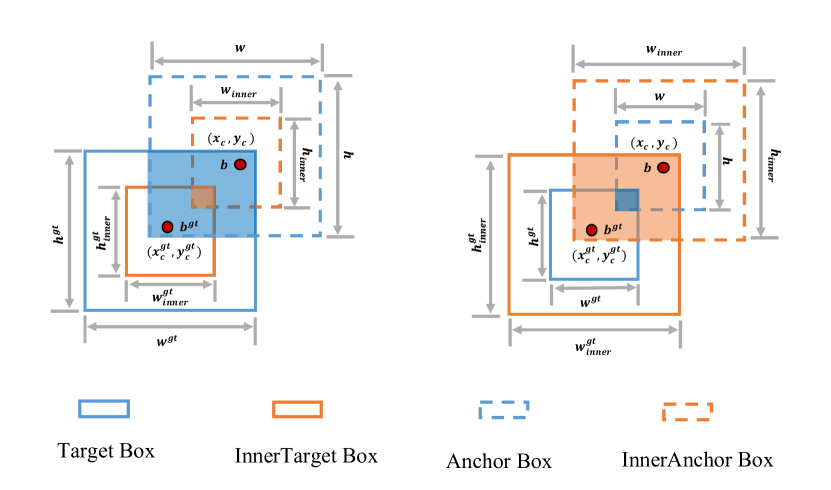
With the rapid development of detectors, Bounding Box Regression (BBR) loss function has constantly updated and optimized. However, the existing IoU-based BBR still focus on accelerating convergence by adding new loss terms, ignoring the limitations of IoU loss term itself. Although theoretically IoU loss can effectively describe the state of bounding box regression,in practical applications, it cannot adjust itself according to different detectors and detection tasks, and does not have strong generalization. Based on the above, we first analyzed the BBR model and concluded that distinguishing different regression samples and using different scales of auxiliary bounding boxes to calculate losses can effectively accelerate the bounding box regression process. For high IoU samples, using smaller auxiliary bounding boxes to calculate losses can accelerate convergence, while larger auxiliary bounding boxes are suitable for low IoU samples. Then, we propose Inner-IoU loss, which calculates IoU loss through auxiliary bounding boxes. For different datasets and detectors, we introduce a scaling factor ratio to control the scale size of the auxiliary bounding boxes for calculating losses. Finally, integrate Inner-IoU into the existing IoU-based loss functions for simulation and comparative experiments. The experiment result demonstrate a further enhancement in detection performance with the utilization of the method proposed in this paper, verifying the effectiveness and generalization ability of Inner-IoU loss. Code is available at https://github.com/malagoutou/Inner-IoU.
Motivation & Objective
- Analyze the bounding box regression process to identify limitations of standard IoU loss.
- Propose Inner-IoU loss that uses auxiliary bounding boxes with a controllable scale ratio.
- Demonstrate generalization by integrating Inner-IoU with existing IoU-based losses across detectors/datasets.
- Show faster convergence and improved detection metrics compared to existing IoU-based losses.
Proposed method
- Analyze IoU-based regression dynamics and gradients for high vs. low IoU samples.
- Define Inner-IoU loss computed with auxiliary bounding boxes scaled by a ratio parameter.
- Show how ratio < 1 benefits high IoU sample regression and ratio > 1 benefits low IoU samples.
- Integrate L_Inner-IoU with existing losses (L_Inner-GIoU, L_Inner-DIoU, L_Inner-CIoU, L_Inner-EIoU, L_Inner-SIoU).
- Conduct simulation and comparative experiments on standard detectors/datasets to evaluate performance.
Experimental results
Research questions
- RQ1Can auxiliary bounding boxes with a scale ratio improve the convergence speed of IoU-based bounding box regression?
- RQ2Does Inner-IoU generalize across detectors and datasets when combined with existing IoU-based losses?
- RQ3What ratio settings optimize high IoU vs. low IoU sample regression in practice?
- RQ4Do experiments show detectable gains in AP50 and mAP50:95 when using Inner-IoU?
Key findings
- Inner-IoU achieves faster convergence by using smaller auxiliary boxes for high IoU samples and larger boxes for low IoU samples.
- Integrating Inner-IoU with CIoU and SIoU yields higher AP50 and mAP50:95 compared to the baselines on evaluated setups.
- On VOC with YOLOv7-tiny, Inner-CIoU and Inner-SIoU show gains in AP50 and mAP50:95 over CIoU and SIoU baselines.
- On AI-TOD with YOLOv5s, Inner-SIoU (ratio > 1) improves AP50 and mAP50:95 relative to SIoU, demonstrating robustness to small targets.
- Simulation results indicate faster convergence for high IoU samples (ratio < 1) and improved regression for low IoU samples (ratio > 1).
- The method demonstrates strong generalization across detectors and pixel sizes, with sota-like performance in the reported experiments.

Better researchstarts right now
From reading papers to final review, dramatically reduce your research time.
No credit card · Free plan available
This review was created by AI and reviewed by human editors.