
[Paper Review] Inverse folding for antibody sequence design using deep learning
The authors fine-tune ProteinMPNN to create AbMPNN, an antibody-specific inverse folding model that improves sequence recovery and designability, especially for CDR-H3, by training on SAbDab and OAS-derived data and evaluating with structure prediction and Rosetta interface energy.
We consider the problem of antibody sequence design given 3D structural information. Building on previous work, we propose a fine-tuned inverse folding model that is specifically optimised for antibody structures and outperforms generic protein models on sequence recovery and structure robustness when applied on antibodies, with notable improvement on the hypervariable CDR-H3 loop. We study the canonical conformations of complementarity-determining regions and find improved encoding of these loops into known clusters. Finally, we consider the applications of our model to drug discovery and binder design and evaluate the quality of proposed sequences using physics-based methods.
Motivation & Objective
- Motivate and address antibody sequence design from 3D backbone structures.
- Develop an antibody-specific inverse folding model by fine-tuning ProteinMPNN on antibody data.
- Assess improvements in residue recovery, designability, and interface stability for antibodies.
- Examine canonical CDR loop encoding and germline distribution compatibility.
- Provide model weights for downstream antibody design and drug discovery applications.
Proposed method
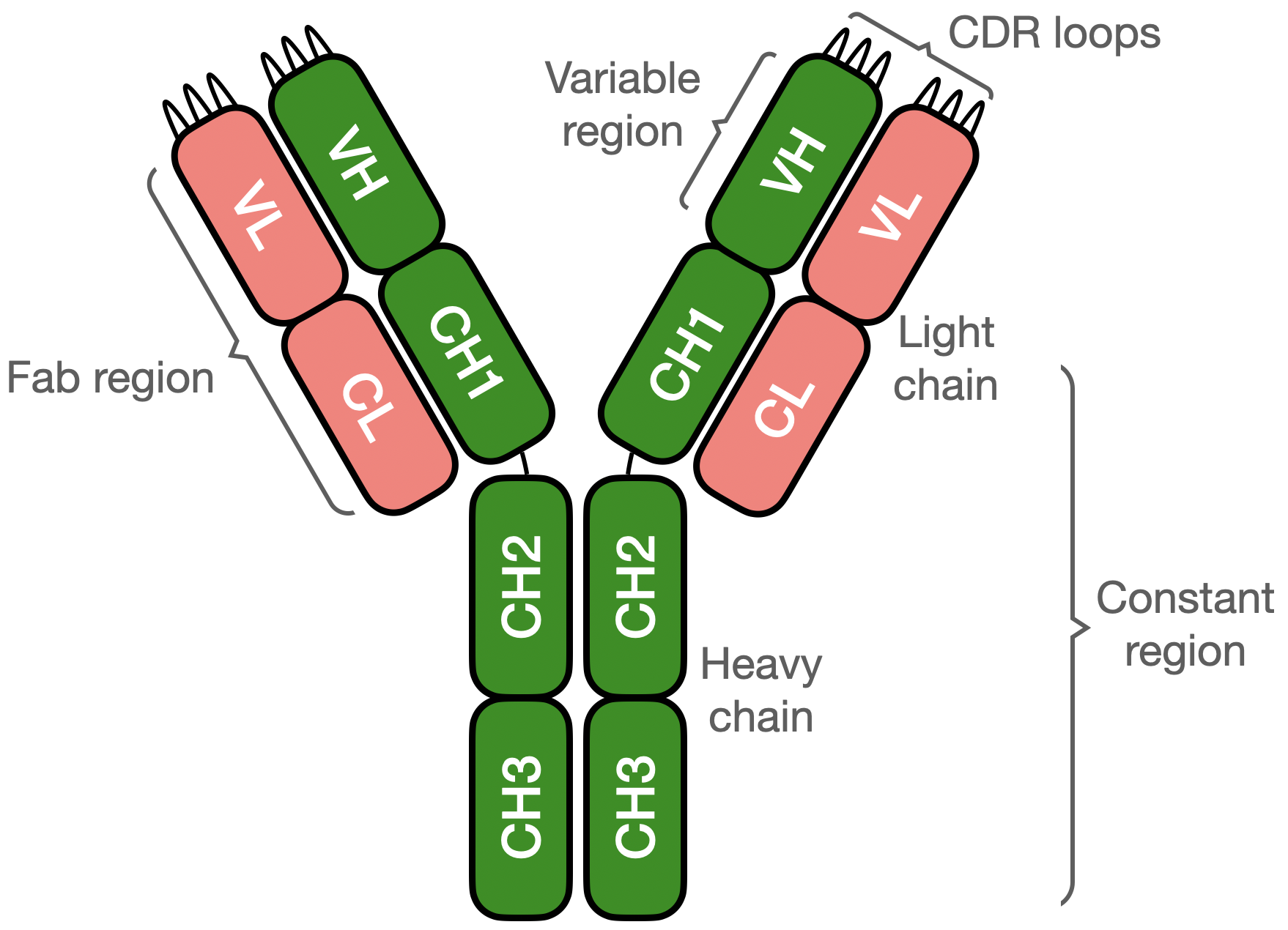
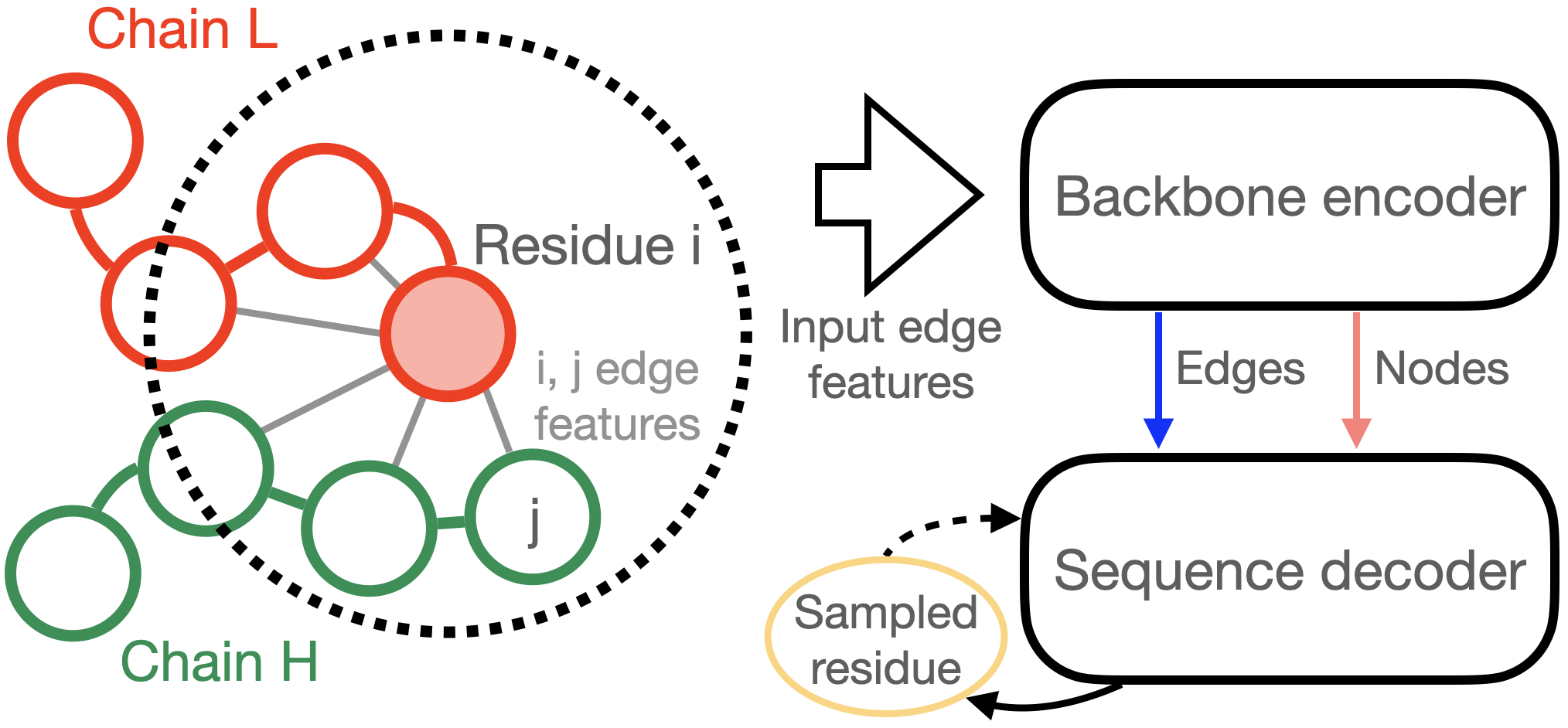
- Adapt ProteinMPNN architecture with structured graph neural networks and order-agnostic decoding for antibodies.
- Fine-tune on two antibody datasets: SAbDab antigen-binding fragments and OAS paired heavy/light chains predicted by ABodyBuilder2.
- Use CD-HIT clustering to create non-redundant training/validation/test splits and ensure dataset separation.
- Train with Adam optimizer; reduce learning rate when validation loss stalls (OAS: factor 10 after 10 epochs; SAbDab: factor 10 after 10 epochs).
- Evaluate designability via self-consistency RMSD after structure prediction with ABodyBuilder2; assess interface energy via Rosetta; measure residue recovery across CDRs; analyze canonical clustering with SCALOP.
Experimental results
Research questions
- RQ1Does antibody-specific fine-tuning improve amino acid sequence recovery in antibody CDR loops compared to generic ProteinMPNN?
- RQ2How does AbMPNN affect designability as measured by structure self-consistency and Rosetta interface energy?
- RQ3Can AbMPNN better recover canonical CDR loop conformations and align with germline distributions in antibodies?
- RQ4What is the impact of antibody-focused training on framework and CDR-region validity and annotation with ANARCI?
- RQ5How well can the model support antibody drug discovery and binder design applications?
Key findings
- AbMPNN shows about a 20% improvement in median CDR-H3 RMSD self-consistency compared to ProteinMPNN.
- 40% of AbMPNN sequences are within 5 kcal/mol interface energy of the native sequence, vs 20.5% for ProteinMPNN.
- Sequence recovery across CDR loops improves to ~60% with AbMPNN, versus ~40% with ProteinMPNN.
- AbMPNN achieves large improvement in recovering the canonical cluster for non-H3 CDRs.
- All AbMPNN predictions are recognized as antibodies by ANARCI, while ProteinMPNN predictions include 16.8% non-annotatable sequences due to framework errors.
- Germline matching distribution improves with AbMPNN, reducing ANARCI annotation failures observed with ProteinMPNN.
Better researchstarts right now
From reading papers to final review, dramatically reduce your research time.
No credit card · Free plan available
This review was created by AI and reviewed by human editors.