
[Paper Review] Investigation of the Anomalous and Topological Hall Effects in Layered Monoclinic Ferromagnet Cr$_{2.76}$Te$_4$
This study investigates the anomalous and topological Hall effects in monoclinic Cr₂.₇₆Te₄, a layered ferromagnet with strong magnetocrystalline anisotropy. The system exhibits a large extrinsic anomalous Hall effect due to skew-scattering and a significant topological Hall effect arising from non-coplanar spin structures stabilized by strong anisotropy, with maximum topological Hall resistivity reaching ~1.1 μΩ·cm between 50 K and 150 K.
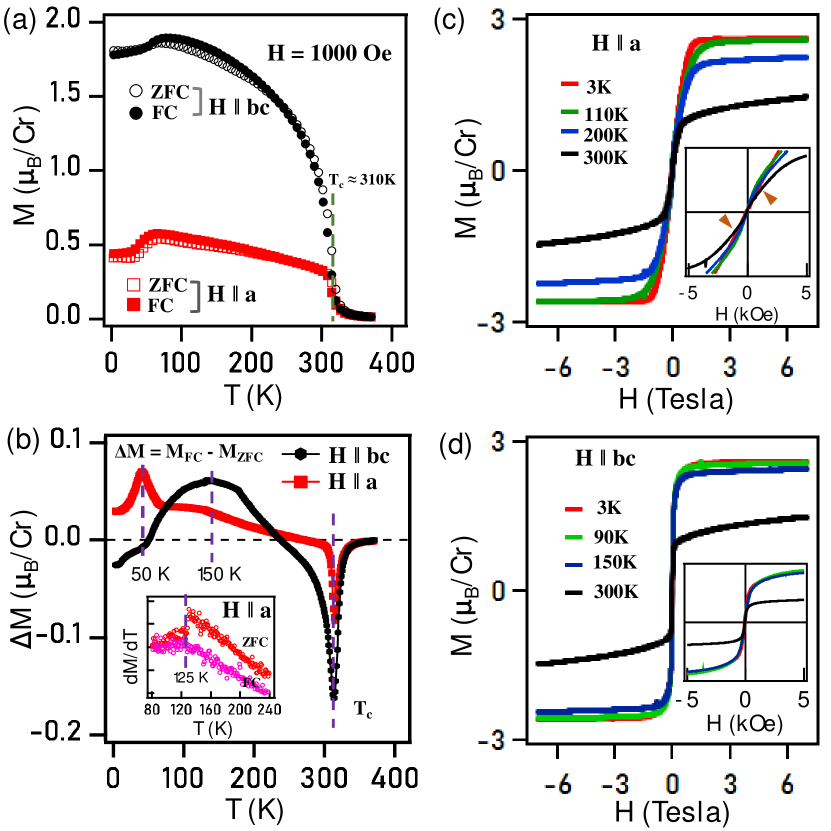
We studied the electrical transport, Hall effect, and magnetic properties of monoclinic layered ferromagnet Cr$_{2.76}$Te$_4$. Our studies demonstrate Cr$_{2.76}$Te$_4$ to be a soft ferromagnet with strong magnetocrystalline anisotropy. Below 50 K, the system shows an antiferromagnetic-like transition. Interestingly, between 50 and 150 K, we observe fluctuating magnetic moments between in-plane and out-of-plane orientations, leading to non-coplanar spin structure. On the other hand, the electrical resistivity data suggest it to be metallic throughout the measured temperature range, except a $kink$ at around 50 K due to AFM ordering. The Rhodes-Wohlfarth ratio $\frac{μ_{eff}}{μ_{s}}=1.89 (>1)$ calculated from our magnetic studies confirms that Cr$_{2.76}$Te$_4$ is an itinerant ferromagnet. Large anomalous Hall effect has been observed due to the skew-scattering of impurities and the topological Hall effect has been observed due to non-coplanar spin-structure in the presence of strong magnetocrystalline anisotropy. We examined the mechanism of anomalous Hall effect by employing the first principles calculations.
Motivation & Objective
- To investigate the electrical transport, Hall effect, and magnetic properties of monoclinic Cr₂.₇₆Te₄ as a candidate for 2D spintronic materials.
- To determine the origin of the anomalous Hall effect (AHE) and topological Hall effect (THE) in this layered ferromagnet.
- To clarify the role of magnetocrystalline anisotropy and spin fluctuations in stabilizing non-coplanar spin textures.
- To establish whether Cr₂.₇₆Te₄ is a itinerant ferromagnet based on magnetic and transport measurements.
- To correlate experimental Hall responses with first-principles calculations of Berry curvature and spin texture.
Proposed method
- High-quality single crystals of Cr₂.₇₆Te₄ were grown via chemical vapor transport (CVT) with iodine as a transport agent.
- X-ray diffraction (XRD) and Rietveld refinement were used to confirm the monoclinic crystal structure and phase purity.
- Electrical resistivity and Hall measurements were performed using the standard four-probe technique to extract transport and Hall responses.
- Magnetic measurements were conducted using a physical property measurement system (PPMS) to determine saturation fields, coercivity, and magnetic anisotropy.
- First-principles calculations were employed to evaluate the intrinsic AHE contribution via Berry curvature near the Fermi level.
- Magnetocrystalline anisotropy energy (Kᵤ) was extracted from field-dependent magnetization and resistivity data to correlate with topological Hall response.
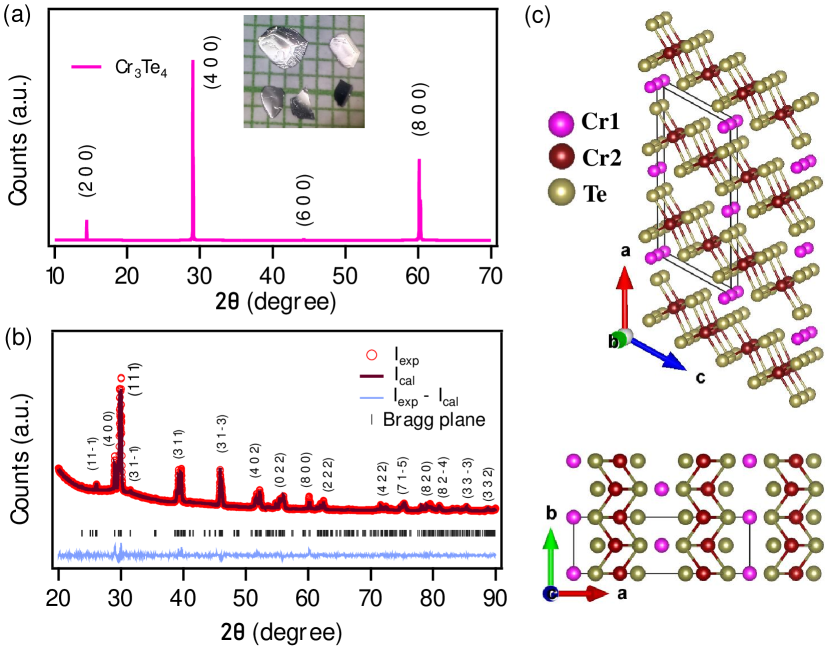
Experimental results
Research questions
- RQ1What is the origin of the large anomalous Hall effect in Cr₂.₇₆Te₄, and is it intrinsic or extrinsic?
- RQ2What causes the topological Hall effect in this monoclinic CrₓTeᵧ system, which is centrosymmetric and lacks inversion symmetry?
- RQ3How does the magnetocrystalline anisotropy influence the stabilization of non-coplanar spin structures in Cr₂.₇₆Te₄?
- RQ4What is the role of spin fluctuations between in-plane and out-of-plane orientations in the 50–150 K temperature range?
- RQ5How do the experimental Hall responses compare with first-principles predictions of Berry curvature and spin chirality?
Key findings
- Cr₂.₇₆Te₄ is a soft ferromagnet with negligible coercivity and strong magnetocrystalline anisotropy, with the easy axis of magnetization aligned along the bc-plane.
- Below 50 K, the system exhibits an antiferromagnetic-like transition, indicated by a kink in resistivity and changes in magnetic susceptibility.
- Between 50 K and 150 K, Cr magnetic moments fluctuate between in-plane and out-of-plane orientations, indicating dynamic non-coplanar spin structure.
- The electrical resistivity is metallic across the entire measured temperature range, with a kink at ~50 K corresponding to the AFM-like transition.
- The topological Hall resistivity reaches a maximum value of ~1.1 μΩ·cm in the 50–150 K range, indicating strong spin chirality and finite Berry curvature.
- First-principles calculations predict intrinsic AHE due to non-zero Berry curvature near the Fermi level, but experimentally the AHE is dominated by extrinsic skew-scattering mechanisms.
Better researchstarts right now
From reading papers to final review, dramatically reduce your research time.
No credit card · Free plan available
This review was created by AI and reviewed by human editors.