
[Paper Review] Is RIS-Aided Massive MIMO Promising with ZF Detectors and Imperfect CSI?
This paper proposes a low-overhead MMSE channel estimator and derives closed-form uplink achievable rate expressions for RIS-aided massive MIMO with ZF detectors under imperfect CSI. It analytically shows that user rates scale at least as $\mathcal{O}(\log_2(MN))$, and can reach $\mathcal{O}(\log_2(MN^2))$ when RIS phase shifts are aligned to a single user, enabling power or antenna reduction proportional to $N$ while maintaining rate. Two low-complexity MM-based algorithms optimize sum and minimum user rates with closed-form solutions per iteration.
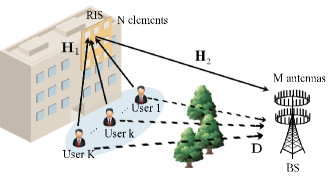
This paper provides a theoretical framework for understanding the performance of reconfigurable intelligent surface (RIS)-aided massive multiple-input multiple-output (MIMO) with zero-forcing (ZF) detectors under imperfect channel state information (CSI). We first propose a low-overhead minimum mean square error (MMSE) channel estimator, and then derive and analyze closed-form expressions for the uplink achievable rate. Our analytical results demonstrate that: $1)$ regardless of the RIS phase shift design, the rate of all users scales at least on the order of $\mathcal{O}\left(\log_2\left(MN ight) ight)$, where $M$ and $N$ are the numbers of antennas and reflecting elements, respectively; $2)$ by aligning the RIS phase shifts to one user, the rate of this user can at most scale on the order of $\mathcal{O}\left(\log_2\left(MN^2 ight) ight)$; $3)$ either $M$ or the transmit power can be reduced inversely proportional to $N$, while maintaining a given rate. Furthermore, we propose two low-complexity majorization-minimization (MM)-based algorithms to optimize the sum user rate and the minimum user rate, respectively, where closed-form solutions are obtained in each iteration. Finally, simulation results validate all derived analytical results. Our simulation results also show that the maximum sum rate can be closely approached by simply aligning the RIS phase shifts to an arbitrary user.
Motivation & Objective
- To establish a theoretical framework for RIS-aided massive MIMO with ZF detection under imperfect CSI.
- To derive closed-form expressions for uplink achievable rate in multi-user RIS-aided systems.
- To investigate the scaling behavior of user rates with respect to the number of antennas $M$ and reflecting elements $N$.
- To propose low-complexity optimization algorithms for sum rate and minimum user rate maximization.
- To validate analytical findings through simulations and demonstrate near-optimal performance with simple phase shift alignment.
Proposed method
- A low-overhead minimum mean square error (MMSE) channel estimator is proposed for pilot overhead reduction.
- Closed-form expressions for uplink achievable rate are derived under imperfect CSI and ZF detection.
- Majorization-minimization (MM) framework is employed to design two low-complexity algorithms for sum rate and minimum rate maximization.
- Each iteration of the MM algorithms computes closed-form solutions for phase shifts and beamformers, ensuring convergence.
- Theoretical analysis leverages matrix perturbation and quadratic form representations to establish rate scaling laws.
- Simulation results are used to validate analytical derivations and demonstrate performance gains of proposed algorithms.
Experimental results
Research questions
- RQ1What is the fundamental scaling law of achievable rate in RIS-aided massive MIMO with ZF detectors under imperfect CSI?
- RQ2How does the rate scale with respect to the number of base station antennas $M$ and RIS elements $N$?
- RQ3Can the rate of a specific user be enhanced by aligning RIS phase shifts to it, and if so, by how much?
- RQ4What is the minimum number of antennas or transmit power required to maintain a target rate as $N$ increases?
- RQ5Can simple phase shift alignment achieve near-optimal sum rate performance?
Key findings
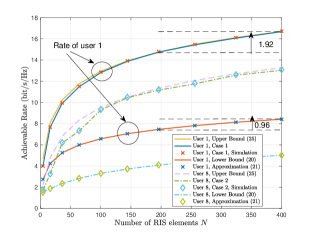
- The achievable rate of all users scales at least as $\mathcal{O}(\log_2(MN))$ regardless of RIS phase shift design.
- When RIS phase shifts are aligned to a single user, its rate can scale as $\mathcal{O}(\log_2(MN^2))$, offering a significant performance gain.
- Either the number of antennas $M$ or the transmit power can be reduced inversely proportional to $N$ while maintaining a given rate, enabling hardware and energy savings.
- The proposed MM-based algorithms achieve closed-form solutions in each iteration, ensuring low computational complexity and convergence.
- Simulation results confirm that aligning RIS phase shifts to any single user closely approaches the maximum sum rate, indicating robustness and simplicity of this strategy.
- Theoretical derivations are validated by simulations, demonstrating accuracy of the derived rate expressions and scaling laws.
Better researchstarts right now
From reading papers to final review, dramatically reduce your research time.
No credit card · Free plan available
This review was created by AI and reviewed by human editors.