
[Paper Review] JADES Imaging of GN-z11: Revealing the Morphology and Environment of a Luminous Galaxy 430 Myr After the Big Bang
JWST/NIRCam 9-band imaging of GN-z11 at z=10.60 reveals a compact, two-component morphology with a blue continuum SED, and a nearby galaxy-rich environment suggesting a massive host halo.
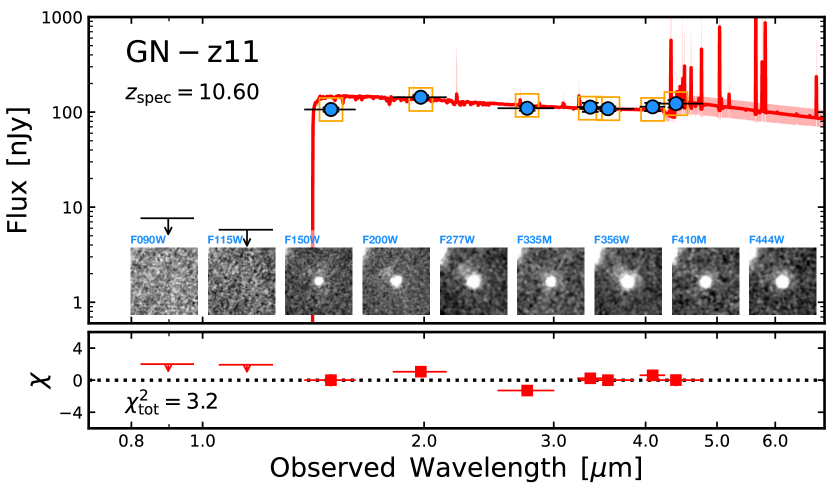
We present JWST NIRCam 9-band near-infrared imaging of the luminous $z=10.6$ galaxy GN-z11 from the JWST Advanced Deep Extragalactic Survey (JADES) of the GOODS-N field. We find a spectral energy distribution (SED) entirely consistent with the expected form of a high-redshift galaxy: a clear blue continuum from 1.5 to 4 microns with a complete dropout in F115W. The core of GN-z11 is extremely compact in JWST imaging. We analyze the image with a two-component model, using a point source and a Sérsic profile that fits to a half-light radius of 200 pc and an index $n=0.9$. We find a low-surface brightness haze about $0.4''$ to the northeast of the galaxy, which is most likely a foreground object but might be a more extended component of GN-z11. At a spectroscopic redshift of 10.60 (Bunker et al. 2023), the comparison of the NIRCam F410M and F444W images spans the Balmer jump. From population synthesis modeling, here assuming no light from an active galactic nucleus, we reproduce the SED of GN-z11, finding a stellar mass of $\sim$$10^{9}~M_{\odot}$, a star-formation rate of $\sim$$20~M_{\odot}~\mathrm{yr}^{-1}$ and a young stellar age of $\sim$$20~\mathrm{Myr}$. As massive galaxies at high redshift are likely to be highly clustered, we search for faint neighbors of GN-z11, finding 9 galaxies out to $\sim$5 comoving Mpc transverse with photometric redshifts consistent with $z=10.6$, and a 10$^{ m th}$ more tentative dropout only $3''$ away. This is consistent with GN-z11 being hosted by a massive dark-matter halo ($\approx8 imes10^{10}~M_{\odot}$), though lower halo masses cannot be ruled out.
Motivation & Objective
- Investigate the morphology of GN-z11 with high-resolution JWST imaging to understand its structure at z~10.6.
- Characterize the spectral energy distribution (SED) to infer stellar mass, star formation rate, and age without AGN contribution.
- Measure redshift spectroscopically and connect it to the galaxy's environment and halo hosting properties.
Proposed method
- Acquire 9-band JWST/NIRCam imaging from the JADES survey in GOODS-N.
- Model the morphology with a two-component fit (point source + Sérsic profile) to derive structural parameters (half-light radius, Sérsic index).
- Perform SED modeling with Prospector assuming no AGN contribution to estimate stellar mass, SFR, and stellar age.
- Compare NIRCam F410M and F444W imaging to probe the Balmer jump and constrain stellar populations.
- Identify and analyze the galaxy's environment by searching for faint neighbors with consistent photometric redshifts.
- Calibrate astrometry and build custom sky-flats for accurate background subtraction and photometry.
Experimental results
Research questions
- RQ1What is the intrinsic morphology of GN-z11 at z=10.6 and how does it compare to other high-redshift galaxies?
- RQ2What are GN-z11’s stellar mass, star formation rate, age, and dust content as inferred from its SED under a no-AGN assumption?
- RQ3Does GN-z11 reside in a massive dark-matter halo, inferred from its environment and clustering of nearby galaxies?
- RQ4What does the Balmer jump between F410M and F444W reveal about the stellar populations?
Key findings
- GN-z11’s core is extremely compact, with a two-component model fitting a half-light radius of 200 pc and a Sérsic index n = 0.9.
- The SED is blue from 1.5 to 4 microns with a dropout in F115W, consistent with a high-redshift galaxy; the spectroscopic redshift is z_spec = 10.60.
- Population synthesis modeling (no AGN) yields a stellar mass of ~1×10^9 solar masses, a star-formation rate of ~20 solar masses per year, and a young stellar age of ~20 Myr.
- GN-z11 has a low-surface-brightness haze to the northeast, likely a foreground object, though it could be an extended component of GN-z11.
- There are 9 nearby galaxies with photometric redshifts consistent with z=10.6 within ~5 comoving Mpc, plus a tentative 10th dropout at 3 arcseconds, supporting a massive-halo hosting scenario (~8×10^10 solar masses).
Better researchstarts right now
From reading papers to final review, dramatically reduce your research time.
No credit card · Free plan available
This review was created by AI and reviewed by human editors.