
[Paper Review] JADES Initial Data Release for the Hubble Ultra Deep Field: Revealing the Faint Infrared Sky with Deep JWST NIRCam Imaging
This paper presents the first JADES NIRCam imaging data release covering ~25 arcmin^2 around the HUDF, including 9 JWST bands, deep mosaics, JEMS additions, and 23-band photometric catalogs with photometric redshifts for ~47,500 sources.
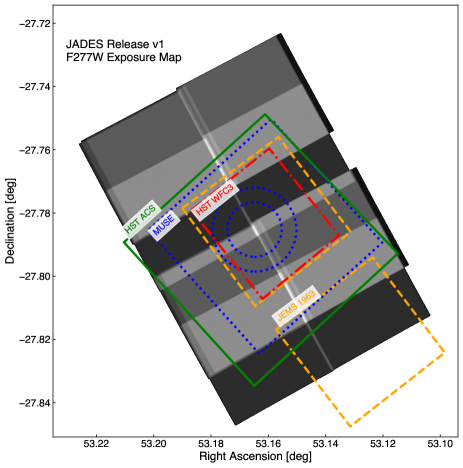
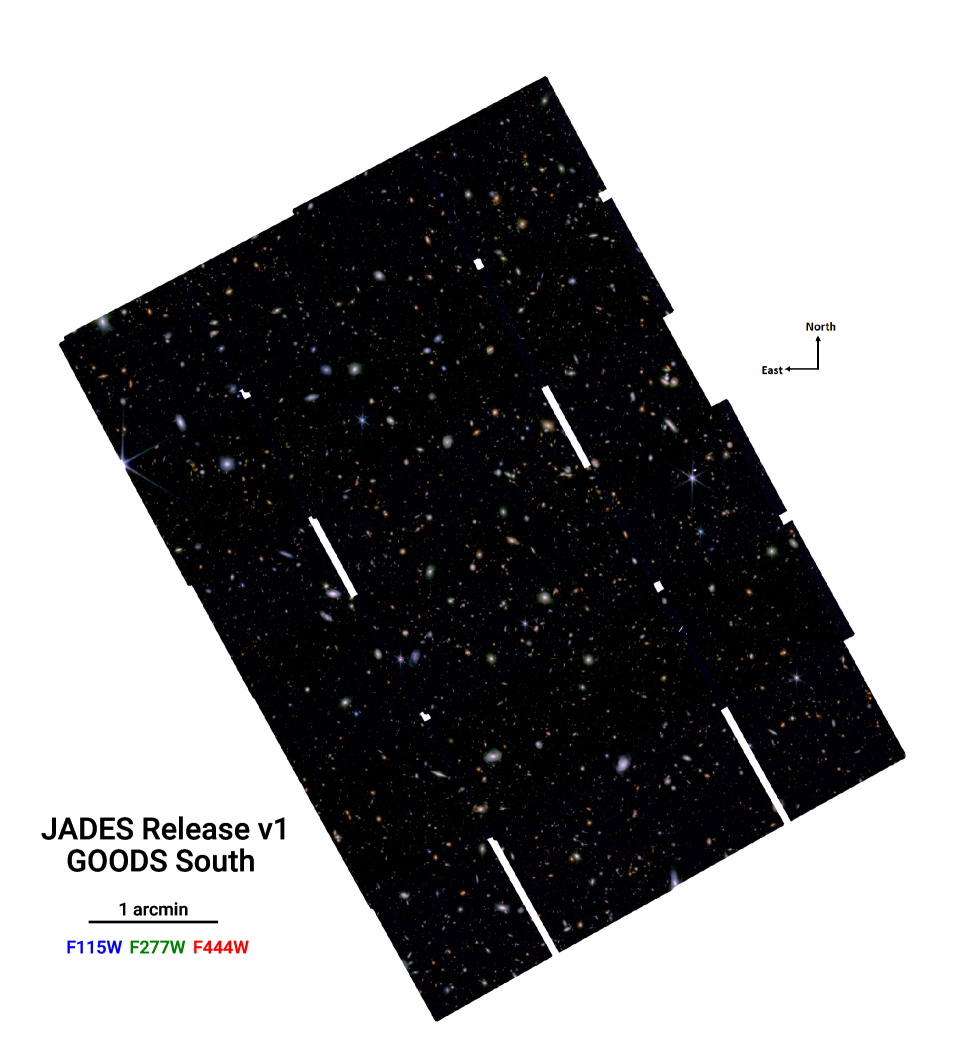
JWST has revolutionized the field of extragalactic astronomy with its sensitive and high-resolution infrared view of the distant universe. Adding to the new legacy of JWST observations, we present the first NIRCam imaging data release from the JWST Advanced Deep Extragalactic Survey (JADES) providing 9 filters of infrared imaging of $\sim$25 arcmin$^2$ covering the Hubble Ultra Deep Field and portions of Great Observatories Origins Deep Survey (GOODS) South. Utilizing 87 on-sky dual-filter hours of exposure time, these images reveal the deepest ever near-infrared view of this iconic field. We supply carefully constructed 9-band mosaics of the JADES bands, as well as matching reductions of 5 additional bands from the JWST Extragalactic Medium-band Survey (JEMS). Combining with existing HST imaging, we provide 23-band space-based photometric catalogs and photometric redshifts for $\approx47,500$ sources. To promote broad engagement with the JADES survey, we have created an interactive { t FitsMap} website to provide an interface for professional researchers and the public to experience these JWST datasets. Combined with the first JADES NIRSpec data release, these public JADES imaging and spectroscopic datasets provide a new foundation for discoveries of the infrared universe by the worldwide scientific community.
Motivation & Objective
- Provide deep JWST/NIRCam imaging of the HUDF and surrounding GOODS-S to extend the legacy of deep field surveys.
- Deliver carefully processed, multi-band mosaics and accompanying photometric catalogs.
- Combine JADES data with JEMS imaging to enhance spectral coverage and emission-line sensitivity.
- Produce photometric redshifts using JWST and HST photometry for a large source sample.
- Promote broad engagement with the data via accessible public interfaces and documentation.
Proposed method
- Process NIRCam imaging with JWST Calibration Pipeline (v1.9.6) using CRDS pmap 1084.
- Apply custom steps: super-sky flats for LW bands, 1/f noise and wisp subtraction, persistence and artifact masking.
- Construct sub-m mosaics per filter, then build final 0.03 arcsec/pixel mosaics with astrometric alignment to Gaia-referenced HST positions.
- Detect sources using a LW SNR-based image and a NoiseChisel-inspired pipeline with watershed deblending and masking of bright stars/persistence.
- Perform forced photometry in multiple circular and Kron apertures, and quantify flux uncertainties via pipeline ERR extensions and random-aperture noise estimates.
Experimental results
Research questions
- RQ1What is the depth and imaging quality achievable in deep NIRCam observations of the HUDF with JADES?
- RQ2How do JADES NIRCam mosaics and JEMS data complement existing HST data to improve spectral energy distributions (SEDs) and emission-line measurements?
- RQ3What is the efficacy of the photometric catalog construction and photometric redshift estimation when combining JWST and HST data over the HUDF?
- RQ4What is the level of accuracy in astrometric alignment and background/flat-field corrections in the JADES data release?
- RQ5How many and what kind of sources (and redshift distribution) are recovered with the 23-band photometric catalog in this field?
Key findings
- Deep 9-filter NIRCam imaging over ~25 arcmin^2 yields the deepest near-infrared view of the HUDF to date.
- A mosaic set includes 87 on-sky hours of dual-filter exposure time across 9 filters, plus 5 JEMS bands for enhanced spectral sampling.
- Photometric catalogs encompassing ~47,500 sources with photometric redshifts are provided by combining 14 JWST bands and 5 HST ACS bands.
- The release delivers 23-band photometry for HUDF sources and supports robust SED fitting and emission-line studies in the rest-frame optical at high redshift.
- The team implements custom flat-fielding, 1/f noise removal, wisps/claws/persistence masking, and refined astrometric alignment to Gaia/HST reference frames, achieving sub-pixel alignment accuracy across bands.
- An interactive FitsMap website accompanies the data to facilitate community access and exploration.
Better researchstarts right now
From reading papers to final review, dramatically reduce your research time.
No credit card · Free plan available
This review was created by AI and reviewed by human editors.