
[Paper Review] JADES NIRSpec Initial Data Release for the Hubble Ultra Deep Field: Redshifts and Line Fluxes of Distant Galaxies from the Deepest JWST Cycle 1 NIRSpec Multi-Object Spectroscopy
The paper presents the deepest JWST/NIRSpec MOS spectra in the HUDF, delivering redshifts for 178 galaxies (up to z=13.2) and a catalog of emission lines from 253 targets, with public data release.
We describe the NIRSpec component of the JWST Deep Extragalactic Survey (JADES), and provide deep spectroscopy of 253 sources targeted with the NIRSpec micro-shutter assembly in the Hubble Ultra Deep Field and surrounding GOODS-South. The multi-object spectra presented here are the deepest so far obtained with JWST, amounting to up to 28 hours in the low-dispersion ($R\sim 30-300$) prism, and up to 7 hours in each of the three medium-resolution $R\approx 1000$ gratings and one high-dispersion grating, G395H ($R\approx2700$). Our low-dispersion and medium-dispersion spectra cover the wavelength range $0.6-5.3μ$m. We describe the selection of the spectroscopic targets, the strategy for the allocation of targets to micro-shutters, and the design of the observations. We present the public release of the reduced 2D and 1D spectra, and a description of the reduction and calibration process. We measure spectroscopic redshifts for 178 of the objects targeted extending up to $z=13.2$. We present a catalog of all emission lines detected at $S/N>5$, and our redshift determinations for the targets. Combined with the first JADES NIRCam data release, these public JADES spectroscopic and imaging datasets provide a new foundation for discoveries of the infrared universe by the worldwide scientific community.
Motivation & Objective
- Describe the NIRSpec MOS observations in the HUDF and surrounding GOODS-South field.
- Provide deep spectroscopy data and a public release of reduced 2D/1D spectra.
- Measure spectroscopic redshifts for targeted objects and compile emission-line fluxes.
- Outline target selection, MSA allocation, and data reduction/calibration procedures.
Proposed method
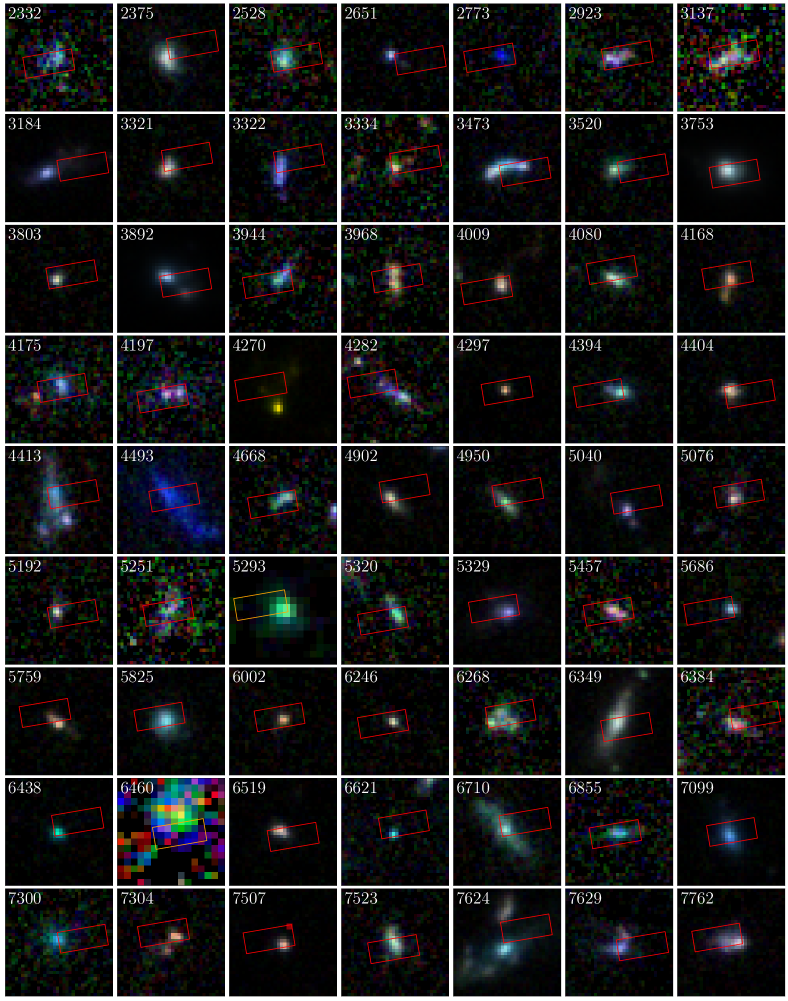
- Use NIRSpec MOS with prism (R~30-300) and medium/high-resolution gratings (R~1000, ~2700) over 0.6–5.3 μm.
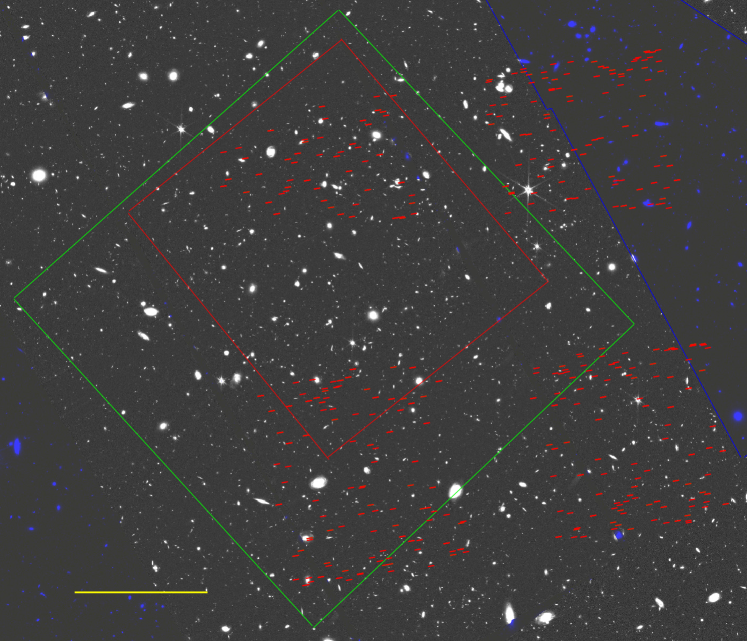
- Allocate targets via the eMPT software to maximize high-priority coverage within MSA shutters.
- Plan three dithered pointings to maximize exposure time and reduce detector defects.
- Reduce and calibrate spectra to produce public 2D and 1D data products.
- Derive redshifts and fluxes of prominent emission lines from low- and medium-dispersion data.
Experimental results
Research questions
- RQ1What is the range of spectroscopic redshifts probed by the JADES NIRSpec MOS observations in HUDF/GOODS-South?
- RQ2What emission-line fluxes are detected with S/N > 5 across the targeted galaxies?
- RQ3How effective is the target selection and MSA allocation strategy in maximizing high-redshift and rare-object coverage?
- RQ4What are the characteristics of the deepest NIRSpec spectra obtained with Cycle 1 (exposure times, resolutions) and their scientific potential?
- RQ5How can the reduced data and redshift/line catalogs be used in conjunction with JWST/NIRCam imaging for future studies?
Key findings
- Public release of reduced 2D and 1D spectra for 253 objects observed with NIRSpec MSA.
- Redshifts are measured for 178 targets, extending up to z = 13.2.
- Emission-line catalog includes all lines detected at S/N > 5 for the observed sources.
- Spectroscopic data reach up to 28 hours in low-dispersion prism and up to 7 hours per medium/high-dispersion grating.
- Three-pronged MSA observing strategy and three dithered pointings maximize exposure and minimize spectral overlap and defects.
- Targets were prioritized to sample from z>8.5 down to 1.5<z<5.7, enabling exploration from the Epoch of Reionization to Cosmic Noon.
Better researchstarts right now
From reading papers to final review, dramatically reduce your research time.
No credit card · Free plan available
This review was created by AI and reviewed by human editors.