
[Paper Review] Joint-Diagonalizability-Constrained Multichannel Nonnegative Matrix Factorization Based on Multivariate Complex Sub-Gaussian Distribution
This paper proposes sub-Gaussian MNMF, a novel multichannel nonnegative matrix factorization method that models observed signals using a multivariate complex generalized Gaussian distribution to better capture sub-Gaussian source characteristics. By introducing a joint-diagonalizability constraint on spatial covariance matrices, the authors derive a convergent auxiliary-function-based optimization algorithm, demonstrating superior source separation accuracy over conventional MNMF and FastMNMF in reverberant conditions, particularly with musical signals.
In this paper, we address a statistical model extension of multichannel nonnegative matrix factorization (MNMF) for blind source separation, and we propose a new parameter update algorithm used in the sub-Gaussian model. MNMF employs full-rank spatial covariance matrices and can simulate situations in which the reverberation is strong and the sources are not point sources. In conventional MNMF, spectrograms of observed signals are assumed to follow a multivariate Gaussian distribution. In this paper, first, to extend the MNMF model, we introduce the multivariate generalized Gaussian distribution as the multivariate sub-Gaussian distribution. Since the cost function of MNMF based on this multivariate sub-Gaussian model is difficult to minimize, we additionally introduce the joint-diagonalizability constraint in spatial covariance matrices to MNMF similarly to FastMNMF, and transform the cost function to the form to which we can apply the auxiliary functions to derive the valid parameter update rules. Finally, from blind source separation experiments, we show that the proposed method outperforms the conventional methods in source-separation accuracy.
Motivation & Objective
- To extend multichannel NMF (MNMF) by modeling observed signals with a multivariate complex sub-Gaussian distribution instead of the conventional Gaussian model.
- To address the challenge of optimizing the cost function in sub-Gaussian MNMF, which lacks a known auxiliary function for monotonic convergence.
- To introduce a joint-diagonalizability constraint on spatial covariance matrices to enable derivation of a valid auxiliary function and stable parameter updates.
- To evaluate the proposed method's performance in blind source separation under strong reverberation, especially for musical signals with sub-Gaussian characteristics.
Proposed method
- Models the observed multichannel signals using a time-variant multivariate complex generalized Gaussian distribution (GGD) with shape parameter β, representing sub-Gaussian source statistics.
- Introduces a joint-diagonalizability constraint on the spatial covariance matrices to transform the cost function into a form amenable to auxiliary function optimization.
- Derives a novel parameter update algorithm using the auxiliary function technique, ensuring monotonic decrease of the cost function during optimization.
- Updates parameters iteratively: source power spectrograms (σ_ijn), basis matrices (t_ik, v_kj, z_kn), spatial covariance matrices (G_in), and beamforming vectors (Q_i) via closed-form expressions.
- Uses the auxiliary function method to handle the non-convex cost function of the sub-Gaussian model, enabling stable and convergent optimization.
- Employs the multivariate GGD with β=4 in experiments, reflecting sub-Gaussian behavior observed in musical instrument signals.

Experimental results
Research questions
- RQ1Can modeling multichannel signals with a multivariate complex sub-Gaussian distribution improve source separation performance in reverberant environments?
- RQ2Is it possible to derive a convergent optimization algorithm for sub-Gaussian MNMF when the cost function is difficult to minimize directly?
- RQ3Does imposing a joint-diagonalizability constraint on spatial covariance matrices enable the derivation of a valid auxiliary function for sub-Gaussian MNMF?
- RQ4How does the proposed sub-Gaussian MNMF compare to conventional MNMF, FastMNMF, and ILRMA in terms of source separation accuracy under strong reverberation?
Key findings
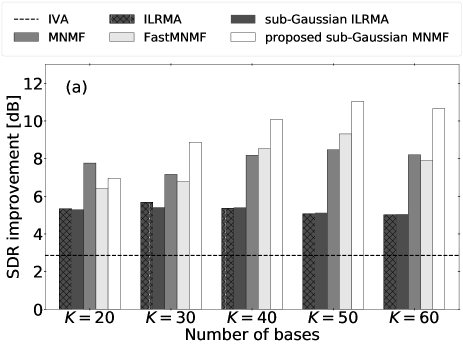
- The proposed sub-Gaussian MNMF significantly outperforms conventional MNMF and FastMNMF in source separation accuracy, as measured by SDR improvement, under strong reverberation conditions.
- The method achieves markedly higher SDR improvements than IVA, ILRMA, and sub-Gaussian ILRMA, especially in cases where the rank-1 spatial model fails due to spatially spread sources or long reverberation.
- The joint-diagonalizability constraint enables the derivation of a valid auxiliary function, leading to a parameter update algorithm that guarantees monotonic decrease of the cost function.
- The proposed algorithm converges stably and achieves better separation performance than conventional methods, even with random initialization, indicating robustness to initial conditions.
- The use of a multivariate complex GGD with β=4 effectively models musical signals, which exhibit sub-Gaussian characteristics, leading to improved modeling fidelity and separation quality.
Better researchstarts right now
From reading papers to final review, dramatically reduce your research time.
No credit card · Free plan available
This review was created by AI and reviewed by human editors.