
[Paper Review] JWST Reveals CH$_4$, CO$_2$, and H$_2$O in a Metal-rich Miscible Atmosphere on a Two-Earth-Radius Exoplanet
JWST transmission spectroscopy of TOI-270 d reveals a highly metal-rich, miscible HMWV-dominated envelope with CH$_4$, CO$_2$, and H$_2$O signatures, constraining interior composition and a new sub-Neptune classification.
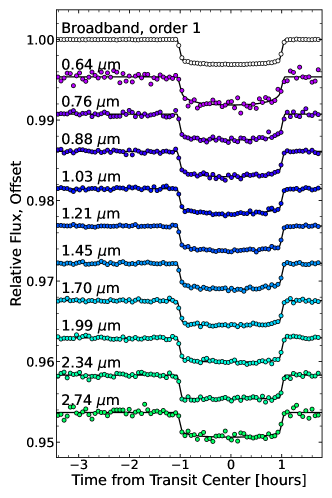
Even though sub-Neptunes likely represent the most common outcome of planet formation, their natures remain poorly understood. In particular, planets near 1.5-2.5$\,R_\oplus$ often have bulk densities that can be explained equally well with widely different compositions and interior structures, resulting in grossly divergent implications for their formation. Here, we present the full 0.6-5.2$\,μ\mathrm{m}$ JWST NIRISS/SOSS+NIRSpec/G395H transmission spectrum of the 2.2$\,R_\oplus$ TOI-270d ($4.78\,M_\oplus$, $T_\mathrm{eq}$=350-380 K), delivering unprecedented sensitivity for atmospheric characterization in the sub-Neptune regime. We detect five vibrational bands of CH$_4$ at 1.15, 1.4, 1.7, 2.3, and 3.3$\,μ$m (9.4$σ$), the signature of CO$_2$ at 4.3$\,μ$m (4.8$σ$), water vapor (2.5$σ$), and potential signatures of SO$_2$ at 4.0$\,μ\mathrm{m}$ and CS$_2$ at 4.6$\,μ\mathrm{m}$. Intriguingly, we find an overall highly metal-rich atmosphere, with a mean molecular weight of $5.47_{-1.14}^{+1.25}$. We infer an atmospheric metal mass fraction of $58_{-12}^{+8}\%$ and a C/O of $0.47_{-0.19}^{+0.16}$, indicating that approximately half the mass of the outer envelope is in high-molecular-weight volatiles (H$_2$O, CH$_4$, CO, CO$_2$) rather than H$_2$/He. We introduce a sub-Neptune classification scheme and identify TOI-270d as a "miscible-envelope sub-Neptune" in which H$_2$/He is well-mixed with the high-molecular-weight volatiles in a miscible supercritical metal-rich envelope. For a fully miscible envelope, we conclude that TOI-270d's interior is $90_{-4}^{+3}\,$wt$\,\%$ rock/iron, indicating that it formed as a rocky planet that accreted a few wt % of H$_2$/He, with the overall envelope metal content explained by magma-ocean/envelope reactions without the need for significant ice accretion. TOI-270d may well be an archetype of the overall population of sub-Neptunes.
Motivation & Objective
- Motivate understanding of sub-Neptune compositions near the radius valley where interior structures are degenerate.
- Characterize the upper-atmosphere chemistry of a ~2.2 R⊕ planet using broad JWST wavelength coverage.
- Constrain interior composition and envelope metal content through atmospheric abundance inferences.
- Propose a classification framework for sub-Neptunes with miscible, metal-rich envelopes.
- Assess implications for planet formation pathways and interior-interior-envelope coupling.
Proposed method
- Obtain 0.6–5.2 μm JWST transmission spectrum of TOI-270 d using NIRISS/SOSS and NIRSpec/G395H (0.6–2.8 μm and 2.7–5.2 μm).
- Reduce data with NAMELESS and supreme-SPOON pipelines; correct for 1/f noise, background, and cosmic rays; extract spectroscopic light curves.
- Fit white and spectroscopic light curves with ExoTEP and batman transit models in an MCMC framework, including systematics and limb-darkening.
- Model the atmosphere with retrievals to identify CH$_4$, CO$_2$, H$_2$O features and potential SO$_2$ and CS$_2$ signals; infer mean molecular weight and metallicity.
- Combine atmospheric constraints with interior-structure modeling to estimate rock/iron fraction and envelope composition.
- Discuss implications for cloud/haze presence and the miscible-envelope hypothesis.

Experimental results
Research questions
- RQ1What molecular species are present in TOI-270 d's upper atmosphere as revealed by JWST transmission spectroscopy?
- RQ2What is the mean molecular weight and metal content of the planet’s envelope, and how do these constraints inform interior structure?
- RQ3Is the H/He envelope, if any, mixed with high-molecular-weight volatiles in a miscible, metal-rich envelope?
- RQ4What formation pathways best explain TOI-270 d’s inferred interior and atmospheric composition?
- RQ5How does TOI-270 d inform a broader sub-Neptune classification scheme near the radius valley?
Key findings
- Detection of five CH$_4$ vibrational bands at 1.15, 1.4, 1.7, 2.3, and 3.3 μm (9.4σ).
- CO$_2$ signature detected around 4.3 μm (4.8σ).
- H$_2$O absorption detected at 1.4 and 1.9 μm (2.5σ).
- Possible signatures of SO$_2$ at 4.0 μm and CS$_2$ at 4.6 μm; overall spectrum indicates a highly metal-rich envelope.
- Mean molecular weight inferred as 5.47$_{-1.14}^{+1.25}$, with atmospheric metal mass fraction 58$_{-12}^{+8}$% and C/O = 0.47$_{-0.19}^{+0.16}$.
- Interior modeling suggests TOI-270 d is ~90$_{-4}^{+3}$ wt% rock/iron if the envelope is fully miscible, implying formation as a rocky body with a small H$_2$/He fraction and magma-ocean–envelope interactions accounting for envelope metals.
Better researchstarts right now
From reading papers to final review, dramatically reduce your research time.
No credit card · Free plan available
This review was created by AI and reviewed by human editors.