
[Paper Review] $k-$Dependent Dark Matter
This paper proposes a $k$-dependent dark matter (k-DM) model where dark matter behaves as cold DM on large scales ($k \ll 1$) and transitions to warm DM on small scales ($k \gtrsim 1$), motivated by scale-dependent free-streaming. Using the CLASS and MontePython codes, it shows that this model reduces the $S_8$ tension by suppressing small-scale power, but only mildly alleviates the $H_0$ tension, offering a phenomenological path to address small-scale $\Lambda$CDM crises without introducing new particle components.
With the emersion of precise cosmology and the emergence of cosmic tensions, we are faced with the question of whether the simple model of cold dark matter needs to be extended and whether doing so can alleviate the tensions and improve our understanding of the properties of dark matter. In this study, we investigate one of the generalized models of dark matter so that the behavior of this dark matter changes according to the scale of $k$. In large scales (small $k$'s), the dark matter is cold, while it becomes warm for small scales (large $k$'s). This behavior is modeled phenomenologically for two different scenarios. We show that the $S_8$ tension can be alleviated, but the $H_0$ tension becomes milder while not too much.
Motivation & Objective
- To address the small-scale crises of the $\Lambda$CDM model, including the cusp-core, missing satellites, and too-big-to-fail problems.
- To investigate whether a scale-dependent dark matter behavior—cold at large $k$, warm at small $k$—can alleviate current cosmological tensions.
- To test if $k$-dependent DM can reduce the $S_8$ and $H_0$ tensions using high-precision CMB and large-scale structure data.
- To explore the phenomenological implications of $k$-dependent dark matter on matter power spectra, CMB anisotropies, and structure growth.
Proposed method
- Formulate a phenomenological $k$-dependent dark matter model where the effective sound speed and equation of state vary with wavenumber $k$.
- Derive and solve the Boltzmann equations for dark matter perturbations in the $k$-dependent framework.
- Implement the model in the CLASS (Cosmic Linear Anisotropy Solving System) code for accurate computation of cosmological observables.
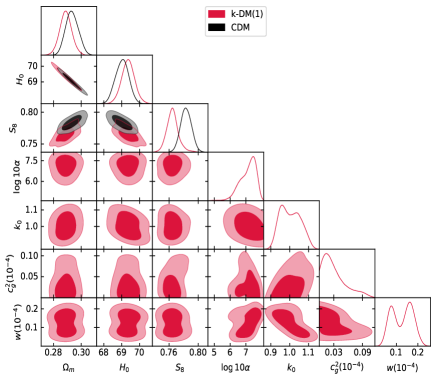
- Perform a Monte Carlo Markov Chain (MCMC) analysis using MontePython-v3 with Planck 2018 CMB data (TT, TE, EE, lensing), BAO (BOSS DR12, eBOSS Ly-$\alpha$), and Ly$\alpha$ forest data.
- Compare the model's predictions for $H_0$, $S_8$, matter power spectrum, and CMB temperature anisotropies against the standard $\Lambda$CDM model.
- Analyze the redshift evolution of $H(z)/(1+z)$ and the reionization redshift $z_{\rm reio}$ to assess model consistency with observations.
Experimental results
Research questions
- RQ1Can a $k$-dependent dark matter model that transitions from cold to warm behavior at small scales reduce the $S_8$ tension?
- RQ2To what extent can such a model alleviate the $H_0$ tension between early- and late-time cosmological probes?
- RQ3How does $k$-dependent dark matter affect the growth rate of matter perturbations across different scales?
- RQ4What is the impact of $k$-dependent DM on the CMB temperature power spectrum, particularly at low multipoles?
- RQ5Does the model alter the reionization history, and how does it compare to $\Lambda$CDM in terms of $z_{\rm reio}$?
Key findings
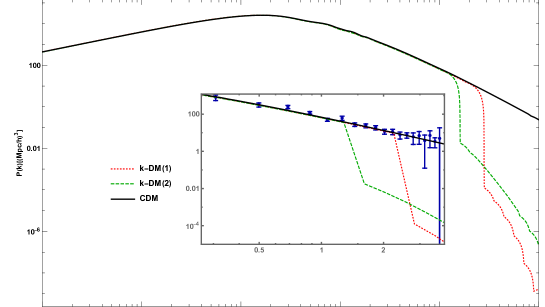
- The $k$-dependent dark matter model reduces the $S_8$ tension by suppressing small-scale power, with the $k$-DM(1) model showing the strongest reduction.
- The $H_0$ tension is only mildly alleviated, with $H_0$ values in the $k$-DM models remaining higher than Planck's $67.0-68.5$ km/s/Mpc but lower than the SH0ES value of $74.03 \pm 1.42$.
- The model slows down the growth rate of matter fluctuations at high $k$, consistent with a suppression of small-scale clustering.
- The temperature power spectrum shows a suppression in the low-$l$ region, particularly in the $k$-DM(1) model, due to modified ISW effects and reionization history.
- The reionization redshift $z_{\rm reio}$ is estimated at 6.02 for $k$-DM(1), 6.41 for $k$-DM(2), and 7.38 for $\Lambda$CDM, indicating a significant deviation in the $k$-DM(1) model.
- The model's predictions remain consistent with Ly$\alpha$ forest data at $\sim$ few Mpc scales, though data scarcity at very small $k$ limits full constraints.
Better researchstarts right now
From reading papers to final review, dramatically reduce your research time.
No credit card · Free plan available
This review was created by AI and reviewed by human editors.