
[Paper Review] Kilonovae of binary neutron star mergers leading to short-lived remnant neutron star formation
This study investigates kilonova emission from binary neutron star mergers that form a short-lived massive neutron star (MNS) before collapsing into a black hole within 20 ms. Using consistent numerical-relativity and nucleosynthesis simulations, it finds these kilonovae are significantly fainter and shorter-lived than those from long-lived MNSs, particularly in the optical band, making them inconsistent with the AT2017gfo emission from GW170817. The results imply the GW170817 remnant likely did not collapse so quickly, and early optical/near-infrared observations are critical to detect such events, which may otherwise be hidden by gamma-ray burst afterglows.
We study kilonova emission from binary neutron star (BNS) mergers for the case that a remnant massive neutron star (MNS) forms and collapses to a black hole within $20$ ms after the onset of the merger (which we refer to as "a short-lived case") by consistently employing numerical-relativity and nucleosynthesis results. We find that such kilonovae are fainter and last shorter than those for BNSs resulting in the formation of long-lived ($\gg 1\,{ m s}$) MNSs, in particular in the optical band. The resulting light curves are too faint and last for a too short duration to explain the kilonova observation for the BNS associated with GW170817, indicating that the merger remnant formed in GW170817 is unlikely to have collapsed to a black hole within a short period of time ($\sim 20$ ms) after the onset of the merger. Our present result implies that early observation is necessary to detect kilonovae associated with BNSs leading to short-lived MNS formation in particular for the optical blue band as well as that kilonovae could be hidden by the gamma-ray burst afterglow for nearly face-on observation. We provide a possible approximate scaling law for near-infrared light curves with the given reference time and magnitude when the decline power of the ${\it z}$-band magnitude, $d M_{\it z}/d{ m log}_{10}t$, reaches $2.5$. This scaling law suggests that the ${\it HK}$-band follow-up observation should be at least $1$ mag deeper than that for the ${\it z}$-band reference magnitude and earlier than 4 times the reference time.
Motivation & Objective
- To determine the electromagnetic signatures of kilonovae produced in binary neutron star mergers that form a short-lived massive neutron star (MNS) before collapsing into a black hole.
- To assess whether such short-lived MNS kilonovae can explain the observed kilonova AT2017gfo associated with GW170817.
- To identify observational challenges, such as masking by gamma-ray burst afterglows, and to guide future multi-messenger observations.
- To develop a scaling law for near-infrared light curves to inform optimal follow-up observation strategies.
Proposed method
- The study employs consistent numerical-relativity simulations to model the merger dynamics and mass ejection for binary neutron star systems with varying equations of state.
- Nucleosynthesis yields from the simulations are used to determine the composition and radioactive heating rates of the ejecta.
- Radiative transfer simulations are performed using detailed opacity tables and heating profiles derived from the simulations to compute light curves across optical and near-infrared bands.
- The light curves are compared with observations of AT2017gfo (GW170817) and GRB130603B to test consistency with short-lived MNS scenarios.
- A scaling law for near-infrared light curves is derived based on the decline power of the z-band magnitude at a reference time.
- The model includes effects such as non-LTE spectral features and aspherical ejecta morphology to assess their impact on observational interpretation.
Experimental results
Research questions
- RQ1Can kilonovae from binary neutron star mergers that form a short-lived MNS (collapsing within ~20 ms) reproduce the observed properties of AT2017gfo?
- RQ2Why is the kilonova emission from short-lived MNS mergers fainter and shorter-lived than that from long-lived MNSs, particularly in the optical band?
- RQ3To what extent are kilonovae from short-lived MNSs masked by gamma-ray burst afterglows in multi-wavelength observations?
- RQ4What observational strategy—specifically in near-infrared bands—maximizes the detection probability of such short-lived MNS kilonovae?
- RQ5How do aspherical ejecta morphology and spectral features (e.g., Sr p-Cygni profiles) affect the interpretation of kilonova light curves?
Key findings
- Kilonovae from short-lived MNS formation are significantly fainter and shorter-lived than those from long-lived MNSs, especially in the optical band, due to reduced mass ejection and shorter radioactive heating timescale.
- The observed kilonova AT2017gfo is inconsistent with a short-lived MNS scenario, implying the GW170817 remnant likely survived for more than 20 ms.
- The optical and near-infrared emission from short-lived MNS kilonovae is often hidden by gamma-ray burst afterglow emission, particularly in face-on viewing geometries.
- A scaling law for near-infrared light curves is derived, indicating that HK-band follow-up observations should be at least 1 magnitude deeper than the z-band reference magnitude and conducted earlier than four times the reference time.
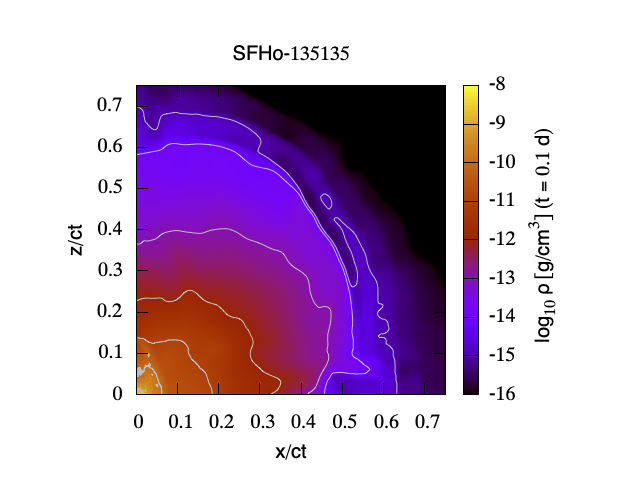
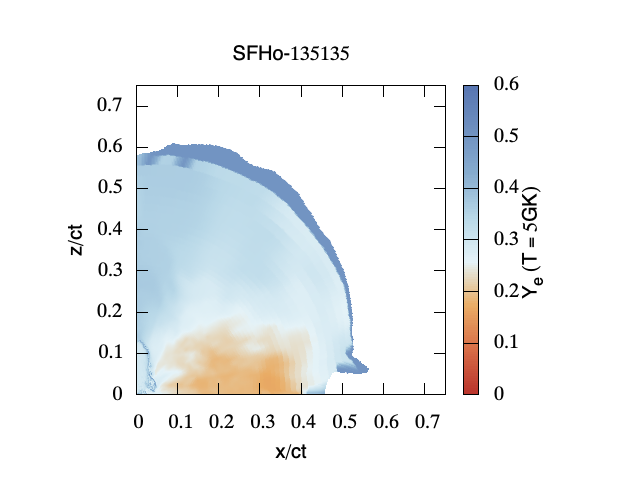
- The Sr mass density profile for short-lived MNS models shows a nearly spherical morphology at 1 day post-merger, which is inconsistent with the aspherical ejecta morphology implied by recent spectral analysis of AT2017gfo.
- The study highlights that early, deep optical and near-infrared observations are essential to detect kilonovae from short-lived MNS mergers, as they are unlikely to be observable in later phases.
Better researchstarts right now
From reading papers to final review, dramatically reduce your research time.
No credit card · Free plan available
This review was created by AI and reviewed by human editors.