
[Paper Review] Krylov complexity and Trotter transitions in unitary circuit dynamics
This paper extends Krylov complexity—a measure of quantum chaos and operator complexity—to unitary circuit dynamics, particularly Trotterized circuits derived from Hamiltonian systems. It identifies two distinct regimes: for small Trotter steps, dynamics recover Hamiltonian behavior with maximal Krylov complexity growth; for large steps, maximally ergodic operators emerge, exhibiting vanishing autocorrelation and acting as memoryless baths, with a crossover in chaotic systems and a nonanalytic transition in integrable ones.
We investigate many-body dynamics where the evolution is governed by unitary circuits through the lens of `Krylov complexity', a recently proposed measure of complexity and quantum chaos. We extend the formalism of Krylov complexity to unitary circuit dynamics and focus on Floquet circuits arising as the Trotter decomposition of Hamiltonian dynamics. For short Trotter steps the results from Hamiltonian dynamics are recovered, whereas a large Trotter step results in different universal behavior characterized by the existence of local maximally ergodic operators: operators with vanishing autocorrelation functions, as exemplified in dual-unitary circuits. These operators exhibit maximal complexity growth, act as a memoryless bath for the dynamics, and can be directly probed in current quantum computing setups. These two regimes are separated by a crossover in chaotic systems. Conversely, we find that free integrable systems exhibit a nonanalytic transition between these different regimes, where maximally ergodic operators appear at a critical Trotter step.
Motivation & Objective
- To generalize the framework of Krylov complexity—previously applied to Hamiltonian dynamics—to unitary circuit dynamics without an underlying static Hamiltonian.
- To investigate how Trotterization of Hamiltonian dynamics affects operator complexity and ergodicity in unitary circuits.
- To identify universal behavior in Krylov complexity growth under different Trotter step sizes, distinguishing between chaotic and integrable systems.
- To characterize the emergence of maximally ergodic operators—those with vanishing autocorrelation—under large Trotter steps and their role as memoryless baths.
- To explore the transition between regimes in both chaotic and integrable systems, revealing a crossover in chaos and a nonanalytic transition in integrability.
Proposed method
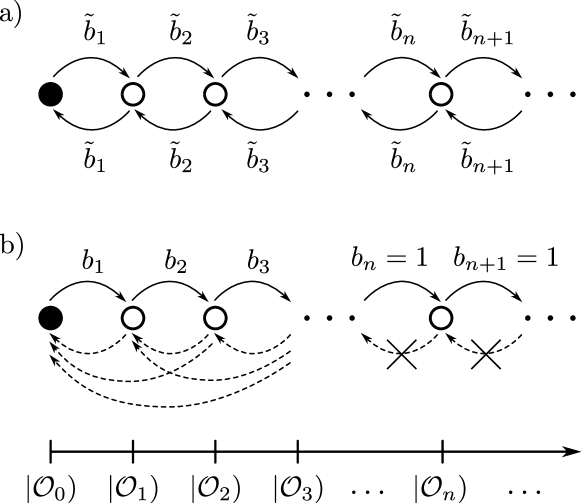
- Define a Krylov subspace for unitary circuit dynamics via Gram-Schmidt orthonormalization of iteratively evolved operators.
- Apply the Krylov complexity formalism to Floquet circuits obtained via Trotter decomposition of Hamiltonian dynamics.
- Use momentum-space fermionic representation to diagonalize the time evolution operator and compute autocorrelation functions.
- Analyze the time evolution of initial local operators under the unitary circuit to compute Krylov basis operators and their complexity growth.
- Derive exact expressions for the autocorrelation functions of initial operators in momentum space using matrix evolution and eigenvalue decomposition.
- Identify the emergence of maximally ergodic operators through vanishing autocorrelation functions at large Trotter steps, linked to random matrix theory predictions.
Experimental results
Research questions
- RQ1How does Krylov complexity behave in unitary circuits derived from Hamiltonian dynamics via Trotterization?
- RQ2What universal behavior emerges in Krylov complexity for large Trotter steps, and how does it differ from the small-step Hamiltonian limit?
- RQ3Under what conditions do maximally ergodic operators—those with vanishing autocorrelation—emerge in unitary circuits?
- RQ4How does the transition between regimes differ between chaotic and integrable systems under varying Trotter steps?
- RQ5Can the Krylov complexity framework be extended beyond Hamiltonian dynamics to general unitary circuit models?
Key findings
- For small Trotter steps, the Krylov complexity growth recovers the universal behavior seen in Hamiltonian dynamics, including maximal growth and delocalization in the Krylov subspace.
- At large Trotter steps, maximally ergodic operators emerge—operators with instantaneously vanishing autocorrelation functions—acting as memoryless baths for the dynamics.
- These maximally ergodic operators are characterized by Krylov complexity growth that saturates to a universal form, consistent with random matrix theory predictions.
- In chaotic systems, the transition between small- and large-step regimes is a crossover, with a distinct change in complexity growth behavior.
- In integrable systems, the transition is nonanalytic and occurs at a critical Trotter step where maximally ergodic operators appear, signaling a qualitative change in dynamics.
- The exact solution for the autocorrelation function of a local spin operator in the circuit model is derived using momentum-space fermionization and matrix evolution, confirming the emergence of maximal ergodicity at large steps.
![Figure 2: The unitary superoperator $\mathcal{U}$ [Eq. ( 14 )] describing the evolution of the initial operator $|O_{0})\propto\sum_{j\in\mathbb{Z}}\sigma^{z}_{2j}$ under dual-unitary two-site gates. Here $\mathcal{U}$ is given in the Krylov basis, which is generated by orthonormalisation of $\{\mat](https://ar5iv.labs.arxiv.org/html/2308.03851/assets/x4.png)
Better researchstarts right now
From reading papers to final review, dramatically reduce your research time.
No credit card · Free plan available
This review was created by AI and reviewed by human editors.