
[Paper Review] Learning CO$_2$ plume migration in faulted reservoirs with Graph Neural Networks
The paper introduces a Graph Neural Network surrogate (MGN-LSTM) that predicts CO2 plume migration and pore pressure on unstructured meshes with faults, reducing temporal error and generalizing to unseen configurations.
Deep-learning-based surrogate models provide an efficient complement to numerical simulations for subsurface flow problems such as CO$_2$ geological storage. Accurately capturing the impact of faults on CO$_2$ plume migration remains a challenge for many existing deep learning surrogate models based on Convolutional Neural Networks (CNNs) or Neural Operators. We address this challenge with a graph-based neural model leveraging recent developments in the field of Graph Neural Networks (GNNs). Our model combines graph-based convolution Long-Short-Term-Memory (GConvLSTM) with a one-step GNN model, MeshGraphNet (MGN), to operate on complex unstructured meshes and limit temporal error accumulation. We demonstrate that our approach can accurately predict the temporal evolution of gas saturation and pore pressure in a synthetic reservoir with impermeable faults. Our results exhibit a better accuracy and a reduced temporal error accumulation compared to the standard MGN model. We also show the excellent generalizability of our algorithm to mesh configurations, boundary conditions, and heterogeneous permeability fields not included in the training set. This work highlights the potential of GNN-based methods to accurately and rapidly model subsurface flow with complex faults and fractures.
Motivation & Objective
- Motivate efficient, accurate surrogate modeling for CO2 plume migration in faulted reservoirs to reduce reliance on high-fidelity simulations.
- Develop a graph-based surrogate capable of handling unstructured meshes conforming to faults and fractures.
- Mitigate temporal error accumulation in autoregressive surrogates through a graph-based recurrent architecture.
- Demonstrate generalizability to unseen meshes, boundary conditions, and heterogeneous permeability fields.
Proposed method
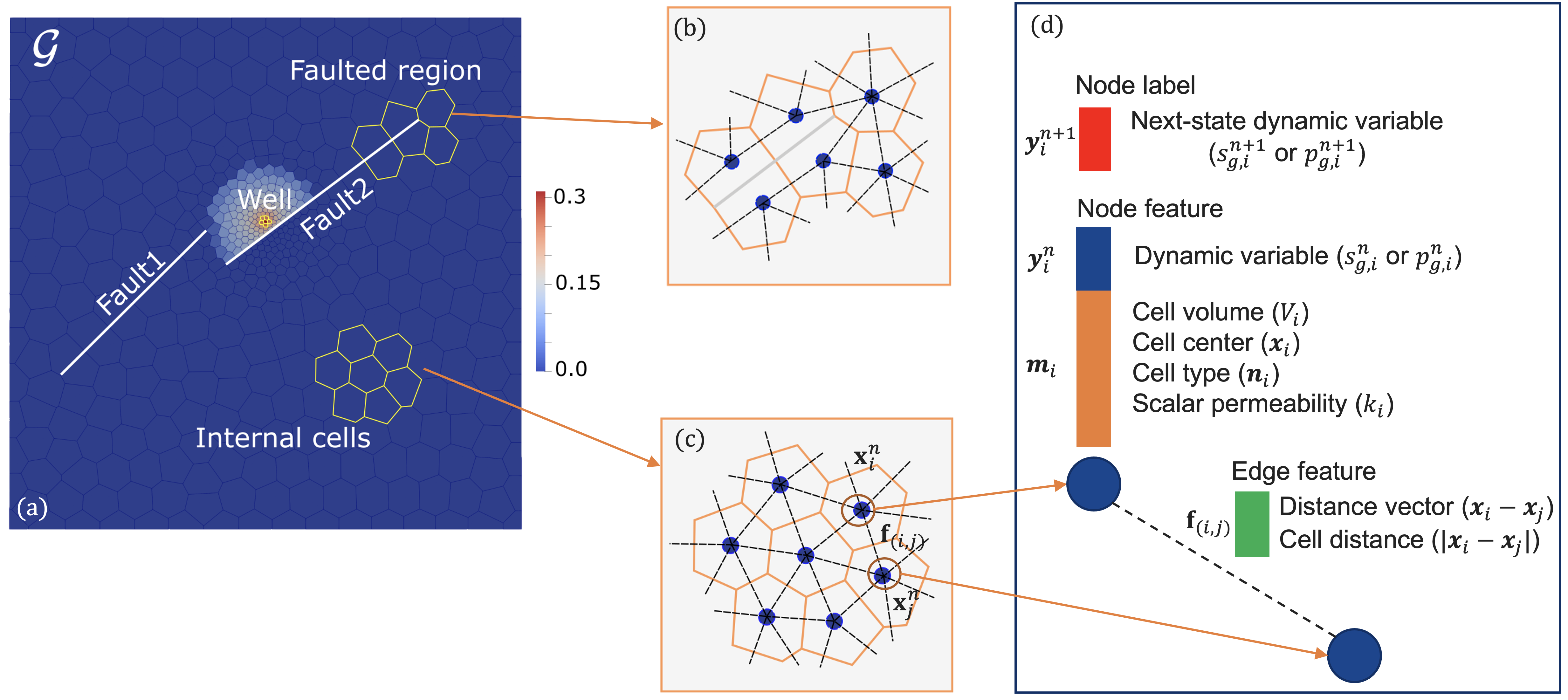
- Represent unstructured mesh data as graphs with node features (dynamic variables plus static properties) and edge features (connectivity and distance).
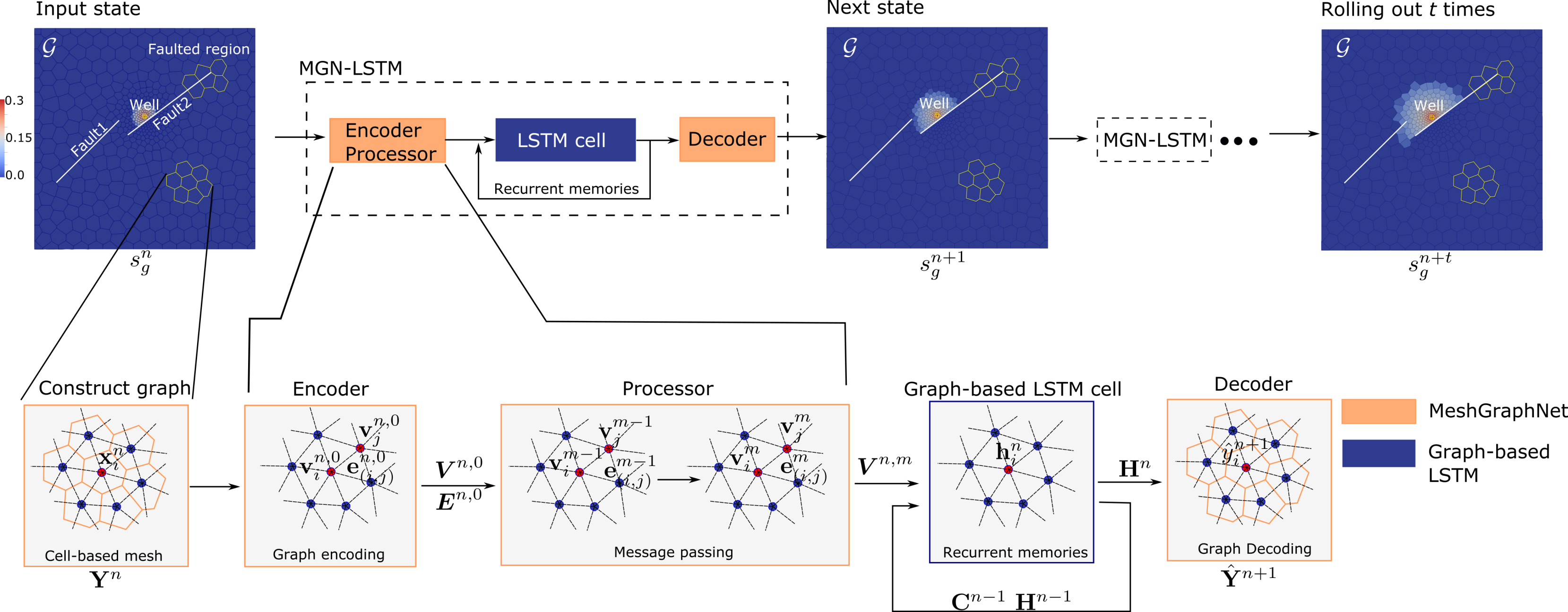
- Leverage MeshGraphNet (MGN) as the encoder/processor to build latent representations from graph inputs.
- Integrate Graph ConvLSTM (GConvLSTM) to capture spatial-temporal dynamics and reduce error accumulation over time.
- Use an autoregressive rollout to predict successive time steps, with gradients propagated through the sequence for stability.
- Train separate MGN-LSTM models for gas saturation and pore pressure using HF simulation data as ground truth.
Experimental results
Research questions
- RQ1Can a graph-based surrogate accurately predict two-phase CO2–brine flow on unstructured meshes with impermeable faults?
- RQ2Does the MGN-LSTM reduce temporal error accumulation compared to standard next-state MGN and other baselines?
- RQ3How well does the model generalize to unseen meshes, boundary conditions, and heterogeneous permeability fields?
- RQ4What is the impact of including additional physical features (e.g., relative permeability) in graph inputs on predictive accuracy?
Key findings
- MGN-LSTM accurately predicts CO2 saturation plumes and pore pressure evolution in faulted reservoirs.
- The model exhibits reduced temporal error accumulation relative to standard MeshGraphNet.
- MGN-LSTM generalizes to unseen mesh configurations, boundary conditions, and permeability fields not seen during training.
- Incorporating more physical features into node/edge inputs can further improve saturation prediction accuracy.
Better researchstarts right now
From reading papers to final review, dramatically reduce your research time.
No credit card · Free plan available
This review was created by AI and reviewed by human editors.