
[Paper Review] Learning to Predict Mutation Effects of Protein-Protein Interactions by Microenvironment-aware Hierarchical Prompt Learning
This paper proposes Prompt-DDG, a microenvironment-aware hierarchical prompt learning framework that efficiently predicts mutational effects on protein-protein interactions by modeling multi-scale structural dependencies through a pre-trained prompt codebook. It achieves state-of-the-art performance in ΔΔG prediction and antibody optimization with significantly reduced pre-training cost.
Protein-protein bindings play a key role in a variety of fundamental biological processes, and thus predicting the effects of amino acid mutations on protein-protein binding is crucial. To tackle the scarcity of annotated mutation data, pre-training with massive unlabeled data has emerged as a promising solution. However, this process faces a series of challenges: (1) complex higher-order dependencies among multiple (more than paired) structural scales have not yet been fully captured; (2) it is rarely explored how mutations alter the local conformation of the surrounding microenvironment; (3) pre-training is costly, both in data size and computational burden. In this paper, we first construct a hierarchical prompt codebook to record common microenvironmental patterns at different structural scales independently. Then, we develop a novel codebook pre-training task, namely masked microenvironment modeling, to model the joint distribution of each mutation with their residue types, angular statistics, and local conformational changes in the microenvironment. With the constructed prompt codebook, we encode the microenvironment around each mutation into multiple hierarchical prompts and combine them to flexibly provide information to wild-type and mutated protein complexes about their microenvironmental differences. Such a hierarchical prompt learning framework has demonstrated superior performance and training efficiency over state-of-the-art pre-training-based methods in mutation effect prediction and a case study of optimizing human antibodies against SARS-CoV-2.
Motivation & Objective
- Address the scarcity of annotated experimental mutation data in protein-protein interaction studies.
- Overcome limitations in existing pre-training methods that fail to model complex higher-order dependencies across multiple structural scales.
- Capture local microenvironmental changes induced by mutations without requiring explicit prediction of mutated complex structures.
- Reduce computational cost in pre-training while maintaining high predictive performance for ΔΔG prediction.
- Enable effective virtual screening and functional site discovery in antibody design, particularly for SARS-CoV-2 neutralizing antibodies.
Proposed method
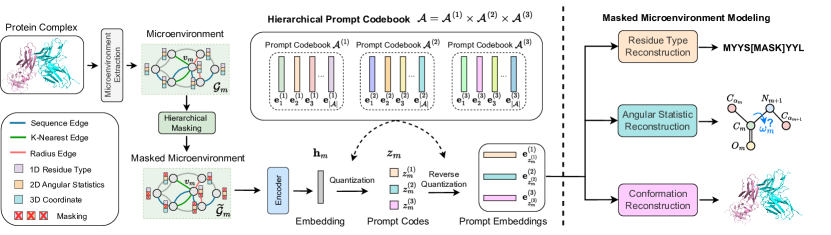
- Construct a hierarchical prompt codebook to encode common microenvironmental patterns at different structural scales (e.g., residue, dihedral angles, local conformation) independently.
- Design a masked microenvironment modeling pre-training task that jointly models residue types, angular statistics, and local conformational changes around each mutation.
- Generate microenvironment-aware prompts for each mutation by combining hierarchical prompts from the codebook, capturing differences between wild-type and mutated complexes.
- Use the learned prompts as in-context representations to guide downstream ΔΔG prediction, avoiding expensive end-to-end fine-tuning.
- Leverage the prompt codebook to enable flexible, multi-scale encoding of structural context without retraining the model for each new mutation.
- Train the framework end-to-end using a contrastive learning objective that aligns wild-type and mutated microenvironment representations.
Experimental results
Research questions
- RQ1Can a hierarchical prompt codebook effectively model multi-scale structural dependencies in protein microenvironments around mutations?
- RQ2Does masked microenvironment modeling pre-training improve downstream ΔΔG prediction performance compared to standard pre-training tasks?
- RQ3Can prompt-based representation learning achieve superior accuracy and efficiency compared to end-to-end pre-training in ΔΔG prediction?
- RQ4To what extent can the model generalize to real-world applications such as antibody optimization for SARS-CoV-2?
- RQ5How does the model’s performance compare to state-of-the-art methods in terms of both predictive accuracy and training efficiency?
Key findings
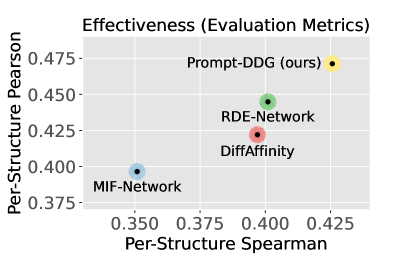
- Prompt-DDG achieved the highest per-structure Pearson correlation (0.6557) and Spearman correlation (0.5691) on the SKEMPI v2.0 benchmark, outperforming all baselines.
- The model reduced pre-training time by over 50% compared to RDE-Network and DiffAffinity, while maintaining superior performance.
- In the SARS-CoV-2 antibody optimization case study, Prompt-DDG ranked all five known favorable mutations within the top 40%, with an average ranking of 10.69%, significantly outperforming RDE-Network (18.26%) and DiffAffinity (24.49%).
- Only Prompt-DDG successfully identified four of the five key neutralizing mutations within the top 10% of predictions, demonstrating strong generalization and precision.
- Ablation studies showed that the optimal mask ratio for the masked microenvironment modeling task was 0.10, yielding the best performance on both Pearson and Spearman correlations.
- The hierarchical prompt codebook enabled effective modeling of multi-scale microenvironmental features, contributing to improved generalization and interpretability of mutation effects.
Better researchstarts right now
From reading papers to final review, dramatically reduce your research time.
No credit card · Free plan available
This review was created by AI and reviewed by human editors.