
[Paper Review] LINKS: A dataset of a hundred million planar linkage mechanisms for data-driven kinematic design
LINKS introduces a dataset of 100 million one-degree-of-freedom planar linkage mechanisms and 1.1 billion coupler curves, generated via a novel topology operator and highly optimized, parallelized simulation. The dataset enables data-driven inverse kinematic design, demonstrated by retrieving mechanisms that closely match target paths using bi-directional chamfer distance, with retrieval accuracy validated on a curated subset of 10 million paths.
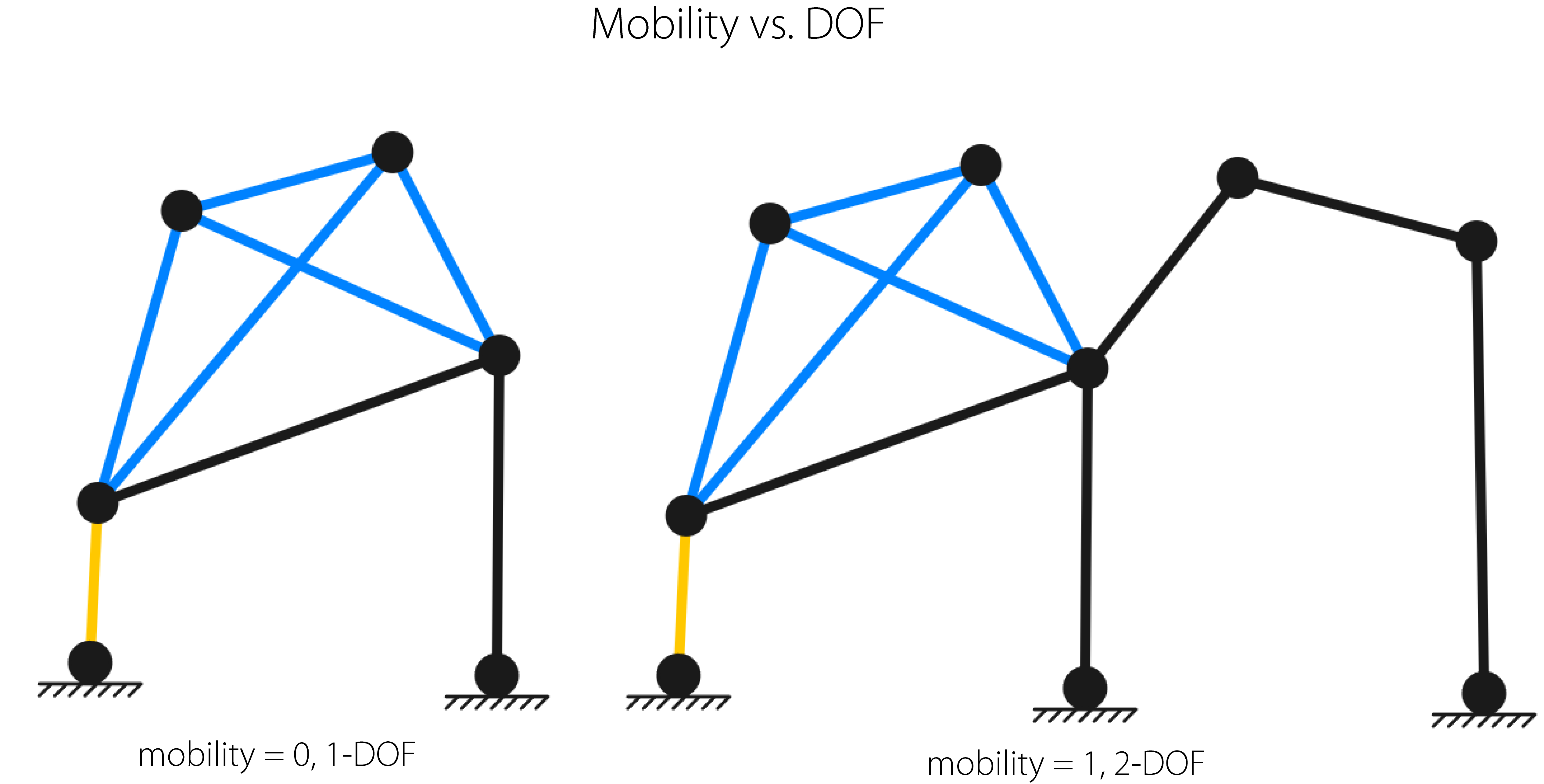
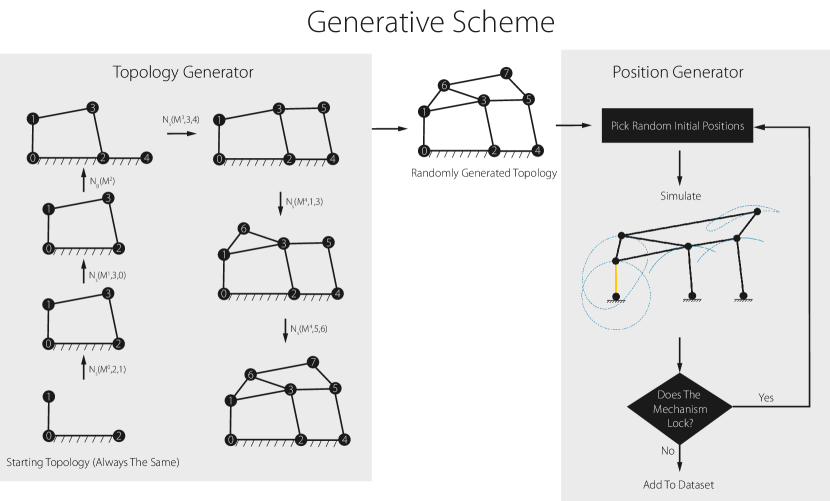
In this paper, we introduce LINKS, a dataset of 100 million one degree of freedom planar linkage mechanisms and 1.1 billion coupler curves, which is more than 1000 times larger than any existing database of planar mechanisms and is not limited to specific kinds of mechanisms such as four-bars, six-bars, \etc which are typically what most databases include. LINKS is made up of various components including 100 million mechanisms, the simulation data for each mechanism, normalized paths generated by each mechanism, a curated set of paths, the code used to generate the data and simulate mechanisms, and a live web demo for interactive design of linkage mechanisms. The curated paths are provided as a measure for removing biases in the paths generated by mechanisms that enable a more even design space representation. In this paper, we discuss the details of how we can generate such a large dataset and how we can overcome major issues with such scales. To be able to generate such a large dataset we introduce a new operator to generate 1-DOF mechanism topologies, furthermore, we take many steps to speed up slow simulations of mechanisms by vectorizing our simulations and parallelizing our simulator on a large number of threads, which leads to a simulation 800 times faster than the simple simulation algorithm. This is necessary given on average, 1 out of 500 candidates that are generated are valid~(and all must be simulated to determine their validity), which means billions of simulations must be performed for the generation of this dataset. Then we demonstrate the depth of our dataset through a bi-directional chamfer distance-based shape retrieval study where we show how our dataset can be used directly to find mechanisms that can trace paths very close to desired target paths.
Motivation & Objective
- To address the lack of large-scale, diverse datasets for data-driven kinematic design in planar linkages.
- To overcome computational bottlenecks in generating and simulating vast numbers of 1-DOF planar mechanisms.
- To create a comprehensive, unbiased dataset covering a broad range of coupler paths for inverse kinematic synthesis.
- To enable efficient, scalable shape retrieval for path generation problems using metric-based similarity search.
- To establish a foundation for future expansion to include complex components like sliders and gears.
Proposed method
- Introduced a novel topology generation operator to systematically create 1-DOF planar mechanisms with up to 20 joints.
- Implemented vectorized and parallelized simulation across thousands of threads, achieving 800× speedup over naive simulation.
- Generated 100 million mechanisms, each simulated for a full actuator revolution to produce coupler curves.
- Normalized all coupler paths to enable consistent shape comparison and reduce bias in the dataset.
- Curated a representative subset of normalized paths to improve design space coverage and reduce redundancy.
- Used bi-directional chamfer distance to compare query paths against dataset paths for shape retrieval.
Experimental results
Research questions
- RQ1Can a large-scale, unbiased dataset of 1-DOF planar linkages enable effective data-driven inverse kinematic design?
- RQ2How effectively can a simple search strategy retrieve mechanisms that generate target paths not present in the dataset?
- RQ3To what extent does the dataset cover the space of possible coupler curves in 1-DOF planar mechanisms?
- RQ4Can the simulation pipeline scale to generate 100 million mechanisms with high computational efficiency?
- RQ5How does the curated path subset improve retrieval performance and representation of the design space?
Key findings
- The dataset contains 100 million 1-DOF planar linkage mechanisms and 1.1 billion coupler curves, making it over 1000× larger than any prior database.
- The simulation pipeline achieved an 800× speedup through vectorization and parallelization, enabling billions of simulations within feasible time.
- A simple bi-directional chamfer distance-based search on a 10-million-path subset successfully retrieved mechanisms matching three unseen target paths with high fidelity.
- The curated path subset effectively reduces bias and improves representation of the output space, enabling more reliable shape retrieval.
- The dataset demonstrates broad coverage of coupler curve types, indicating strong potential for use in inverse kinematic synthesis.
- The current version excludes locking mechanisms, complex loops (e.g., double-butterfly), and non-joint components like sliders, which are planned for future expansion.
Better researchstarts right now
From reading papers to final review, dramatically reduce your research time.
No credit card · Free plan available
This review was created by AI and reviewed by human editors.