
[Paper Review] LLM-as-a-tutor in EFL Writing Education: Focusing on Evaluation of Student-LLM Interaction
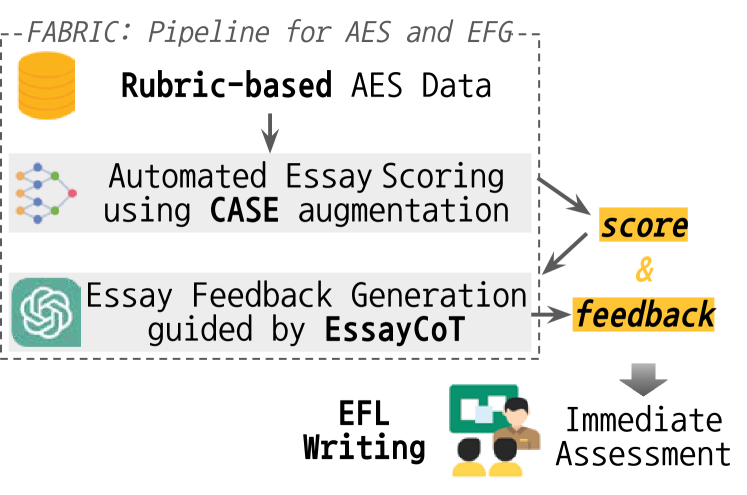
This paper introduces FABRIC, a pipeline that enhances EFL writing education by generating rubric-based scores (content, organization, language) and detailed, helpful feedback using LLMs. It combines a new real-world dataset (DREsS), a corruption-based data augmentation strategy (CASE), and a novel Essay Chain-of-Thought prompting method (EssayCoT), achieving significant improvements in feedback helpfulness and model performance over baselines.
In the context of English as a Foreign Language (EFL) writing education, LLM-as-a-tutor can assist students by providing real-time feedback on their essays. However, challenges arise in assessing LLM-as-a-tutor due to differing standards between educational and general use cases. To bridge this gap, we integrate pedagogical principles to assess student-LLM interaction. First, we explore how LLMs can function as English tutors, providing effective essay feedback tailored to students. Second, we propose three metrics to evaluate LLM-as-a-tutor specifically designed for EFL writing education, emphasizing pedagogical aspects. In this process, EFL experts evaluate the feedback from LLM-as-a-tutor regarding quality and characteristics. On the other hand, EFL learners assess their learning outcomes from interaction with LLM-as-a-tutor. This approach lays the groundwork for developing LLMs-as-a-tutor tailored to the needs of EFL learners, advancing the effectiveness of writing education in this context.
Motivation & Objective
- To address the lack of standardized, rubric-based datasets for automated essay scoring (AES) in EFL writing education.
- To improve the accuracy of rubric-based AES models through a novel data augmentation strategy (CASE) that introduces controlled errors.
- To develop a prompting method (EssayCoT) that generates more helpful, specific feedback by leveraging predicted rubric scores.
- To evaluate the end-to-end pipeline in real-world EFL writing classrooms, assessing both model performance and user satisfaction.
Proposed method
- FABRIC is a three-component pipeline: DREsS (a real-world dataset of 1,782 EFL essays scored by experts on content, organization, and language), CASE (corruption-based data augmentation generating synthetic essays with errors to improve model generalization), and EssayCoT (a prompting strategy that uses predicted rubric scores to guide LLM feedback generation).
- DREsS is constructed from actual EFL student essays and includes expert-annotated rubric-based scores, forming a standardized benchmark for rubric-based AES.
- CASE generates synthetic training data by introducing plausible sentence-level errors into high-quality essays, creating 3.9K content, 15.7K organization, and 0.9K language synthetic samples to enhance model robustness.
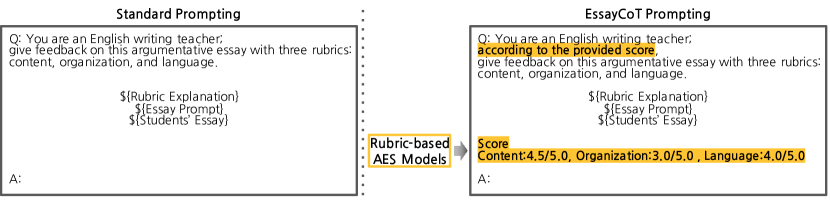
- EssayCoT uses the predicted rubric scores from the AES model as a chain-of-thought to guide the LLM in generating feedback that is more targeted and coherent than standard prompting.
- The AES model is fine-tuned on DREsS and augmented with CASE, improving its quadratic weighted kappa (QWK) score by 26.37% over the baseline.
- Feedback is evaluated via expert assessment and student deployment, with the pipeline integrated into an essay editing platform for real-world testing.
Experimental results
Research questions
- RQ1Can a standardized, expert-annotated rubric-based dataset (DREsS) improve the reliability and consistency of automated essay scoring in EFL writing education?
- RQ2Does corruption-based data augmentation (CASE) significantly enhance the performance of rubric-based AES models compared to baseline training on existing datasets?
- RQ3Can a chain-of-thought prompting strategy (EssayCoT) that uses predicted rubric scores generate feedback that is significantly more helpful and preferred by English education experts than standard prompting?
- RQ4How do students perceive and rate AI-generated scores and feedback in a real-world EFL writing classroom setting?
Key findings
- The DREsS dataset, comprising 1,782 real EFL student essays with expert-annotated scores on content, organization, and language, provides a reliable benchmark for rubric-based AES.
- The CASE augmentation strategy improved the baseline model’s quadratic weighted kappa (QWK) score by 26.37%, significantly enhancing the accuracy of rubric-based scoring.
- Feedback generated using EssayCoT prompting was rated as significantly more helpful and preferred by 13 English education experts compared to standard prompting methods.
- In a real-world deployment with 33 EFL students, the generated scores and feedback received an average Likert rating of 6 out of 7, indicating strong user acceptance.
- The pipeline achieved a QWK score of approximately 0.6 on the augmented dataset, demonstrating strong performance in rubric-based scoring.
- Expert evaluation confirmed that EssayCoT-generated feedback was more specific, actionable, and aligned with pedagogical goals than feedback from standard prompting.
Better researchstarts right now
From reading papers to final review, dramatically reduce your research time.
No credit card · Free plan available
This review was created by AI and reviewed by human editors.