
[Paper Review] Local minima in quantum systems
This paper establishes that finding local minima in quantum systems is computationally hard for classical computers but efficiently solvable by quantum computers using a thermal gradient descent algorithm. The key contribution is proving that while local minima are easier than ground states, they remain classically intractable under BQP-hard Hamiltonians—highlighting a quantum advantage in simulating natural cooling processes.
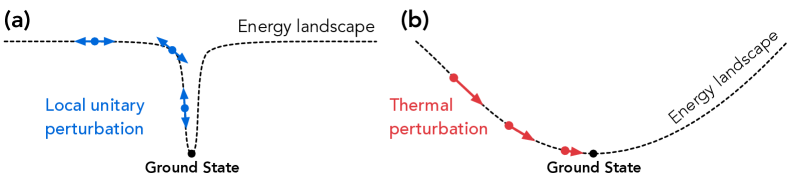
Finding ground states of quantum many-body systems is known to be hard for both classical and quantum computers. As a result, when Nature cools a quantum system in a low-temperature thermal bath, the ground state cannot always be found efficiently. Instead, Nature finds a local minimum of the energy. In this work, we study the problem of finding local minima in quantum systems under thermal perturbations. While local minima are much easier to find than ground states, we show that finding a local minimum is computationally hard for classical computers, even when the task is to output a single-qubit observable at any local minimum. In contrast, we prove that a quantum computer can always find a local minimum efficiently using a thermal gradient descent algorithm that mimics the cooling process in Nature. To establish the classical hardness of finding local minima, we consider a family of two-dimensional Hamiltonians such that any problem solvable by polynomial-time quantum algorithms can be reduced to finding ground states of these Hamiltonians. We prove that for such Hamiltonians, all local minima are global minima. Therefore, assuming quantum computation is more powerful than classical computation, finding local minima is classically hard and quantumly easy.
Motivation & Objective
- To investigate the computational complexity of finding local minima in quantum many-body systems under thermal perturbations.
- To determine whether local minima, though easier than ground states, remain classically intractable.
- To establish a quantum advantage in solving the local minimum problem by constructing a polynomial-time quantum algorithm.
- To prove that for a broad class of Hamiltonians, all local minima are global minima, linking the problem to BQP-hardness.
- To formalize local minima in quantum systems using thermal and local unitary perturbations, providing a physically motivated definition.
Proposed method
- Defining local minima in quantum systems via energy expectation values under small thermal and local unitary perturbations.
- Introducing a thermal gradient descent algorithm that mimics natural cooling processes on a quantum computer.
- Using thermal Lindbladians to model open quantum systems coupled to a heat bath at low temperature.
- Proving that the energy gradient under thermal perturbations is monotonic under small perturbations, ensuring convergence.
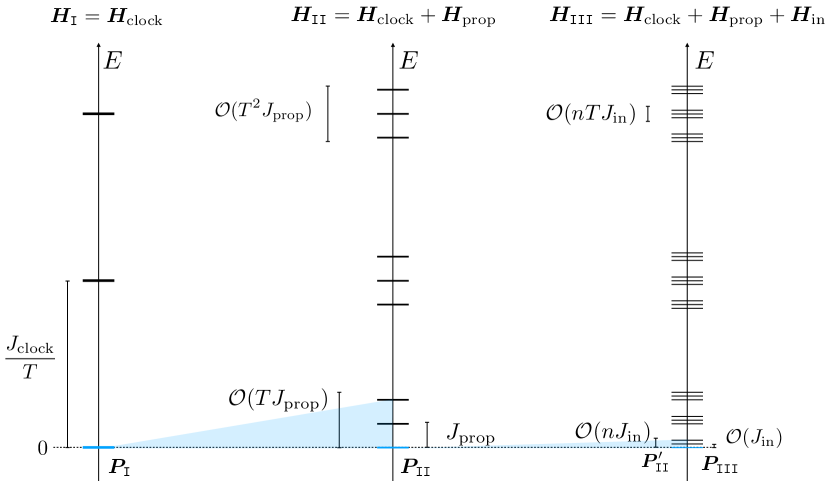
- Applying perturbation theory to analyze eigenvalue and eigensubspace changes, especially in low-energy subspaces.
- Reducing any problem in BQP to the ground state problem of a two-dimensional local Hamiltonian, where all local minima are global minima.
Experimental results
Research questions
- RQ1Is finding a local minimum in quantum systems computationally hard for classical computers?
- RQ2Can a quantum computer efficiently find a local minimum using a physically motivated algorithm?
- RQ3Are there Hamiltonians for which all local minima are also global minima, and what is the complexity of such problems?
- RQ4How does the energy gradient behave under thermal perturbations, and can it be preserved under small Hamiltonian changes?
- RQ5What is the relationship between the computational hardness of local minima and the quantum advantage in BQP?
Key findings
- Finding local minima is classically hard: even outputting a single-qubit observable at a local minimum is computationally intractable for classical computers.
- A polynomial-time quantum algorithm exists for finding local minima using thermal gradient descent, proving quantum advantage.
- For a family of two-dimensional local Hamiltonians, all local minima are global minima, and the ground state problem is BQP-complete.
- The energy gradient under thermal perturbations is preserved under small perturbations, provided the perturbation is not too large relative to energy gaps.
- In some cases, a small perturbation can destroy the energy gradient entirely, showing that gradient preservation is not automatic.
- The quantum algorithm's success relies on the monotonicity of the energy gradient under level splitting, which is proven via perturbation theory and secular approximation.
Better researchstarts right now
From reading papers to final review, dramatically reduce your research time.
No credit card · Free plan available
This review was created by AI and reviewed by human editors.