
[Paper Review] Locally Interdependent Multi-Agent MDP: Theoretical Framework for Decentralized Agents with Dynamic Dependencies
This paper introduces the Locally Interdependent Multi-Agent MDP, a theoretical framework for decentralized multi-agent systems with dynamic, proximity-based dependencies. It proposes three closed-form policies—Amalgam, Cutoff, and First Step Finite Horizon Optimal—that achieve near-optimal performance, with the partially observable decentralized solution exponentially close to the fully observable optimal solution as visibility radius increases.
Many multi-agent systems in practice are decentralized and have dynamically varying dependencies. There has been a lack of attempts in the literature to analyze these systems theoretically. In this paper, we propose and theoretically analyze a decentralized model with dynamically varying dependencies called the Locally Interdependent Multi-Agent MDP. This model can represent problems in many disparate domains such as cooperative navigation, obstacle avoidance, and formation control. Despite the intractability that general partially observable multi-agent systems suffer from, we propose three closed-form policies that are theoretically near-optimal in this setting and can be scalable to compute and store. Consequentially, we reveal a fundamental property of Locally Interdependent Multi-Agent MDP's that the partially observable decentralized solution is exponentially close to the fully observable solution with respect to the visibility radius. We then discuss extensions of our closed-form policies to further improve tractability. We conclude by providing simulations to investigate some long horizon behaviors of our closed-form policies.
Motivation & Objective
- Address the lack of theoretical analysis for decentralized multi-agent systems with dynamically varying dependencies.
- Model real-world applications such as cooperative navigation, obstacle avoidance, and formation control using a metric-space-based MDP with time-varying dependence and communication graphs.
- Develop theoretically grounded, scalable policies for partially observable decentralized settings where agents have limited visibility and interaction ranges.
- Establish a fundamental theoretical property: the performance gap between decentralized and fully observable optimal policies decays exponentially with visibility radius.
- Provide a provably near-optimal, closed-form solution framework that is both computationally tractable and practically implementable.
Proposed method
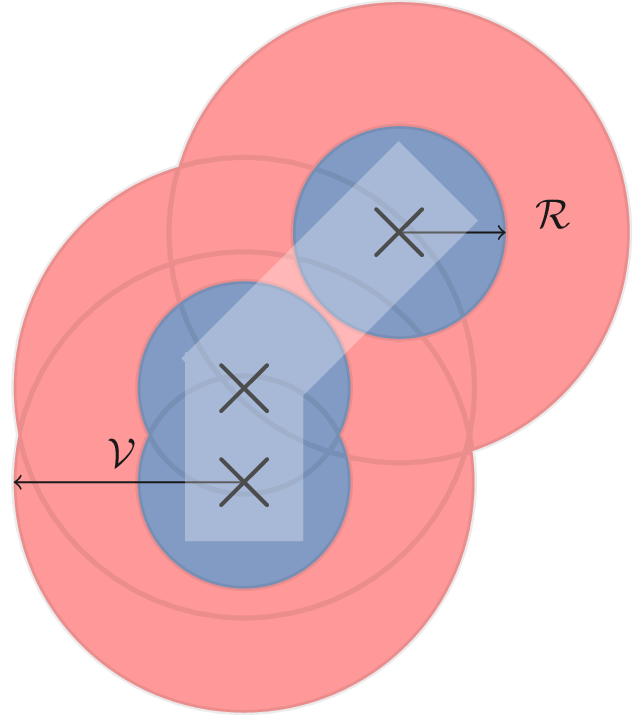
- Propose the Locally Interdependent Multi-Agent MDP model, where agents interact only within a radius $\mathcal{R}$ and communicate within a visibility radius $\mathcal{V}$, both dynamically changing over time.
- Define three closed-form policies: Amalgam, Cutoff, and First Step Finite Horizon Optimal, each designed to maximize expected cumulative reward under partial observability.
- Use a telescoping lemma and reward adjustment technique to bound the performance gap between the proposed policy and the optimal centralized policy.
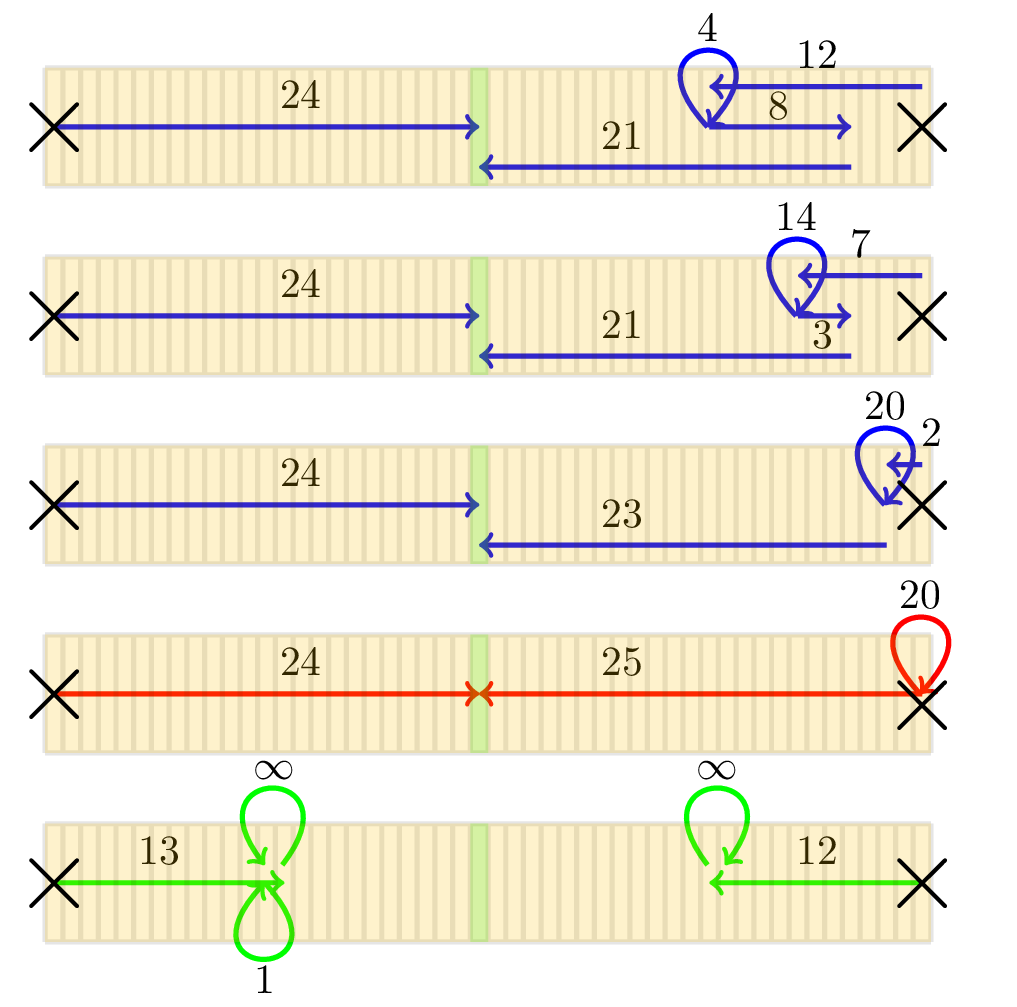
- Construct a deterministic lower-bound MDP with collision penalties to prove that no decentralized policy can outperform the derived upper bounds by more than a constant factor.
- Apply dynamic programming and value function decomposition to derive theoretical performance guarantees under partial observability.
- Extend the framework to improve scalability through policy modifications and validate long-horizon behaviors via simulations in obstacle avoidance, navigation, and formation control.
Experimental results
Research questions
- RQ1Can we theoretically model decentralized multi-agent systems with dynamically varying local dependencies and partial observability?
- RQ2Are there closed-form, scalable policies that achieve near-optimal performance in such decentralized, partially observable settings?
- RQ3How does the visibility radius affect the performance gap between decentralized and fully observable optimal policies?
- RQ4Can we establish theoretical performance bounds that are both tight and computationally tractable for decentralized multi-agent decision-making?
- RQ5How do the proposed policies behave over long horizons in practical multi-agent tasks like navigation and formation control?
Key findings
- The Amalgam, Cutoff, and First Step Finite Horizon Optimal policies achieve theoretical performance guarantees that are within a constant factor of the optimal centralized solution.
- The performance of the decentralized policy is exponentially close to the fully observable optimal policy, with the gap bounded by $\frac{2}{1-\gamma}\gamma^{c+1}\tilde{r}$, where $c = \lfloor(\mathcal{V} - \mathcal{R})/2\rfloor$.
- A lower bound construction proves that no decentralized policy can achieve better performance than the derived upper bounds by more than a constant factor, confirming near-optimality.
- The visibility radius $\mathcal{V}$ controls the exponential decay of the performance gap: larger visibility leads to significantly better decentralized performance.
- Simulations in obstacle avoidance, cooperative navigation, and formation control demonstrate stable, long-horizon behaviors consistent with theoretical expectations.
- Extensions to the policies improve scalability without sacrificing theoretical performance guarantees, enabling practical deployment in complex systems.
Better researchstarts right now
From reading papers to final review, dramatically reduce your research time.
No credit card · Free plan available
This review was created by AI and reviewed by human editors.