
[Paper Review] Low-rank quantics tensor train representations of Feynman diagrams for multiorbital electron-phonon models
This paper introduces a low-rank quantics tensor train (QTT) representation combined with Tensor Cross Interpolation (TCI) to efficiently compute Feynman diagrams in multiorbital electron-phonon models. It demonstrates exponential convergence of integration error with respect to computational cost and robustness to discontinuities and symmetry breaking, enabling high-resolution, sign-problem-free numerical integration of self-energy diagrams.
Feynman diagrams are an essential tool for simulating strongly correlated electron systems. However, stochastic quantum Monte Carlo sampling suffers from the sign problem, particularly when solving a multiorbital quantum impurity model. Recently, two approaches have been proposed for efficient numerical treatment of Feynman diagrams: Tensor Cross Interpolation (TCI) to replace stochastic sampling and the Quantics Tensor Train (QTT) representation for compressing space-time dependence. One of the remaining challenges is the nontrivial task of identifying low-rank structures in weak-coupling Feynman diagrams for multiorbital electron-phonon systems. In particular, the traditional TCI algorithm faces an ergodicity problem, which prevents it from fully exploring the multiorbital space. To address this, we incorporate a new algorithm called global search, which resolves this issue. By combining this approach with QTT, we uncover low-rank structures and achieve efficient numerical integration with exponential resolution in time and faster-than-power-law convergence of error relative to computational cost. Additionally, our approach does not require the division of discontinuous regions necessary in non-quantics TCI.
Motivation & Objective
- To investigate whether low-rank tensor train (TT) structures exist in self-energy Feynman diagrams for multiorbital electron-phonon systems.
- To assess the robustness of Tensor Cross Interpolation (TCI) for integrating complex integrands with both continuous and discrete degrees of freedom.
- To evaluate whether TCI can effectively handle phonon contributions, which often exacerbate the sign problem in quantum Monte Carlo (QMC) methods.
- To determine if the quantics tensor train (QTT) representation enables exponential convergence in error with respect to computational cost.
Proposed method
- Discretization of imaginary-time variables using the quantics tensor train (QTT) format to achieve exponential resolution in time.
- Embedding discrete degrees of freedom—such as spin-orbital indices and phonon vibrational modes—into the same tensor train as continuous time variables.
- Application of Tensor Cross Interpolation (TCI) to learn and integrate high-dimensional Feynman diagram integrands via low-rank TT approximations.
- Use of a hierarchical low-rank structure to compress the integrand and enable efficient numerical integration without domain partitioning.
- Evaluation of interpolation error and convergence rate as a function of bond dimension χ, with error normalized to the maximum function value.
- Validation of results through projection onto an IR basis, confirming expected decay of expansion coefficients.
Experimental results
Research questions
- RQ1Do low-rank tensor train (TT) structures exist in the integrands of self-energy Feynman diagrams for multiorbital electron-phonon models?
- RQ2Is TCI robust for interpolating integrands with mixed continuous and discrete degrees of freedom, including those with discontinuities?
- RQ3Can TCI effectively handle phonon contributions that worsen the sign problem in stochastic QMC simulations?
- RQ4Does the QTT representation enable exponential convergence of integration error with respect to computational cost?
Key findings
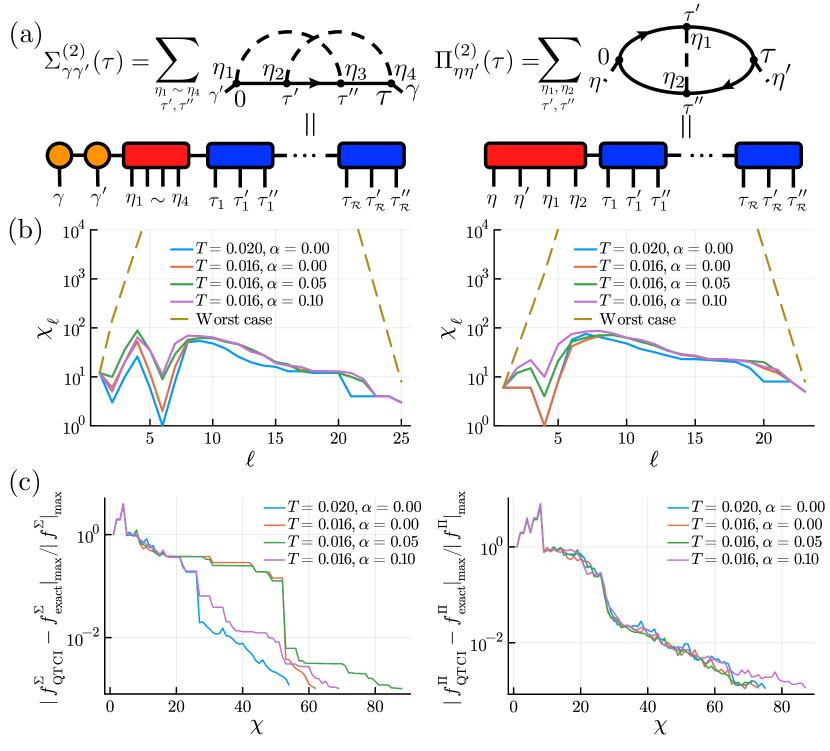
- The integrands for electron and phonon self-energies in second-order diagrams exhibit low-rank structures, with bond dimensions χ ≈ 35–55 for TCI tolerance ε = 10⁻³, significantly below the incompressible limit.
- Interpolation error decreases exponentially with increasing bond dimension χ, with convergence rates exceeding O(1/n_s^a) for a > 1/2, indicating superior performance over standard QMC sampling.
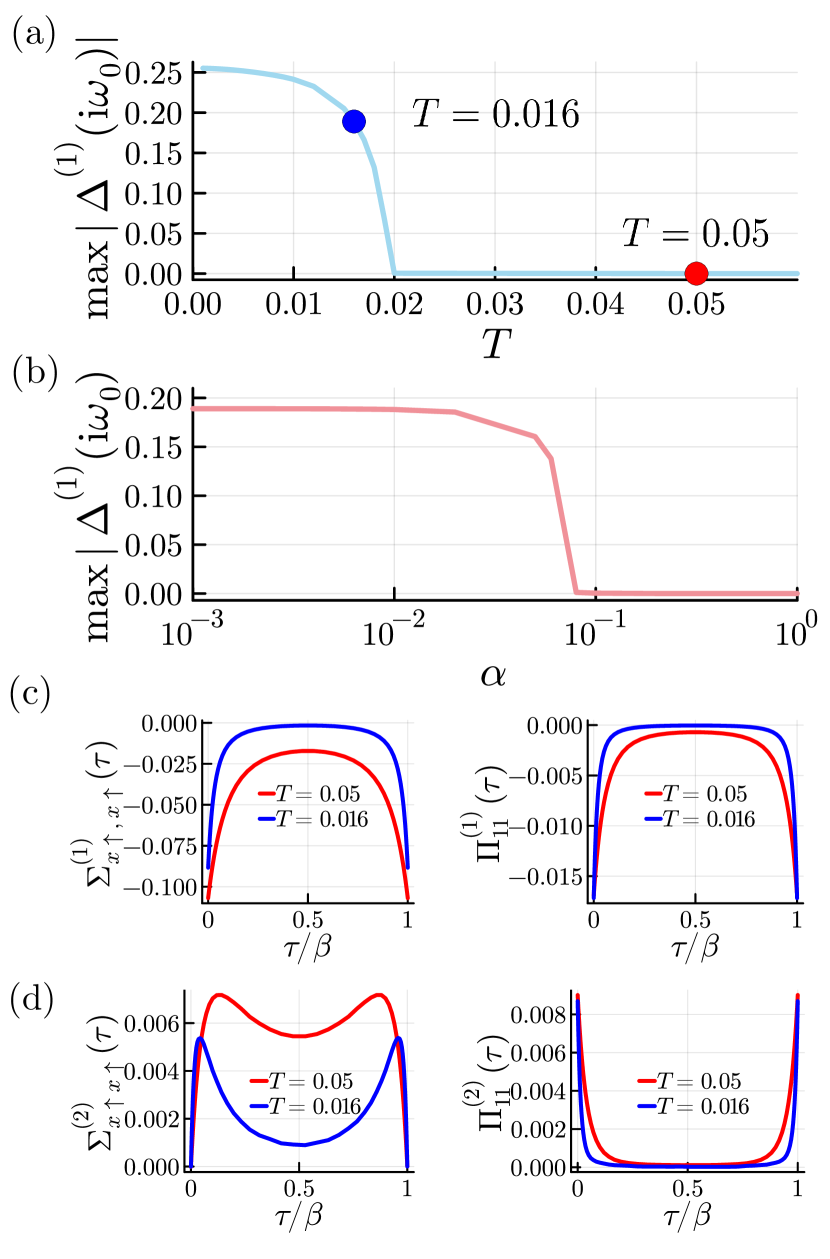
- The presence of a superconducting transition or external field (α) increases the required χ to reach ε = 10⁻² by roughly a factor of two, due to nonzero components in the self-energy.
- Even with discontinuities in the self-energy integrand, the QTT representation maintains compactness and enables exponential error decay, eliminating the need for domain partitioning.
- The reconstructed self-energy shows no discretization artifacts, and its τ dependence exhibits smooth, high-resolution behavior consistent with exponential resolution.
- The method successfully integrates both Σ⁽²⁾ and Π⁽²⁾ diagrams with amplitudes much smaller than Σ⁽¹⁾ and Π⁽¹⁾, validating the one-shot approximation at second order.
Better researchstarts right now
From reading papers to final review, dramatically reduce your research time.
No credit card · Free plan available
This review was created by AI and reviewed by human editors.