
[Paper Review] Low Regularity Exponential-Type Integrators for Semilinear Schrödinger Equations
This paper introduces a novel first-order exponential-type integrator for semilinear Schrödinger equations that achieves convergence in $H^r$ for solutions in $H^{r+1}$, requiring only one additional derivative of regularity—significantly lower than classical methods. The scheme uses a twisted variable formulation and exact integration of stiff terms via $\varphi_1$-functions, enabling optimal convergence even for low-regularity solutions.
We introduce low regularity exponential-type integrators for nonlinear Schrödinger equations for which first-order convergence only requires the boundedness of one additional derivative of the solution. More precisely, we will prove first-order convergence in H$^r$ for solutions in H$^r$$^+$$^1$ (r > d/2) of the derived schemes. This allows us lower regularity assumptions on the data than for instance required for classical splitting or exponential integration schemes. For one dimensional quadratic Schrödinger equations we can even prove first-order convergence without any loss of regularity. Numerical experiments underline the favorable error behavior of the newly introduced exponential-type integrators for low regularity solutions compared to classical splitting and exponential integration schemes.
Motivation & Objective
- To address the high regularity requirements of classical splitting and exponential integrators for semilinear Schrödinger equations.
- To develop a time integrator that maintains first-order convergence under minimal regularity assumptions on the solution.
- To reduce the smoothness requirement from two additional derivatives (as in classical schemes) to only one.
- To demonstrate superior convergence behavior for non-smooth and low-regularity solutions through numerical experiments.
- To extend the applicability of exponential integrators to problems with limited solution smoothness, particularly in low-regularity regimes.
Proposed method
- The method is based on Duhamel's formula applied to the twisted variable $v(t) = e^{-it\Delta}u(t)$, which decouples the stiff linear evolution from the nonlinear term.
- The dominant nonlinear term involving $\overline{u}^{2p}$ is treated exactly using the $\varphi_1$-function, defined as $\varphi_1(z) = (e^z - 1)/z$, to preserve structure and accuracy.
- The integrator is constructed as $u^{n+1} = e^{i\tau\Delta}\left[u^n - i\mu\tau (u^n)^{p+1} \varphi_1(-2i\tau\Delta)(\overline{u^n})^p\right]$, ensuring first-order convergence.
- The approach avoids approximating the integral in Duhamel's formula by directly solving the stiff part exactly, reducing local truncation error.
- The method is analyzed in $H^r$-norms for $r > d/2$, with convergence proven under $H^{r+1}$-regularity of the solution.
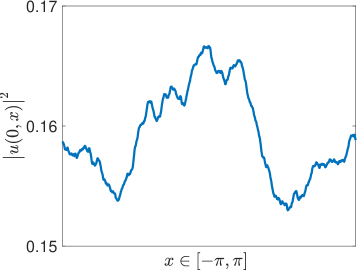
- Numerical validation is performed using smooth and non-smooth initial data, comparing with Lie splitting, Strang splitting, and classical exponential integrators.
Experimental results
Research questions
- RQ1Can a first-order exponential integrator be constructed for semilinear Schrödinger equations that requires only one additional derivative of regularity beyond the solution space $H^r$?
- RQ2Does the proposed integrator maintain first-order convergence for solutions with low regularity, particularly in cases where classical schemes suffer from order reduction?
- RQ3How does the new integrator compare in accuracy and convergence rate to classical splitting and exponential integrators for non-smooth or low-regularity initial data?
- RQ4Can the method achieve optimal convergence for non-integer powers $p$ in the nonlinearity $|u|^{2p}u$, especially when the nonlinearity is not smooth?
- RQ5Does the method remain stable and convergent under small nonlinearity, such as in quadratic Schrödinger equations?
Key findings
- The proposed exponential-type integrator achieves first-order convergence in $H^r$ for solutions in $H^{r+1}$, requiring only one additional derivative of regularity, unlike classical schemes that require two.
- For one-dimensional quadratic Schrödinger equations ($p=1$), the method achieves first-order convergence without any loss of regularity.
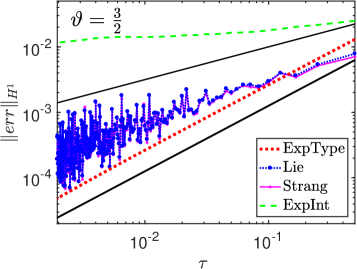
- In numerical experiments with non-smooth initial data, the classical exponential integrator fails to converge, and Lie/Strang splitting suffer from strong order reduction to order 1/2.
- The new integrator maintains first-order convergence for non-smooth solutions, as predicted by theory and confirmed by numerical results.
- For non-integer exponents $p$, the new integrator retains first-order convergence down to $p = 1/4$, while classical splitting schemes deteriorate significantly.
- In the case of small nonlinearity ($\mu = 0.01$), the new integrator remains highly accurate and first-order convergent for both smooth and non-smooth data, outperforming classical schemes.
Better researchstarts right now
From reading papers to final review, dramatically reduce your research time.
No credit card · Free plan available
This review was created by AI and reviewed by human editors.