
[Paper Review] $Λ_{ m s}$CDM model: A promising scenario for alleviation of cosmological tensions
The paper analyzes the $\Lambda_{\rm s}$CDM model, which introduces a sign-switching cosmological constant at redshift z_† ≈ 1.7–2, showing it can alleviate the H0, MB, and S8 tensions while fitting Planck, BAOtr, PantheonPlus, SH0ES, and KiDS-1000 data. It finds strong Bayesian evidence for this model over ΛCDM in most data combinations.
We present a comprehensive analysis of the $Λ_{ m s}$CDM model, which explores the recent conjecture suggesting a rapid transition of the Universe from anti-de Sitter vacua to de Sitter vacua (viz., the cosmological constant switches sign from negative to positive) at redshift ${z_\dagger\sim 2}$, inspired by the graduated dark energy (gDE) model. Our analysis shows that, predicting $z_\dagger\approx1.7$, $Λ_{ m s}$CDM simultaneously addresses the major cosmological tensions of the standard $Λ$CDM model, viz., the Hubble constant $H_0$, the Type Ia Supernovae absolute magnitude $M_{ m B}$, and the growth parameter $S_8$ tensions, along with other less significant tensions such as the BAO Lyman-$α$ discrepancy.
Motivation & Objective
- Motivate the need for an alternative to ΛCDM due to growing cosmological tensions (H0, MB, S8, etc.).
- Introduce and test a sign-switching cosmological constant model (ΛsCDM) with a late-time transition around z†~2.
- Evaluate the model against multiple data sets (Planck CMB, 2D BAO, PantheonPlus SNe, SH0ES, KiDS-1000) and compare to ΛCDM.
- Perform Bayesian model comparison to quantify the statistical support for ΛsCDM relative to ΛCDM.
Proposed method
- Phenomenological replacement of Λ by a sign-switching Λs with Λs ≡ Λs0 sgn[z†−z].
- Parameter space: baseline {ωb, ωc, θs, As, ns, τreio, z†} analyzed with CLASS+MontePython.
- Data combinations: Planck, Planck+BAOtr, Planck+BAOtr+PP, Planck+BAOtr+PP&SH0ES, Planck+BAOtr+PP&SH0ES+KiDS-1000.
- Use HMcode for nonlinear matter power spectrum with altered late-time H(z).
- Bayesian evidence computed via MCEvidence to compare ΛsCDM vs ΛCDM (Trotta’s Jeffreys scale).
Experimental results
Research questions
- RQ1Can a late-time sign-switching cosmological constant alleviate the H0, MB, and S8 tensions simultaneously?
- RQ2What redshift (z†) best reconciles Planck CMB constraints with low-z measurements when using 2D BAO data?
- RQ3Do PantheonPlus and SH0ES priors shift the preferred z† and H0 in ΛsCDM while remaining consistent with Ly-α and other BAO data?
- RQ4Is the ΛsCDM model statistically preferred over ΛCDM across multiple data combinations?
- RQ5Does ΛsCDM maintain standard pre-recombination physics and consistency with BBN, Ly-α, and age constraints?
Key findings
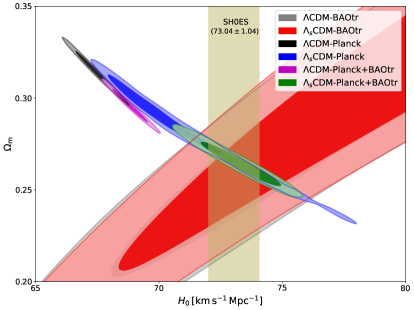
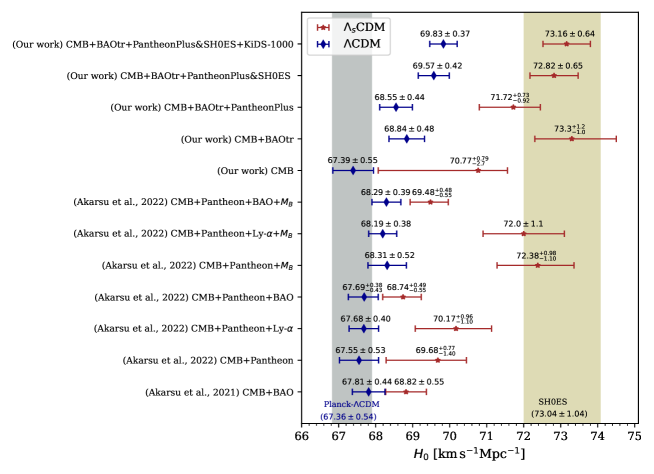
- With Planck+BAOtr, z† = 1.70^{+0.09}_{−0.19}, H0 = 73.3^{+1.2}_{−1.0} km/s/Mpc, aligning with SH0ES measurements.
- PantheonPlus data (with/without SH0ES prior) yields z† ≈ 1.87^{+0.13}_{−0.21}, H0 ≈ 71.7 km/s/Mpc, and MB consistent with SH0ES, resolving MB tension.
- ΛsCDM predicts S8 values that align Planck and KiDS-1000 (S8 ≈ 0.80–0.83 Planck vs ≈0.746 KiDS-1000), indicating no S8 tension in this model.
- For all data combinations including BAOtr, ΛsCDM provides a better fit than ΛCDM, with strong to very strong Bayesian evidence in most cases.
- The model leaves pre-recombination physics intact (drag redshift, sound horizon, Yp, ωb) and yields an age t0 ≈ 13.522 Gyr, consistent with independent estimates.
Better researchstarts right now
From reading papers to final review, dramatically reduce your research time.
No credit card · Free plan available
This review was created by AI and reviewed by human editors.