
[Paper Review] MACE-OFF: Transferable Short Range Machine Learning Force Fields for Organic Molecules
MACE-OFF23 is a transferable local machine learning force field for organic molecules, trained on high-level quantum data, and validated across gases, liquids, crystals, and biomolecules with high accuracy and efficiency.
Classical empirical force fields have dominated biomolecular simulation for over 50 years. Although widely used in drug discovery, crystal structure prediction, and biomolecular dynamics, they generally lack the accuracy and transferability required for first-principles predictive modeling. In this paper, we introduce MACE-OFF, a series of short range transferable force fields for organic molecules created using state-of-the-art machine learning technology and first-principles reference data computed with a high level of quantum mechanical theory. MACE-OFF demonstrates the remarkable capabilities of short range models by accurately predicting a wide variety of gas and condensed phase properties of molecular systems. It produces accurate, easy-to-converge dihedral torsion scans of unseen molecules, as well as reliable descriptions of molecular crystals and liquids, including quantum nuclear effects. We further demonstrate the capabilities of MACE-OFF by determining free energy surfaces in explicit solvent, as well as the folding dynamics of peptides.Finally, we simulate a fully solvated small protein, observing accurate secondary structure and vibrational spectrum. These developments enable first-principles simulations of molecular systems for the broader chemistry community at high accuracy and relatively low computational cost.
Motivation & Objective
- Develop a transferable, purely local ML force field for organic molecules covering H, C, N, O, F, P, S, Cl, Br, I.
- Train on high-level quantum data (omegaB97M-D3(BJ)/def2-TZVPPD) using the SPICE dataset and augment with larger fragments and water clusters.
- Demonstrate accurate predictions for intramolecular and intermolecular interactions across gases, liquids, crystals, and biopolymers.
- Showcase the model's ability to reproduce dihedral scans, lattice parameters, sublimation enthalpies, water structure, and peptide/protein related properties.
- Assess computational performance in common MD engines (LAMMPS, OpenMM) and scalability.
Proposed method
- Use the MACE architecture with two message-passing layers and equivariant features.
- Represent atomic environments with a local cutoff (4.5–5.0 Å) and construct an equivariant product basis up to body order 4.
- Train three model sizes (S, M, L) with 96/128/192 chemical channels and 0/1/2 equivariant messages.
- Train on SPICE data (10 elements, neutral species) augmented with larger fragments and water clusters; remove outliers with force error > 2 eV/Å.
- Predict energies and forces as a sum of read-out functions (layer 1: invariant, layer 2: MLP); forces from analytical energy derivatives.
- Evaluate on torsion scans (TorsionNet-500 and biaryl benchmarks), molecular crystals (vibrational spectra, sublimation enthalpies), water structure/dynamics (RDF, vibrational spectra with quantum nuclear effects), and condensed-phase liquids (densities, heats of vaporization).
Experimental results
Research questions
- RQ1Can MACE-OFF23 achieve chemical accuracy in energies/forces for a wide range of organic systems?
- RQ2How well do the local MACE-OFF23 models generalize to larger fragments and explicit solvent environments beyond training data?
- RQ3Do the models reproduce dihedral barriers and conformations accurately compared with DFT and higher-level quantum references?
- RQ4Can the models describe crystalline and liquid phase properties, including vibrational spectra and sublimation enthalpies, and handle quantum nuclear effects in water?
- RQ5What is the computational performance of MACE-OFF23 in MD simulations (speed and scalability)?
Key findings
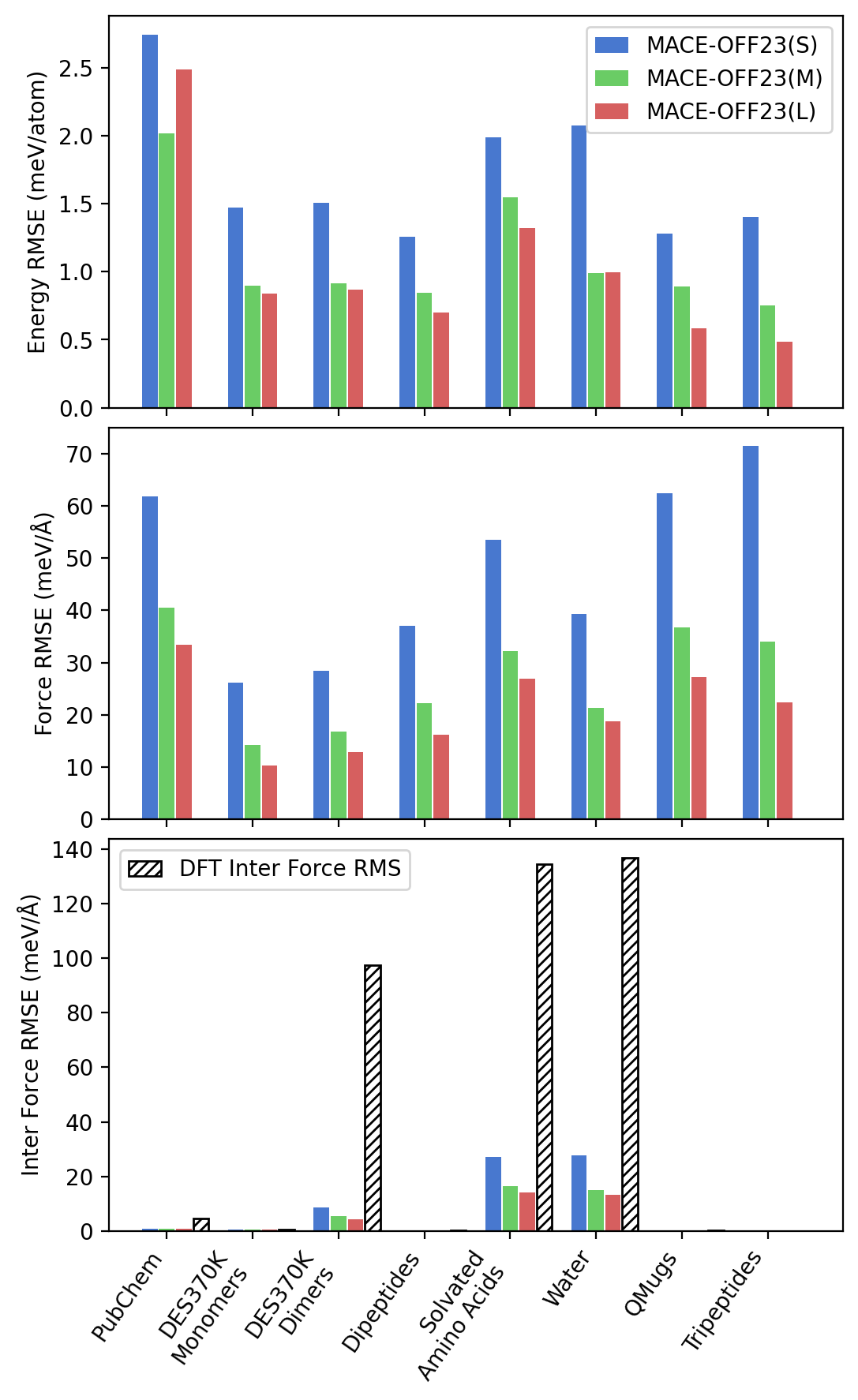
- Large MACE-OFF23 models reach ~0.5–1.0 meV/atom energy/force RMSE and ~15–20 meV/Å intermolecular forces, well below chemical accuracy for tested organics.
- Intermolecular force errors are ~5–15 meV/Å, about 1.5–3 times smaller than total force errors, with intramolecular errors around 1–2%.
- Dihedral barrier heights achieve ~0.3–0.5 kcal/mol errors on biaryl benchmarks and ~0.25 kcal/mol on TorsionNet-500 when compared at SPICE DFT level, approaching DFT reference accuracy.
- MACE-OFF23(S/M/L) reproduce water RDFs comparably to TIP3P/MB-pol and, when including quantum nuclear effects (PIGS), align with experimental Raman/IR features across frequencies.
- Large model MACE-OFF23 enables sublimation enthalpy predictions with mean error around 1.7 kcal/mol across 23 crystals, comparable to dispersion-corrected functionals.
- For liquids, densities show MAEs ~0.09 g/cm3 (M model) with reasonable vaporization predictions, and water/ether/dibromo cases are discussed with observed systematic trends and potential error cancellations.
![Figure 2: Dihedral benchmark scans. The top panel shows torsion drive data for the TorsionNet-500 dataset, which has a wide chemical diversity (five example molecules are shown). The bottom panel focuses on the torsion angle between two aromatic rings in the biaryl torsion benchmark [ 66 ] which con](https://ar5iv.labs.arxiv.org/html/2312.15211/assets/x1.png)
Better researchstarts right now
From reading papers to final review, dramatically reduce your research time.
No credit card · Free plan available
This review was created by AI and reviewed by human editors.