
[Paper Review] Machine-learning-accelerated simulations to enable automatic surface reconstruction
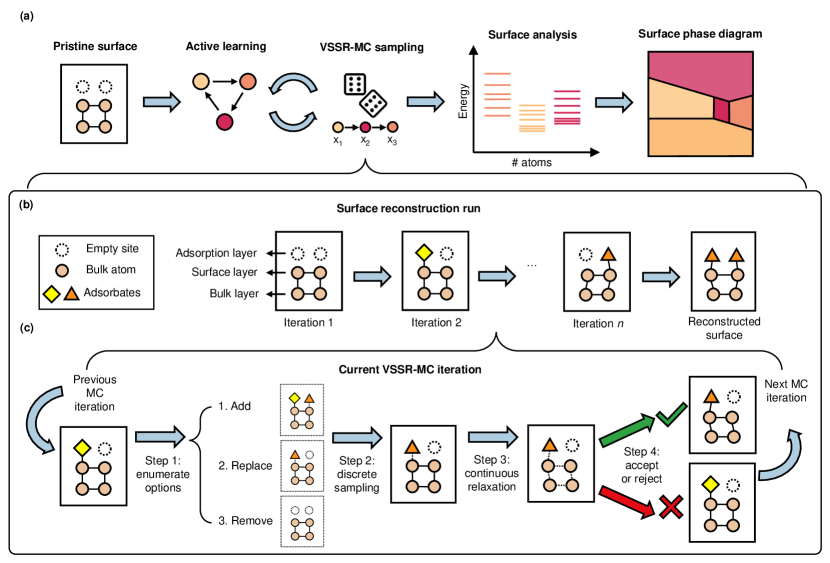
This paper presents a machine learning-accelerated computational framework that enables automatic surface reconstruction in multi-component materials by combining differentiable, data-efficient machine learning interatomic potentials with virtual surface site-enabled Markov-chain Monte Carlo sampling in the semi-grand canonical ensemble. The method predicts thermodynamically stable surface phases for GaN(0001), Si(111), and SrTiO3(001), including previously unreported terminations, with high accuracy and scalability.
Understanding material surfaces and interfaces is vital in applications like catalysis or electronics. By combining energies from electronic structure with statistical mechanics, ab initio simulations can in principle predict the structure of material surfaces as a function of thermodynamic variables. However, accurate energy simulations are prohibitive when coupled to the vast phase space that must be statistically sampled. Here, we present a bi-faceted computational loop to predict surface phase diagrams of multi-component materials that accelerates both the energy scoring and statistical sampling methods. Fast, scalable, and data-efficient machine learning interatomic potentials are trained on high-throughput density-functional theory calculations through closed-loop active learning. Markov-chain Monte Carlo sampling in the semi-grand canonical ensemble is enabled by using virtual surface sites. The predicted surfaces for GaN(0001), Si(111), and SrTiO3(001) are in agreement with past work and suggest that the proposed strategy can model complex material surfaces and discover previously unreported surface terminations.
Motivation & Objective
- To overcome the computational bottleneck of ab initio simulations in exploring vast surface phase spaces for multi-component materials.
- To enable accurate and efficient prediction of surface phase diagrams under varying thermodynamic conditions (temperature, chemical potentials, applied potential).
- To develop a self-directed simulation loop that automatically discovers stable surface terminations without relying on human-guided structural guesses.
- To integrate high-throughput DFT data with differentiable, data-efficient machine learning potentials to reduce computational cost while maintaining accuracy.
- To enable statistical sampling of complex surface compositions and configurations using virtual surface sites in the semi-grand canonical ensemble.
Proposed method
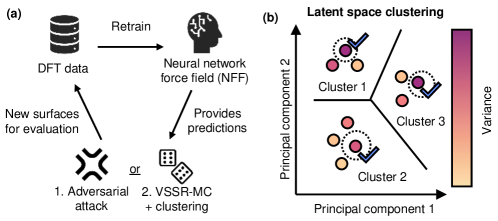
- Training fast, scalable, and data-efficient machine learning interatomic potentials via closed-loop active learning on high-throughput DFT calculations of surface structures.
- Implementing a virtual surface site (VSS) formalism to enable Markov-chain Monte Carlo (MCMC) sampling in the semi-grand canonical ensemble, allowing dynamic exchange of surface species.
- Using the semi-grand canonical ensemble to sample surface compositions and configurations under fixed chemical potentials, enabling free energy minimization.
- Defining the grand potential Ω_surf as the key thermodynamic quantity to evaluate surface stability, approximated as Ω_surf ≈ E_slab - N_Ti·g_bulk_SrTiO3 - Γ_Ti_Sr·μ'_Sr - Γ_Ti_O·μ'_O.
- Employing bulk-subtracted chemical potentials (μ'_Sr, μ'_O) to simplify phase diagram construction and enable direct comparison with experimental conditions.
- Transforming the surface free energy into a form suitable for MCMC sampling by expressing it in terms of excess surface species relative to bulk stoichiometry.
Experimental results
Research questions
- RQ1Can machine learning interatomic potentials trained via active learning accelerate the prediction of surface phase diagrams for complex multi-component materials?
- RQ2Can virtual surface sites enable efficient and accurate Markov-chain Monte Carlo sampling in the semi-grand canonical ensemble for surface composition and structure exploration?
- RQ3Does the proposed loop-based simulation framework automatically discover stable surface terminations without human input or prior assumptions about structure?
- RQ4To what extent can the method predict surface structures consistent with experimental and prior theoretical findings for materials like GaN(0001), Si(111), and SrTiO3(001)?
- RQ5Can the framework capture thermodynamic stability across varying chemical potentials and temperatures, including entropy effects, beyond static DFT structures?
Key findings
- The method successfully predicts surface phase diagrams for GaN(0001), Si(111), and SrTiO3(001) that are consistent with prior experimental and theoretical studies.
- The framework discovers previously unreported surface terminations in SrTiO3(001) and GaN(0001), demonstrating its ability to uncover non-intuitive, thermodynamically stable structures.
- The use of virtual surface sites enables efficient MCMC sampling in the semi-grand canonical ensemble, allowing dynamic variation of surface composition and structure.
- The machine learning potentials achieve high accuracy with minimal data through closed-loop active learning, reducing reliance on expensive DFT calculations.
- The framework enables free energy minimization by incorporating both enthalpic and entropic contributions through statistical sampling, overcoming limitations of static DFT-based approaches.
- The predicted surface phase diagrams are expressed in terms of bulk-subtracted chemical potentials (μ'_Sr, μ'_O), enabling direct comparison with experimental conditions such as O2 partial pressure and temperature.
Better researchstarts right now
From reading papers to final review, dramatically reduce your research time.
No credit card · Free plan available
This review was created by AI and reviewed by human editors.