
[Paper Review] Machine Learning Potentials for Heterogeneous Catalysis
This paper reviews machine learning potentials (MLPs) as a transformative tool for simulating heterogeneous catalysis with ab initio accuracy at a fraction of the computational cost of traditional methods. By enabling large-scale, long-timescale molecular dynamics simulations of complex catalytic interfaces—including dynamic effects, solvent interactions, and nuclear quantum effects—MLPs bridge the complexity, materials, and pressure gaps in catalysis research.
The sustainable production of many bulk chemicals relies on heterogeneous catalysis. The rational design or improvement of the required catalysts critically depends on insights into the underlying mechanisms at the atomic scale. In recent years, substantial progress has been made in applying advanced experimental techniques to complex catalytic reactions in operando, but in order to achieve a comprehensive understanding, additional information from computer simulations is indispensable in many cases. In particular, ab initio molecular dynamics (AIMD) has become an important tool to explicitly address the atomistic level structure, dynamics, and reactivity of interfacial systems, but the high computational costs limit applications to systems consisting of at most a few hundred atoms for simulation times of up to tens of picoseconds. Rapid advances in the development of modern machine learning potentials (MLP) now offer a new approach to bridge this gap, enabling simulations of complex catalytic reactions with ab initio accuracy at a small fraction of the computational costs. In this perspective, we provide an overview of the current state of the art of applying MLPs to systems relevant for heterogeneous catalysis along with a discussion of the prospects for the use of MLPs in catalysis science in the years to come.
Motivation & Objective
- Address the limitations of static DFT and classical force fields in modeling complex, dynamic catalytic interfaces with realistic length and time scales.
- Overcome the computational bottleneck of ab initio molecular dynamics (AIMD) by replacing high-cost quantum mechanical calculations with trained machine learning potentials.
- Enable simulations of heterogeneous catalytic systems with thousands of atoms over nanosecond timescales, capturing finite-temperature effects and dynamic surface processes.
- Integrate nuclear quantum effects (NQEs) into catalytic simulations using MLP-accelerated ring polymer molecular dynamics to improve accuracy in proton transfer and reaction kinetics.
- Advance the rational design of catalysts by providing atomistic insights into reaction mechanisms, solvent roles, defect effects, and surface reconstructions under operando-like conditions.
Proposed method
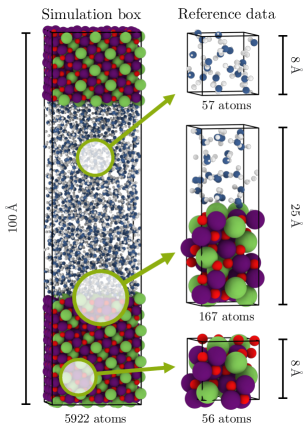
- Train machine learning potentials (MLPs) on high-accuracy ab initio data (e.g., DFT) to reproduce electronic structure energies and forces with quantum mechanical precision.
- Use symmetry-invariant graph neural networks (e.g., SchNet, PhysNet,ANI) to encode atomic environments and ensure invariance under rotation and translation.
- Apply active learning strategies to iteratively select the most informative configurations for training, improving data efficiency and model transferability.
- Integrate MLPs into path-integral molecular dynamics (PIMD) to account for nuclear quantum effects (NQEs), enabling simulations of proton transfer and zero-point motion.
- Validate MLPs across diverse conditions—different surfaces, adsorbates, solvents, and temperatures—to ensure robustness and transferability beyond training data.
- Combine MLP-driven simulations with enhanced sampling techniques to explore rare events and free energy landscapes in complex catalytic mechanisms.
Experimental results
Research questions
- RQ1How can machine learning potentials accurately model complex, reactive interfacial interactions in heterogeneous catalysis with ab initio accuracy and reduced computational cost?
- RQ2To what extent do MLPs improve the simulation of dynamic surface processes, such as surface reconstructions and defect-mediated reactions, compared to static DFT approaches?
- RQ3What is the impact of nuclear quantum effects (NQEs) on proton transfer and reaction barriers in catalytic systems, and how can MLPs enable their efficient inclusion in simulations?
- RQ4How do solvent effects—especially in solid-liquid interfaces—alter reaction mechanisms, and can MLPs capture these effects with sufficient accuracy and scalability?
- RQ5Can MLPs reliably predict catalytic activity and selectivity across diverse materials and reaction conditions, enabling high-throughput screening and rational catalyst design?
Key findings
- MLPs enable ab initio-level accuracy in simulations of catalytic systems with up to thousands of atoms and nanosecond-scale timescales, overcoming the limitations of conventional ab initio molecular dynamics.
- In simulations of proton hopping in zeolites, nuclear quantum effects (NQEs) computed via MLP-accelerated ring polymer molecular dynamics reduced activation barriers and increased hopping rates by a factor of 65 at 273 K.
- Even at 473 K, proton hopping rates in quantum simulations were 7 times higher than in classical simulations, demonstrating the critical role of NQEs in catalytic proton transfer.
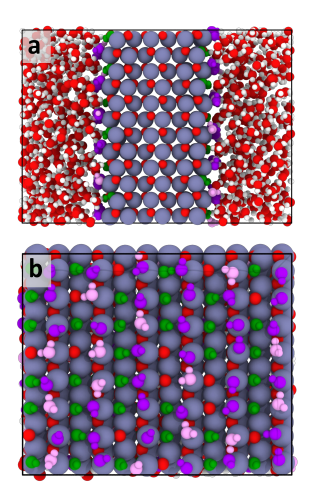
- MLPs successfully capture complex solvent-surface interactions, including interfacial water structure and reactivity, which are often neglected in static DFT models.
- The integration of MLPs with enhanced sampling and PIMD allows for the exploration of free energy landscapes and rare events in catalytic mechanisms with high accuracy and efficiency.
- Despite their advantages, MLPs require careful curation of training data, validation of transferability, and robustness testing across diverse chemical environments to ensure reliability in catalysis research.
Better researchstarts right now
From reading papers to final review, dramatically reduce your research time.
No credit card · Free plan available
This review was created by AI and reviewed by human editors.