
[Paper Review] MALADE: Orchestration of LLM-powered Agents with Retrieval Augmented Generation for Pharmacovigilance
MALADE is a multi-agent LLM system that uses Retrieval-Augmented Generation (RAG) and critic agents to extract and validate adverse drug event (ADE) associations from drug labels with high accuracy. It achieves an AUC of 0.90 against OMOP ground truth, demonstrating improved reliability through structured orchestration and evidence-based reasoning.
In the era of Large Language Models (LLMs), given their remarkable text understanding and generation abilities, there is an unprecedented opportunity to develop new, LLM-based methods for trustworthy medical knowledge synthesis, extraction and summarization. This paper focuses on the problem of Pharmacovigilance (PhV), where the significance and challenges lie in identifying Adverse Drug Events (ADEs) from diverse text sources, such as medical literature, clinical notes, and drug labels. Unfortunately, this task is hindered by factors including variations in the terminologies of drugs and outcomes, and ADE descriptions often being buried in large amounts of narrative text. We present MALADE, the first effective collaborative multi-agent system powered by LLM with Retrieval Augmented Generation for ADE extraction from drug label data. This technique involves augmenting a query to an LLM with relevant information extracted from text resources, and instructing the LLM to compose a response consistent with the augmented data. MALADE is a general LLM-agnostic architecture, and its unique capabilities are: (1) leveraging a variety of external sources, such as medical literature, drug labels, and FDA tools (e.g., OpenFDA drug information API), (2) extracting drug-outcome association in a structured format along with the strength of the association, and (3) providing explanations for established associations. Instantiated with GPT-4 Turbo or GPT-4o, and FDA drug label data, MALADE demonstrates its efficacy with an Area Under ROC Curve of 0.90 against the OMOP Ground Truth table of ADEs. Our implementation leverages the Langroid multi-agent LLM framework and can be found at https://github.com/jihyechoi77/malade.
Motivation & Objective
- Address the challenge of extracting accurate adverse drug event (ADE) associations from unstructured, heterogeneous medical text sources such as drug labels and clinical notes.
- Overcome limitations of standalone LLMs, including hallucination and lack of grounding in up-to-date medical data, by integrating retrieval-augmented generation (RAG).
- Improve reliability and consistency of ADE extraction through a collaborative multi-agent architecture with dedicated agents for drug identification, side effect gathering, and final summarization.
- Enhance trustworthiness by incorporating critic agents that validate and refine responses at each stage of the reasoning pipeline.
- Provide structured, explainable outputs with confidence scores for each ADE association, enabling transparent decision-making in pharmacovigilance.
Proposed method
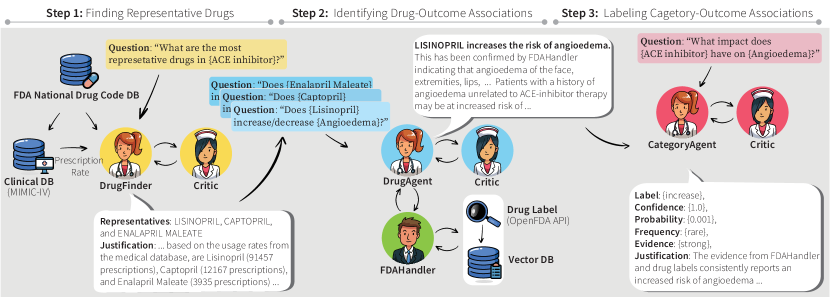
- Employ a multi-agent orchestration framework where specialized agents handle distinct sub-tasks: DrugFinder (drug category identification), DrugAgent (side effect extraction), and CategoryAgent (final ADE association synthesis).
- Integrate Retrieval-Augmented Generation (RAG) by retrieving relevant information from external sources such as FDA OpenFDA API, drug labels, and medical literature to ground LLM responses.
- Pair each agent with a dedicated critic agent that evaluates the reasoning and factual consistency of the response, enabling iterative refinement and error correction.
- Use GPT-4 Turbo or GPT-4o as the underlying LLMs, with prompts designed to ensure responses are grounded in retrieved evidence and logically justified.
- Apply a pipeline architecture where outputs from earlier agents are used as input for subsequent agents, with critic feedback enabling dynamic response revision.
- Implement confidence scoring for each ADE prediction (increase, decrease, no-effect), with statistical validation across ablated configurations to assess component contributions.
Experimental results
Research questions
- RQ1Can a multi-agent LLM system with RAG improve the accuracy and reliability of ADE extraction compared to standalone LLMs?
- RQ2How do critic agents contribute to reducing variance and improving confidence calibration in ADE predictions?
- RQ3To what extent does RAG enhance factual grounding and reduce hallucination in pharmacovigilance tasks?
- RQ4What is the relative impact of RAG versus critic components on the system's performance and confidence scores?
- RQ5How does the system perform across different ADE outcome categories (increase, decrease, no-effect) in terms of accuracy and confidence calibration?
Key findings
- MALADE achieves an Area Under the ROC Curve (AUC) of 0.90 when evaluated against the OMOP Ground Truth table for ADEs, demonstrating high performance in ADE extraction.
- The inclusion of both RAG and critic agents significantly improves reliability, with p-values < 0.05 indicating that critics enhance confidence calibration, especially for 'no-effect' cases.
- RAG alone reduces variance and improves performance compared to using critics alone, but the combination of both components yields the most robust and consistent results.
- The variance in outputs is primarily driven by the CategoryAgent, indicating that final summarization is the most sensitive stage in the pipeline.
- When RAG is absent, the system performs comparably or better than configurations with RAG alone, suggesting that RAG is essential for generalization and factual grounding.
- Paired t-tests show that confidence in 'no-effect' predictions is significantly higher when both RAG and critics are used, indicating improved reliability for negative associations.
![Figure 2: Example of how iteration among responder methods works when a task T has sub-tasks [T1, T2] and T1 has a sub-task T3.](https://ar5iv.labs.arxiv.org/html/2408.01869/assets/x2.png)
Better researchstarts right now
From reading papers to final review, dramatically reduce your research time.
No credit card · Free plan available
This review was created by AI and reviewed by human editors.