
[Paper Review] MAPE-PPI: Towards Effective and Efficient Protein-Protein Interaction Prediction via Microenvironment-Aware Protein Embedding
MAPE-PPI introduces a microenvironment-aware protein embedding via a learnable codebook and Masked Codebook Modeling to jointly encode sequence and structure for scalable PPI prediction, achieving superior efficiency and performance over state-of-the-art methods.
Protein-Protein Interactions (PPIs) are fundamental in various biological processes and play a key role in life activities. The growing demand and cost of experimental PPI assays require computational methods for efficient PPI prediction. While existing methods rely heavily on protein sequence for PPI prediction, it is the protein structure that is the key to determine the interactions. To take both protein modalities into account, we define the microenvironment of an amino acid residue by its sequence and structural contexts, which describe the surrounding chemical properties and geometric features. In addition, microenvironments defined in previous work are largely based on experimentally assayed physicochemical properties, for which the "vocabulary" is usually extremely small. This makes it difficult to cover the diversity and complexity of microenvironments. In this paper, we propose Microenvironment-Aware Protein Embedding for PPI prediction (MPAE-PPI), which encodes microenvironments into chemically meaningful discrete codes via a sufficiently large microenvironment "vocabulary" (i.e., codebook). Moreover, we propose a novel pre-training strategy, namely Masked Codebook Modeling (MCM), to capture the dependencies between different microenvironments by randomly masking the codebook and reconstructing the input. With the learned microenvironment codebook, we can reuse it as an off-the-shelf tool to efficiently and effectively encode proteins of different sizes and functions for large-scale PPI prediction. Extensive experiments show that MAPE-PPI can scale to PPI prediction with millions of PPIs with superior trade-offs between effectiveness and computational efficiency than the state-of-the-art competitors.
Motivation & Objective
- Motivate efficient and effective large-scale PPI prediction beyond sequence-only methods by incorporating protein structure.
- Introduce a microenvironment-based encoding with a large learnable codebook to capture residue contexts.
- Develop Masked Codebook Modeling (MCM) to pre-train the codebook by masking microenvironment codes.
- Integrate microenvironment embeddings with a graph-based PPI predictor to scale to millions of PPIs.
- Demonstrate superior efficiency and predictive accuracy compared to state-of-the-art baselines on multiple datasets.
Proposed method
- Define residue microenvironments from sequential and structural contexts.
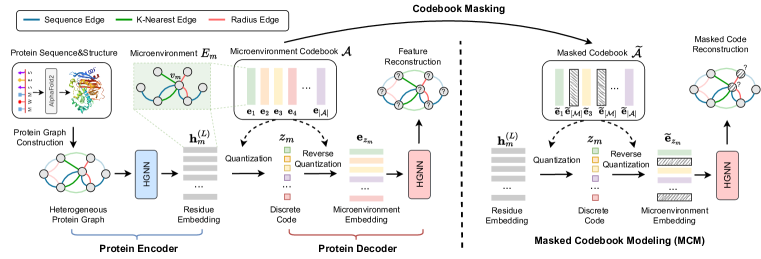
- Train a large microenvironment codebook via a VQ-VAE style objective (L_VQ) with reconstruction, codebook, and commitment losses.
- Introduce Masked Codebook Modeling (L_MCM) by masking codebook entries to capture dependencies among microenvironments.
- Encode proteins by mapping residue embeddings to discrete microenvironment codes, combining with encoder outputs to form protein representations.
- Use a Graph Isomorphism Network (GIN) over a PPI graph with learned protein embeddings to predict interaction types.
- Optimize with a joint pre-training objective L_Pre = L_VQ + eta * L_MCM, followed by supervised PPI prediction loss on labeled data.
Experimental results
Research questions
- RQ1Can a microenvironment-based, discrete codebook effectively capture residue contexts from both sequence and structure for PPI prediction?
- RQ2Does pre-training the microenvironment codebook improve downstream PPI prediction efficiency and accuracy on large-scale data?
- RQ3How does MAPE-PPI compare to sequence-based and structure-based baselines in terms of accuracy and scalability?
- RQ4Is the learned microenvironment codebook interpretable with respect to amino acid distributions and residue contexts?
- RQ5How robust is the model to variations in protein 3D structure quality and domain shift across datasets?
Key findings
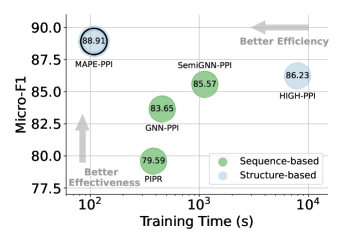
- MAPE-PPI achieves superior accuracy and efficiency compared to state-of-the-art baselines on SHS27k, SHS148k, and STRING datasets.
- Pre-training the microenvironment codebook on 42k unlabeled sequence-structure pairs from CATH 4.2 yields strong generalization without fine-tuning.
- MAPE-PPI outperforms both sequence-based and structure-based competitors under multiple data partitions, especially on challenging ES/NS subsets.
- The learned microenvironment codes form meaningful clusters that correspond to local residue environments and reflect realistic amino acid distributions.
- Pre-trained embeddings show stronger generalization under domain shifts and robustness to structural perturbations compared to HIGH-PPI and several baselines.
Better researchstarts right now
From reading papers to final review, dramatically reduce your research time.
No credit card · Free plan available
This review was created by AI and reviewed by human editors.