
[Paper Review] $\mathbf{\mathbb{E}^{FWI}}$: Multi-parameter Benchmark Datasets for Elastic Full Waveform Inversion of Geophysical Properties
This paper introduces $Ε^{FWI}$, an open-source benchmark dataset for elastic full waveform inversion (FWI) comprising eight diverse subsurface models with P- and S-wave velocities and multicomponent seismic data. It enables deep learning-based multiparameter inversion, demonstrating improved resilience to real-world complexity while highlighting challenges in convergence and computational cost due to coupled P- and S-wave physics.
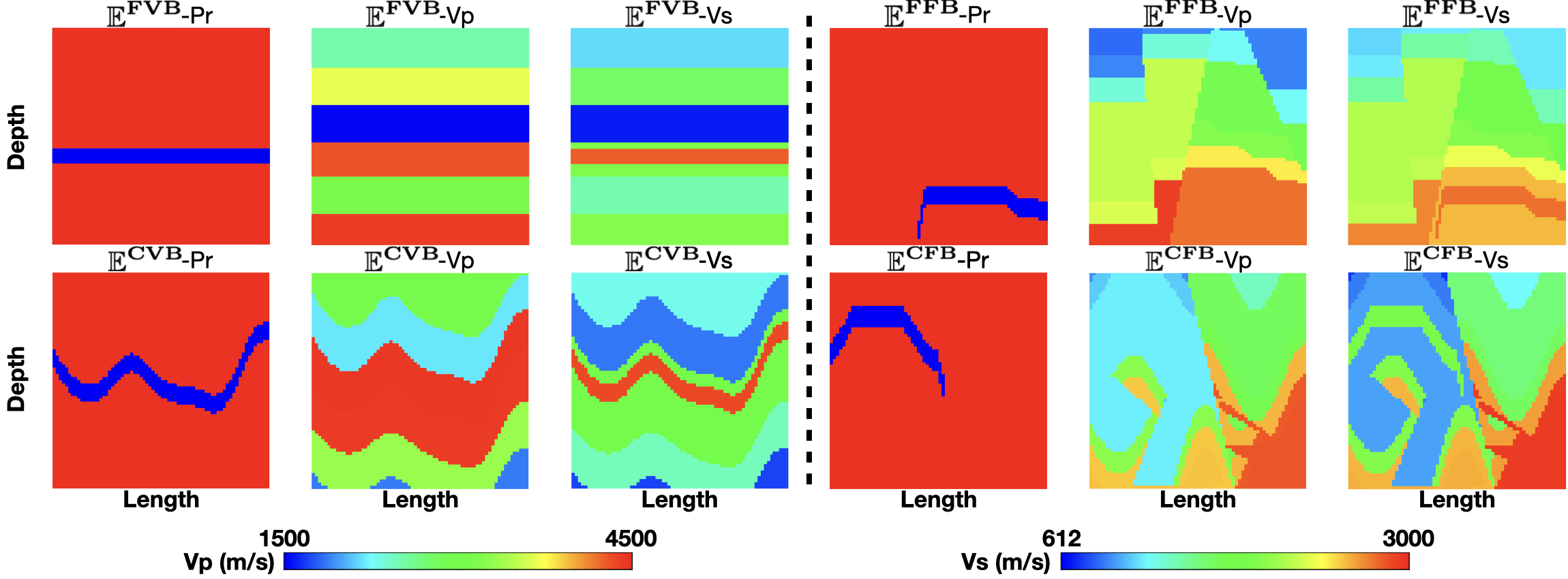
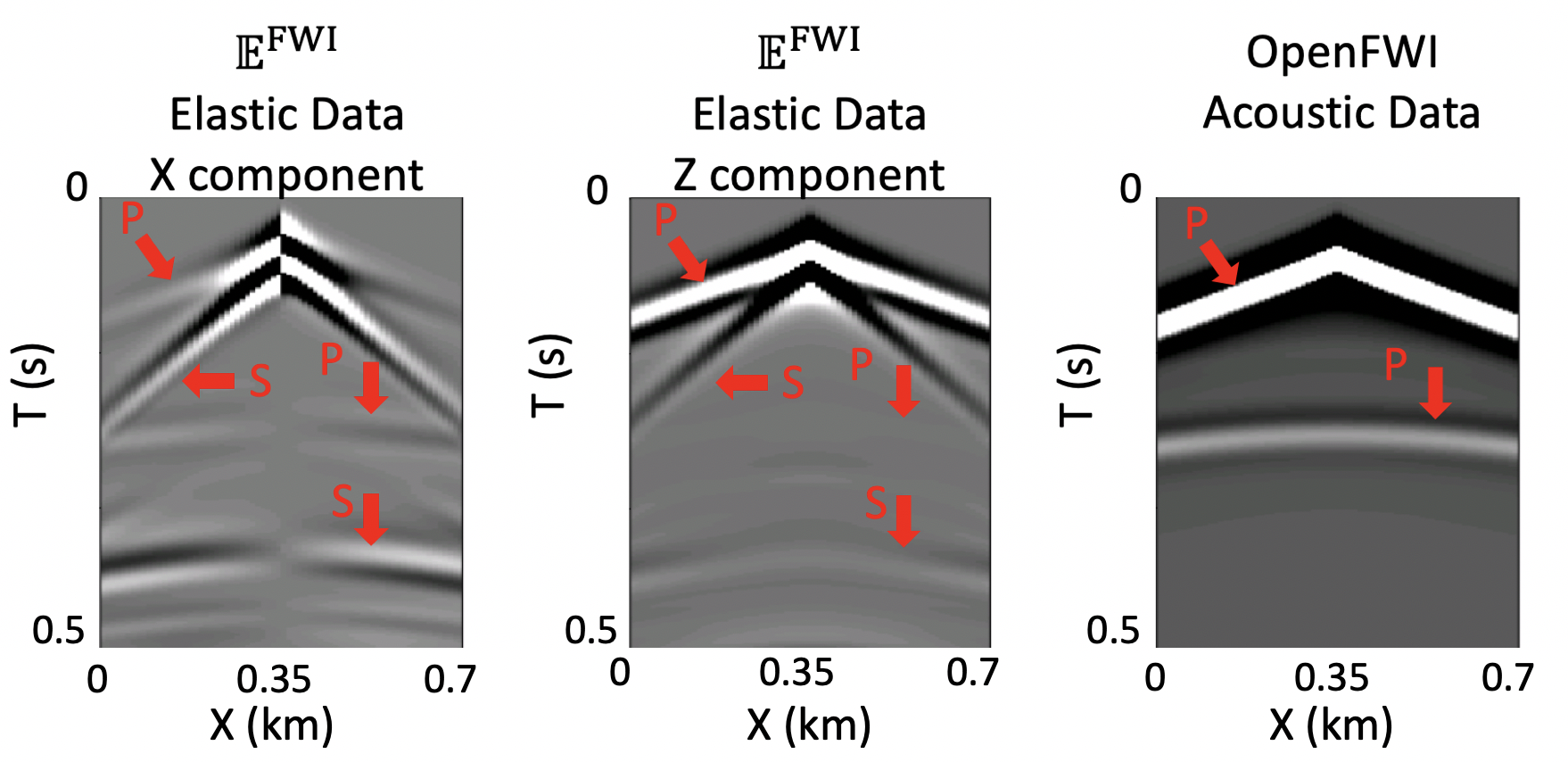
Elastic geophysical properties (such as P- and S-wave velocities) are of great importance to various subsurface applications like CO$_2$ sequestration and energy exploration (e.g., hydrogen and geothermal). Elastic full waveform inversion (FWI) is widely applied for characterizing reservoir properties. In this paper, we introduce $\mathbf{\mathbb{E}^{FWI}}$, a comprehensive benchmark dataset that is specifically designed for elastic FWI. $\mathbf{\mathbb{E}^{FWI}}$ encompasses 8 distinct datasets that cover diverse subsurface geologic structures (flat, curve, faults, etc). The benchmark results produced by three different deep learning methods are provided. In contrast to our previously presented dataset (pressure recordings) for acoustic FWI (referred to as OpenFWI), the seismic dataset in $\mathbf{\mathbb{E}^{FWI}}$ has both vertical and horizontal components. Moreover, the velocity maps in $\mathbf{\mathbb{E}^{FWI}}$ incorporate both P- and S-wave velocities. While the multicomponent data and the added S-wave velocity make the data more realistic, more challenges are introduced regarding the convergence and computational cost of the inversion. We conduct comprehensive numerical experiments to explore the relationship between P-wave and S-wave velocities in seismic data. The relation between P- and S-wave velocities provides crucial insights into the subsurface properties such as lithology, porosity, fluid content, etc. We anticipate that $\mathbf{\mathbb{E}^{FWI}}$ will facilitate future research on multiparameter inversions and stimulate endeavors in several critical research topics of carbon-zero and new energy exploration. All datasets, codes and relevant information can be accessed through our website at https://efwi-lanl.github.io/
Motivation & Objective
- To address the lack of standardized, realistic benchmark datasets for multiparameter elastic FWI that include both P- and S-wave velocities and multicomponent seismic data.
- To support the development and evaluation of deep learning methods for elastic FWI by providing diverse subsurface geologic structures (e.g., faults, curved layers).
- To investigate the coupling between P- and S-wave velocities and its impact on inversion accuracy and convergence.
- To facilitate research in carbon-zero energy applications, including geothermal energy and carbon capture and storage, by enabling high-fidelity subsurface characterization.
Proposed method
- The dataset includes eight synthetic seismic datasets with varying geologic structures, such as flat layers, curved interfaces, and faulted formations.
- Each dataset features full elastic wavefield simulations using both P- and S-wave velocities, with synthetic seismic data recorded on both vertical and horizontal components.
- The benchmark includes forward modeling results using elastic wave equations, with a focus on minimizing numerical dispersion through fine grid spacing and accurate time-domain solvers.
- Three deep learning models are evaluated on the dataset to establish baseline performance for multiparameter inversion of P- and S-wave velocities.
- The dataset provides Poisson’s ratio and Young’s modulus maps derived from P- and S-wave velocity pairs to support lithology and fluid content analysis.
- All data and code will be released via a public website upon approval by Los Alamos National Laboratory and the U.S. Department of Energy.
Experimental results
Research questions
- RQ1How does the inclusion of both P- and S-wave velocities in seismic data affect the convergence and accuracy of elastic FWI using deep learning methods?
- RQ2What is the impact of multicomponent (vertical and horizontal) seismic data on the inversion of subsurface elastic parameters compared to single-component data?
- RQ3How do different geologic structures—such as faults and curved layers—affect the performance of multiparameter FWI models trained on $Ε^{FWI}$?
- RQ4To what extent can deep learning models trained on $Ε^{FWI}$ generalize to real-world field data, given the dataset’s complexity and physical realism?
- RQ5What are the key challenges in elastic FWI related to velocity trade-offs and nonlinearity, and how can they be mitigated through network design?
Key findings
- The $Ε^{FWI}$ benchmark demonstrates that deep learning models trained on the dataset exhibit improved robustness in handling complex, realistic elastic wavefield data with both P- and S-wave components.
- P- and S-wave velocity coupling significantly increases the nonlinearity of the inversion problem, leading to slower convergence and higher computational costs compared to acoustic FWI.
- The inclusion of horizontal component data improves the resolution and accuracy of subsurface velocity model reconstruction, especially in faulted and complex structures.
- Benchmark results show that while some models achieve high-fidelity inversion on simpler structures, performance degrades on highly heterogeneous or anisotropic models, indicating a need for improved network architectures.
- The dataset enables the derivation of Poisson’s ratio and Young’s modulus from P- and S-wave velocities, providing critical insights into lithology, porosity, and fluid content.
- The study identifies that current deep learning models still struggle with trade-offs between P- and S-wave velocities, suggesting that future work should focus on decoupling strategies and physics-informed regularization.
Better researchstarts right now
From reading papers to final review, dramatically reduce your research time.
No credit card · Free plan available
This review was created by AI and reviewed by human editors.