
[Paper Review] Maximum information states for coherent scattering measurements
Introduces maximum information states for coherent scattering measurements; shows these states are eigenstates of the Fisher information operator derived from the system’s scattering matrix and demonstrates order-of-magnitude precision improvements in disordered media.
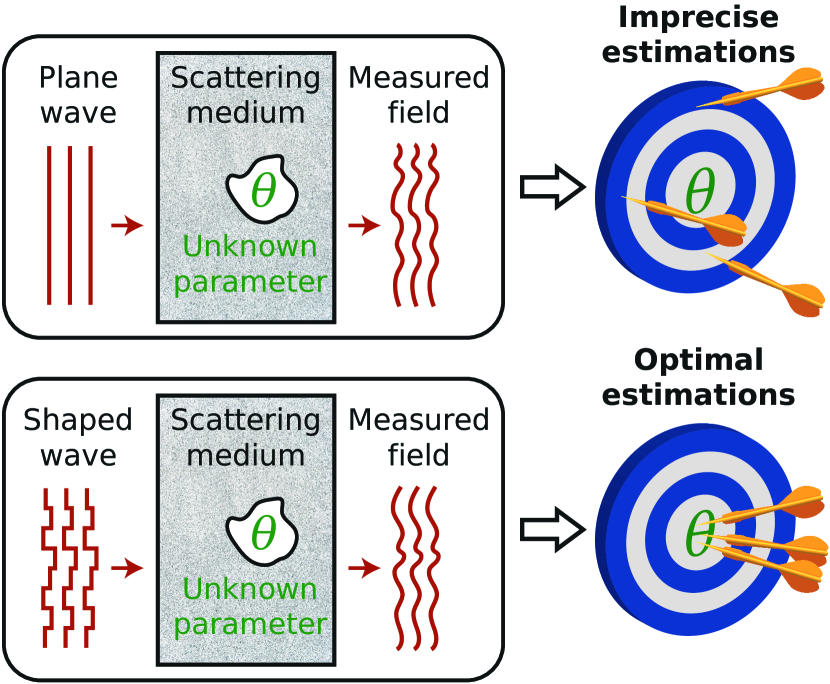
The use of coherent light for precision measurements has been a key driving force for numerous research directions, ranging from biomedical optics to semiconductor manufacturing. Recent work demonstrates that the precision of such measurements can be significantly improved by tailoring the spatial profile of light fields used for estimating an observable system parameter. These advances naturally raise the intriguing question of which states of light can provide the ultimate measurement precision. Here, we introduce a general approach to determine the optimal coherent states of light for estimating any given parameter, regardless of the complexity of the system. Our analysis reveals that the light fields delivering the ultimate measurement precision are eigenstates of a Hermitian operator which quantifies the Fisher information based on the system's scattering matrix. To illustrate this concept, we experimentally show that these maximum information states can probe the phase or the position of an object that is hidden by a disordered medium with a precision improved by an order of magnitude as compared to unoptimized states. Our results enable optimally precise measurements in arbitrarily complex systems, thus establishing a new benchmark for metrology and imaging applications.
Motivation & Objective
- Motivate the need to maximize measurement precision in coherent light scattering through complex media.
- Develop a general framework that links Fisher information to the system's scattering matrix to identify optimal light states.
- Demonstrate experimentally that maximum information states outperform plane waves in estimating local observables behind disorder.
- Show robustness of the approach and connect to broader metrology and imaging applications.
Proposed method
- Define the Fisher information for a parameter theta in a coherent-state scattering setup with input |E^{in}> and output |E^{out}> linked by S.
- Introduce the Fisher information operator F_theta = (∂_theta S)† (∂_theta S) and prove the optimal input is its largest-eigenvalue eigenstate.
- Relate the quantum Fisher information to the specific homodyne detection scheme used, showing I(theta) = J(theta) under the experiment.
- Compute the derivative ∂_theta r of the measured reflection matrix with respect to theta to construct the optimal input.
- Experimentally measure reflection matrices and their derivatives to build maximum information states for phase and position observables behind a diffuser.
- Demonstrate the link to the Wigner-Smith operator and discuss the unitary S-matrix limit where F_theta = Q_theta^2.
Experimental results
Research questions
- RQ1What is the optimal incident light state that maximizes Fisher information for a given parameter in a complex scattering medium?
- RQ2How can the Fisher information be expressed in terms of the system’s scattering matrix and used to design maximum information states?
- RQ3Do maximum information states provide measurable improvements in estimating hidden parameters behind disorder, compared to plane waves?
- RQ4How does the observer’s position and the observable of interest affect the structure of maximum information states?
- RQ5What is the connection between maximum information states and existing concepts like the Wigner-Smith operator and measurement backaction?
Key findings
- Maximum information states are eigenstates of the Hermitian Fisher information operator F_theta = (∂_theta S)†(∂_theta S).
- The optimal incident state maximizes the Fisher information (largest eigenvalue of F_theta) for a given number of incident photons.
- Experimentally, maximum information states deliver substantial enhancements in Fisher information (e.g., 300-fold on average) and intensity (20-fold) over plane-wave illumination.
- Maximum information states adapt to the observer’s field of view and to the observable of interest, concentrating information where it matters for the measurement.
- In the unitary S-matrix limit, F_theta = Q_theta^2, linking maximum information states to principal modes and measurement backaction concepts.

Better researchstarts right now
From reading papers to final review, dramatically reduce your research time.
No credit card · Free plan available
This review was created by AI and reviewed by human editors.