
[Paper Review] Measurement-efficient quantum Krylov subspace diagonalisation
This paper proposes a measurement-efficient quantum Krylov subspace diagonalization algorithm that minimizes statistical errors by expressing Hamiltonian-power-Gaussian functions as integrals of real-time evolution, enabling exponential error suppression. It reduces measurement costs by 10⁴ to 10¹² times compared to existing methods, particularly through efficient projector construction for ground-state projection.
The Krylov subspace methods, being one category of the most important classical numerical methods for linear algebra problems, can be much more powerful when generalised to quantum computing. However, quantum Krylov subspace algorithms are prone to errors due to inevitable statistical fluctuations in quantum measurements. To address this problem, we develop a general theoretical framework to analyse the statistical error and measurement cost. Based on the framework, we propose a quantum algorithm to construct the Hamiltonian-power Krylov subspace that can minimise the measurement cost. In our algorithm, the product of power and Gaussian functions of the Hamiltonian is expressed as an integral of the real-time evolution, such that it can be evaluated on a quantum computer. We compare our algorithm with other established quantum Krylov subspace algorithms in solving two prominent examples. To achieve an error comparable to that of the classical Lanczos algorithm at the same subspace dimension, our algorithm typically requires orders of magnitude fewer measurements than others. Such an improvement can be attributed to the reduced cost of composing projectors onto the ground state. These results show that our algorithm is exceptionally robust to statistical fluctuations and promising for practical applications.
Motivation & Objective
- Address the high measurement cost in quantum Krylov subspace diagonalization (KSD) due to statistical fluctuations.
- Develop a general theoretical framework to analyze statistical error and measurement cost in quantum KSD algorithms.
- Minimize measurement overhead in constructing the Hamiltonian-power Krylov subspace for ground-state energy estimation.
- Enable robust, practical quantum simulation by reducing sensitivity to statistical noise in near-term quantum devices.
Proposed method
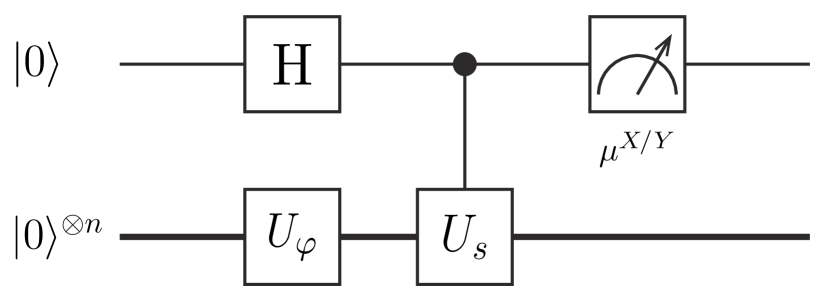
- Express the product of Hamiltonian powers and a Gaussian function as an integral over real-time evolution operators, enabling quantum evaluation via time-evolution circuits.
- Utilize Chebyshev polynomials to construct projectors that isolate the ground state while suppressing excited states within the interval [-1, 1].
- Expand the Chebyshev projector as a linear combination of Hamiltonian powers (H - E₀)^(k-1), enabling efficient quantum circuit implementation.
- Derive an upper bound on the coefficients of the polynomial expansion to control the overhead and ensure measurement efficiency.
- Apply the framework to benchmark models (anti-ferromagnetic Heisenberg and Hubbard models) across various lattices to compare measurement costs.
- Use spectral decomposition and properties of Chebyshev polynomials to ensure exponential suppression of excited-state contributions with increasing polynomial order.
![Figure 1: Empirical distribution of the measurement overhead $\gamma$ for algorithms listed in Table 1 . In the Gaussian-power algorithm, we take a random $E_{0}$ in the interval $[E_{g}-0.1\|H\|_{2},E_{g}+0.1\|H\|_{2}]$ , i.e. we assume that we have a preliminary estimation of the ground-state ener](https://ar5iv.labs.arxiv.org/html/2301.13353/assets/x1.png)
Experimental results
Research questions
- RQ1How can statistical error in quantum Krylov subspace diagonalization be rigorously bounded and minimized under realistic measurement constraints?
- RQ2What is the theoretical upper bound on the number of measurements required for a given accuracy in quantum KSD algorithms?
- RQ3Can real-time evolution integrals be used to efficiently construct Hamiltonian-power Krylov subspaces with reduced measurement cost?
- RQ4How does the measurement cost of the proposed algorithm compare to existing quantum KSD methods across representative quantum many-body models?
- RQ5To what extent can Chebyshev polynomial-based projectors reduce the effective measurement overhead in ground-state energy estimation?
Key findings
- The proposed algorithm reduces measurement cost by 10⁴ to 10¹² times compared to existing quantum Krylov subspace diagonalization methods.
- Statistical error decreases exponentially with polynomial order due to the exponential suppression of excited-state contributions via Chebyshev polynomials.
- The framework provides a general upper bound on measurement number applicable to all quantum KSD algorithms, enabling systematic cost comparison.
- The algorithm’s robustness to statistical fluctuations stems from the efficient construction of projectors onto the ground state using time-evolution integrals.
- Benchmarking on the anti-ferromagnetic Heisenberg and Hubbard models confirms the method’s scalability and superiority across various lattice sizes.
- The overhead factor γ in the polynomial expansion is bounded by a geometric series, ensuring controllable resource scaling with system size.
Better researchstarts right now
From reading papers to final review, dramatically reduce your research time.
No credit card · Free plan available
This review was created by AI and reviewed by human editors.