
[Paper Review] Measuring the Variance of the Macquart Relation in z-DM Modeling
The paper introduces a forward-modeling approach that treats the fluctuation parameter F of the DM variance in the z-DM Macquart relation as a free parameter, fits it with FRB data, and forecasts improvements with synthetic localized FRB samples, while exploring degeneracies with H0.
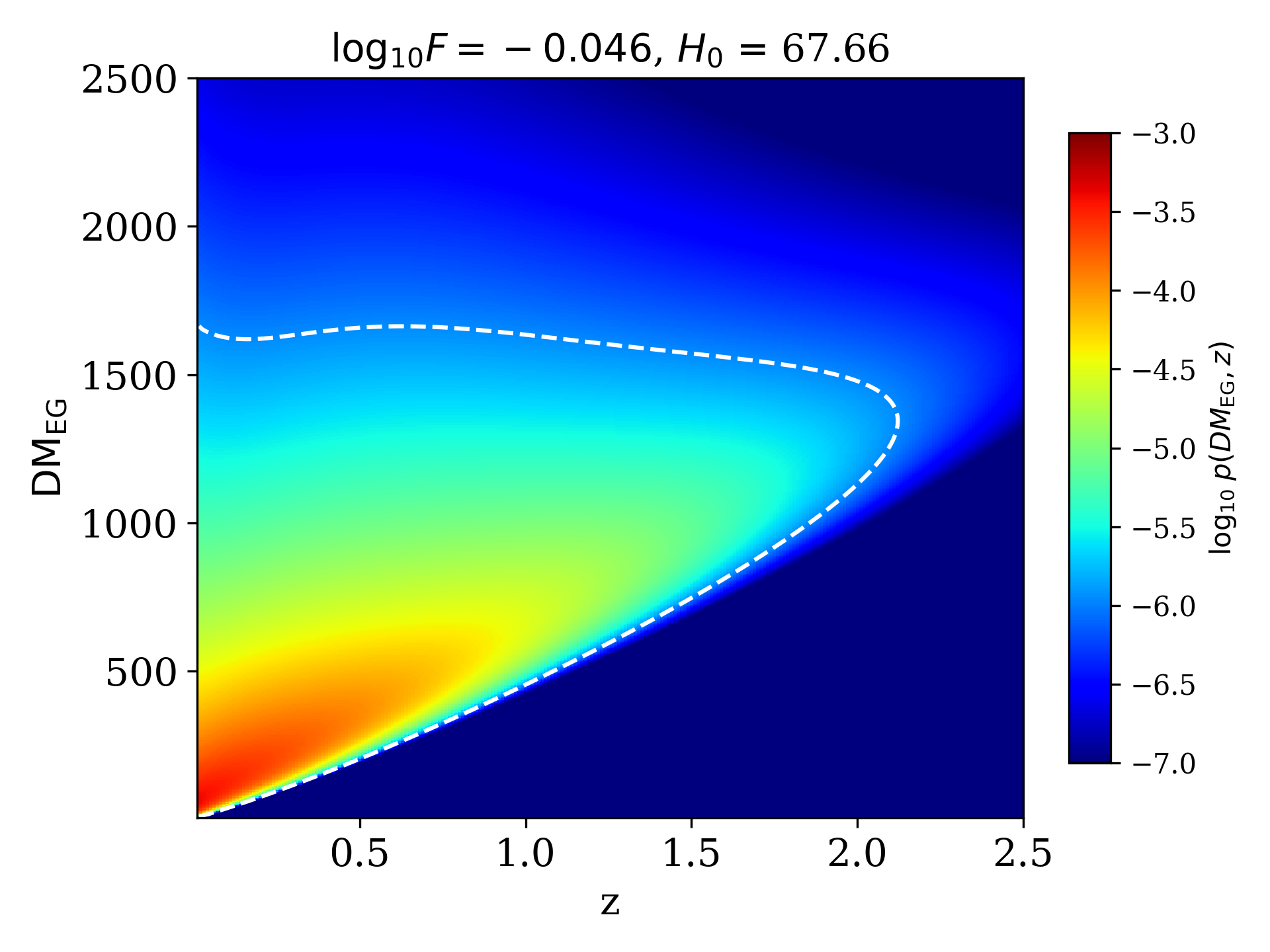
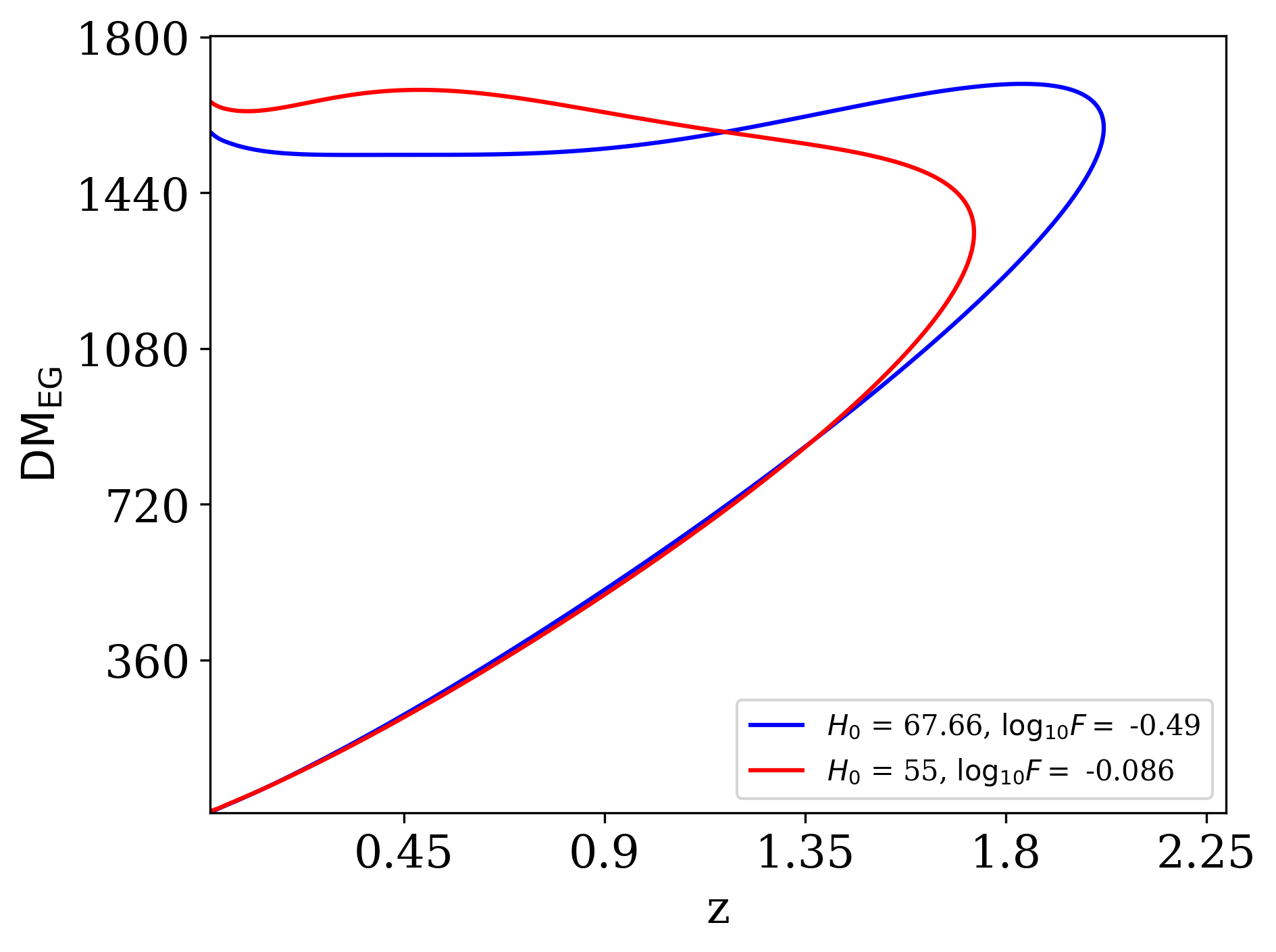
The Macquart relation describes the correlation between the dispersion measure (DM) of fast radio bursts (FRBs) and the redshift $z$ of their host galaxies. The scatter of the Macquart relation is sensitive to the distribution of baryons in the intergalactic medium (IGM) including those ejected from galactic halos through feedback processes. The width of the distribution in DMs from the cosmic web (${ m DM}_{ m cosmic}$) is parameterized by a fluctuation parameter $F$, which is related to the cosmic DM variance by $σ_{ m DM}= F z^{-0.5}$. In this work, we present a new measurement of $F$ using 78 FRBs of which 21 have been localized to host galaxies. Our analysis simultaneously fits for the Hubble constant $H_0$ and the DM distribution due to the FRB host galaxy. We find that the fluctuation parameter is degenerate with these parameters, most notably $H_0$, and use a uniform prior on $H_0$ to measure $\log_{10} F > -0.89$ at the $3σ$ confidence interval and a new constraint on the Hubble constant $H_0 = 85.3_{-8.1}^{+9.4} \, { m km \, s^{-1} \, Mpc^{-1}}$. Using a synthetic sample of 100 localized FRBs, the constraint on the fluctuation parameter is improved by a factor of $\sim 2$. Comparing our $F$ measurement to simulated predictions from cosmological simulation (IllustrisTNG), we find agreement between $0.4 < z < 2$. However, at $z < 0.4$, the simulations underpredict $F$ which we attribute to the rapidly changing extragalactic DM excess distribution at low redshift.
Motivation & Objective
- Motivate constraints on the distribution of baryons in the intergalactic medium via the Macquart z-DM relation and FRB dispersion measures.
- Introduce a fluctuation parameter F to quantify DM variance from the cosmic web and halos in the IGM.
- Simultaneously fit FRB extragalactic DM components and H0 to FRB data to measure F.
- Assess degeneracies between F and H0 and with host-galaxy DM parameters.
- Forecast how larger, localized FRB samples improve constraints on F.
Proposed method
- Adopt the z-DM modeling framework (zdm) to decompose DM_FRB into DM_ISM, DM_halo, and DM_EG.
- Model DM_EG as DM_cosmic + DM_host, with DM_cosmic variance described by a non-Gaussian distribution p_cosmic(Δ) and a fluctuation parameter F with σ_DM ∝ F z^-0.5.
- Represent host DM as a log-normal distribution with mean μ_host and scatter σ_host as free parameters.
- Perform a brute-force grid search to obtain parameter likelihoods over a defined parameter space, incorporating redshift-localized FRBs to constrain F and H0.
- Explore degeneracies, notably between F and H0, by applying priors on H0 (uniform between Planck and SNe values) and by analyzing 1D/2D likelihoods.
- Forecast constraints on F using a synthetic sample of 100 localized FRBs to study improvements in F and H0 precision.
Experimental results
Research questions
- RQ1What is the fluctuation parameter F describing the DM variance from the cosmic web and halos, and how can FRB data constrain it?
- RQ2How degenerate is F with the Hubble constant H0 and host DM parameters in the z-DM EG model?
- RQ3How does incorporating redshift information (localized FRBs) improve constraints on F and H0?
- RQ4What is the impact of including priors on H0 on the measurement of F?
- RQ5How does a synthetic sample of localized FRBs improve bounds on F compared to current data?
Key findings
- From 78 FRBs (21 with redshifts), the fluctuation parameter is constrained to log10 F > -0.89 at 3σ, i.e., a lower limit.
- Allowing F to vary degrades H0 constraints, yielding H0 = 85.3(-8.1,+9.4) km/s/Mpc without H0 priors.
- With a uniform H0 prior, log10 F = -0.48^{+0.26}_{-0.18} (1σ) and log10 F > -0.89 (3σ).
- A synthetic sample of 100 localized FRBs improves F constraints and yields tighter H0 constraints (e.g., H0 ≈ 67.6^{+3.5}_{-3.4} km/s/Mpc with priors).
- Comparisons to IllustrisTNG show agreement for 0.4 < z < 2, while at z < 0.4 simulations overpredict F due to low-z DM_IGM behavior.
Better researchstarts right now
From reading papers to final review, dramatically reduce your research time.
No credit card · Free plan available
This review was created by AI and reviewed by human editors.