
[Paper Review] Mental-LLM: Leveraging Large Language Models for Mental Health Prediction via Online Text Data
The paper evaluates multiple instruction-tuned LLMs across zero-shot, few-shot, and instruction-finetuning setups for mental health prediction tasks using online text data, finding that instruction finetuning substantially boosts performance and that Mental-Alpaca and Mental-FLAN-T5 reach state-of-the-art-like capabilities.
Advances in large language models (LLMs) have empowered a variety of applications. However, there is still a significant gap in research when it comes to understanding and enhancing the capabilities of LLMs in the field of mental health. In this work, we present a comprehensive evaluation of multiple LLMs on various mental health prediction tasks via online text data, including Alpaca, Alpaca-LoRA, FLAN-T5, GPT-3.5, and GPT-4. We conduct a broad range of experiments, covering zero-shot prompting, few-shot prompting, and instruction fine-tuning. The results indicate a promising yet limited performance of LLMs with zero-shot and few-shot prompt designs for mental health tasks. More importantly, our experiments show that instruction finetuning can significantly boost the performance of LLMs for all tasks simultaneously. Our best-finetuned models, Mental-Alpaca and Mental-FLAN-T5, outperform the best prompt design of GPT-3.5 (25 and 15 times bigger) by 10.9% on balanced accuracy and the best of GPT-4 (250 and 150 times bigger) by 4.8%. They further perform on par with the state-of-the-art task-specific language model. We also conduct an exploratory case study on LLMs' capability on mental health reasoning tasks, illustrating the promising capability of certain models such as GPT-4. We summarize our findings into a set of action guidelines for potential methods to enhance LLMs' capability for mental health tasks. Meanwhile, we also emphasize the important limitations before achieving deployability in real-world mental health settings, such as known racial and gender bias. We highlight the important ethical risks accompanying this line of research.
Motivation & Objective
- Assess how zero-shot, few-shot, and instruction finetuning affect LLMs on mental health tasks using online text data.
- Compare a wide set of LLMs (Alpaca, Alpaca-LoRA, FLAN-T5, LLaMA2, GPT-3.5, GPT-4) on diverse datasets.
- Demonstrate that instruction finetuning yields broad performance gains across tasks and datasets.
- Provide open-source mental-health tailored models and guidelines for future research.
Proposed method
- Design zero-shot prompts with four-part structure and four prompt strategies (Basic, Context Enhancement, Mental Health Enhancement, Context & Mental Health Enhancement).
- Implement few-shot prompting by adding a set of prompt-label demonstrations to the zero-shot prompt.
- Perform instruction finetuning using multi-dataset training to enable multi-task handling across different mental-health tasks.
- Evaluate on six tasks drawn from seven Reddit and non-Reddit datasets with train/test splits and external evaluations.
- Develop and release Mental-Alpaca and Mental-FLAN-T5 as open-source finetuned models for mental-health prediction tasks.
Experimental results
Research questions
- RQ1How do zero-shot and few-shot prompting compare across multiple LLMs on mental health prediction tasks?
- RQ2To what extent can instruction finetuning improve performance across diverse mental health tasks and datasets?
- RQ3Can finetuned models match or surpass task-specific models in mental health prediction?
- RQ4What are the ethical considerations and biases when deploying LLMs for mental health analyses?
Key findings
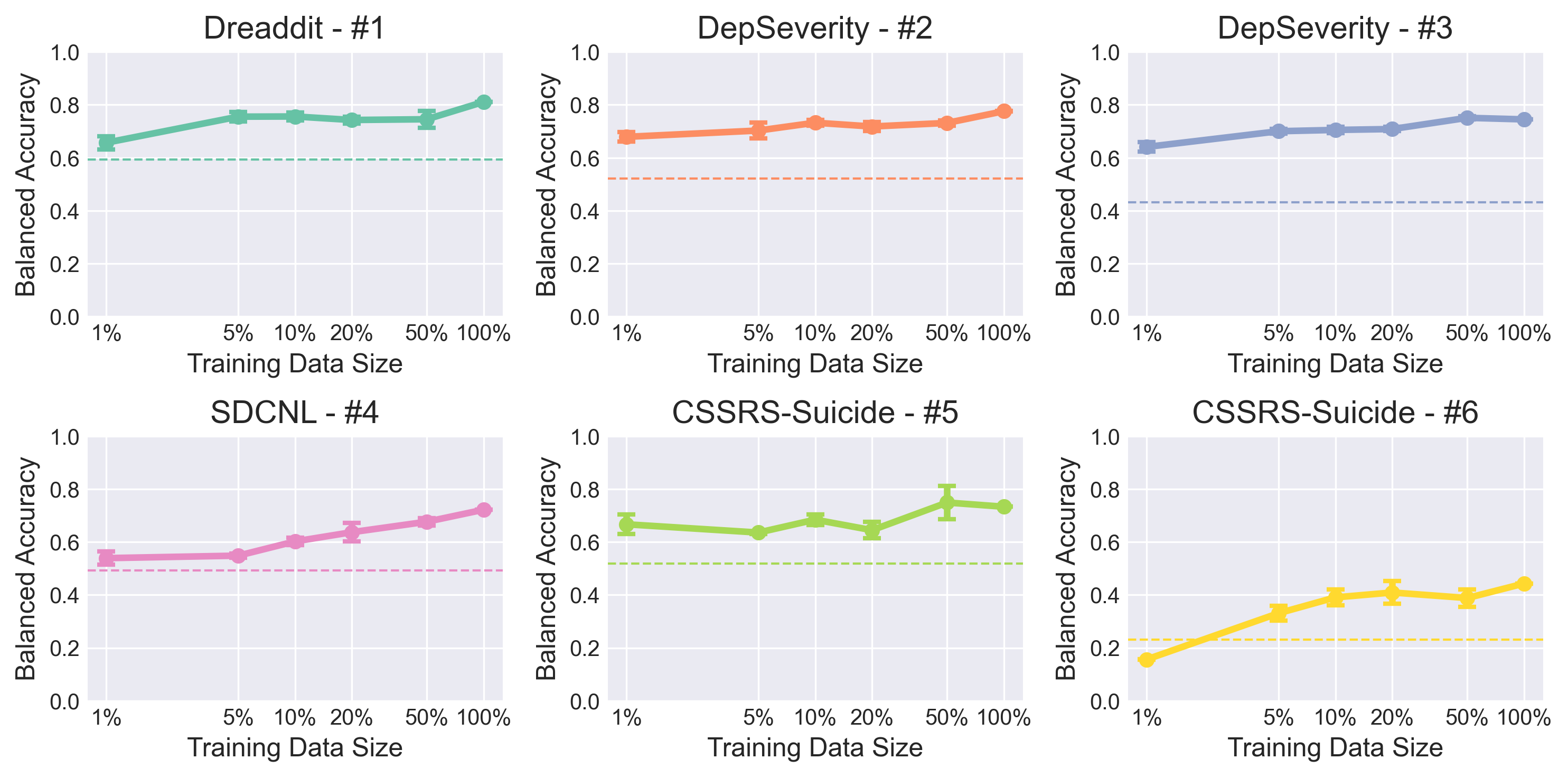
- Instruction finetuning significantly boosts model performance across multiple mental-health tasks and datasets.
- Mental-Alpaca and Mental-FLAN-T5 outperform the best GPT-3.5 prompt designs by 10.9% average balance accuracy (despite being much smaller) and beat the best GPT-4 prompts by 4.8% on average.
- Finetuned models reach parity with the state-of-the-art task-specific Mental-RoBERTa on several tasks.
- Zero-shot and few-shot prompts show promising but limited performance, with few-shot giving an average improvement of about 4.1%.
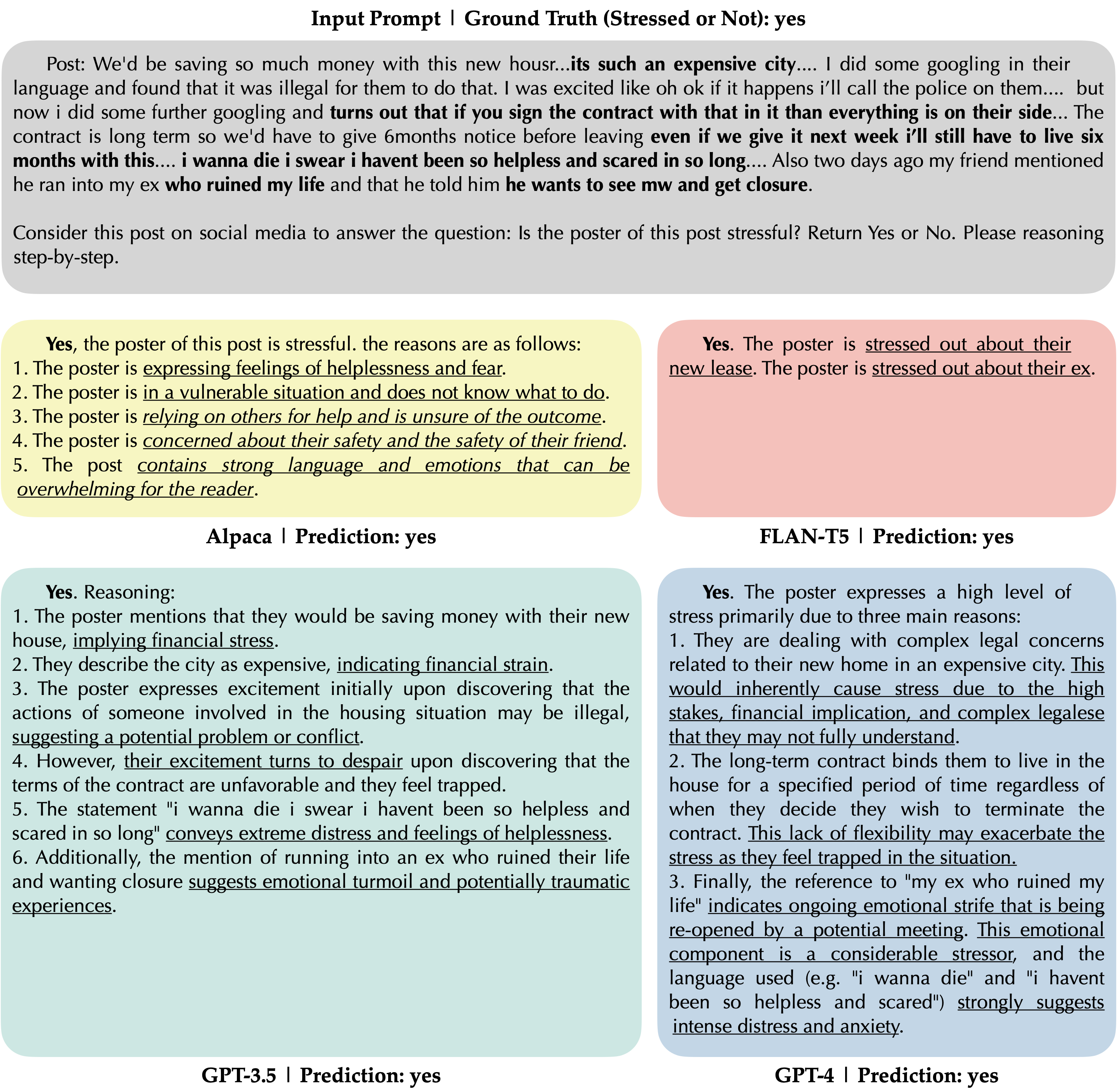
- Case study indicates nuanced reasoning capabilities in models like GPT-4 and highlights failure cases requiring further research.
- Open-source release of Mental-Alpaca and Mental-FLAN-T5 to facilitate research in multi-task mental-health prediction.
Better researchstarts right now
From reading papers to final review, dramatically reduce your research time.
No credit card · Free plan available
This review was created by AI and reviewed by human editors.