
[Paper Review] Metallic quantum criticality enabled by flat bands in a kagome lattice
The paper demonstrates an orbital-selective Mott transition of molecular orbitals in a kagome lattice, yielding a metallic quantum critical point with strange-metal behavior via an extended dynamical mean-field theory of a two-orbital Hubbard/Anderson framework.
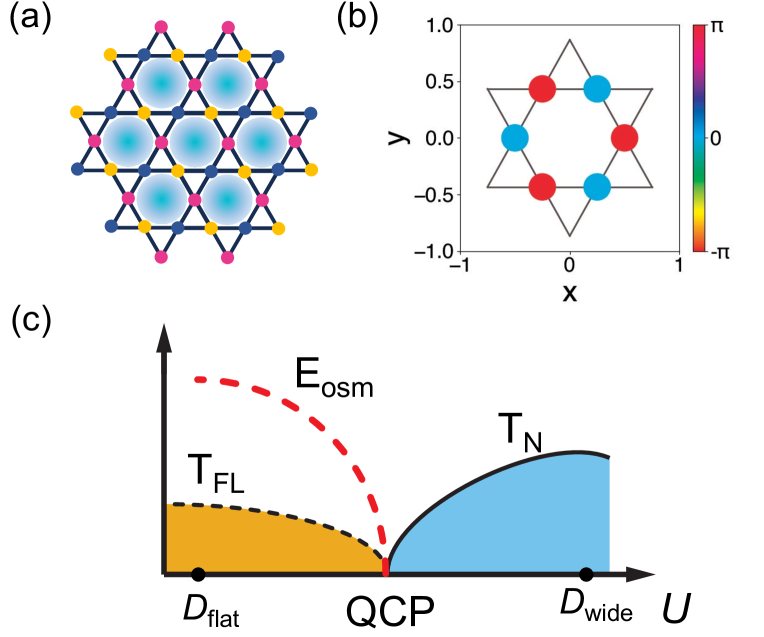
Strange metals arise in a variety of platforms for strongly correlated electrons, ranging from the cuprates, heavy fermions to flat band systems. Motivated by recent experiments in kagome metals, we study a Hubbard model on a kagome lattice whose noninteracting limit contains flat bands. A Kondo lattice description is constructed, in which the correlation effects are captured by symmetry preserving and exponentially localized molecular orbitals. These compact molecular orbitals represent the local degrees of freedom that emerge from topological flat bands. We identify a quantum critical point at which quasiparticles are lost and strange metallicity emerges. Our theoretical work opens up a new route for realizing beyond-Landau quantum criticality, as well as the associated strange metallicity and emergent quantum phases.
Motivation & Objective
- Motivate the study of strong correlations in flat-band kagome systems and their connection to strange metallicity.
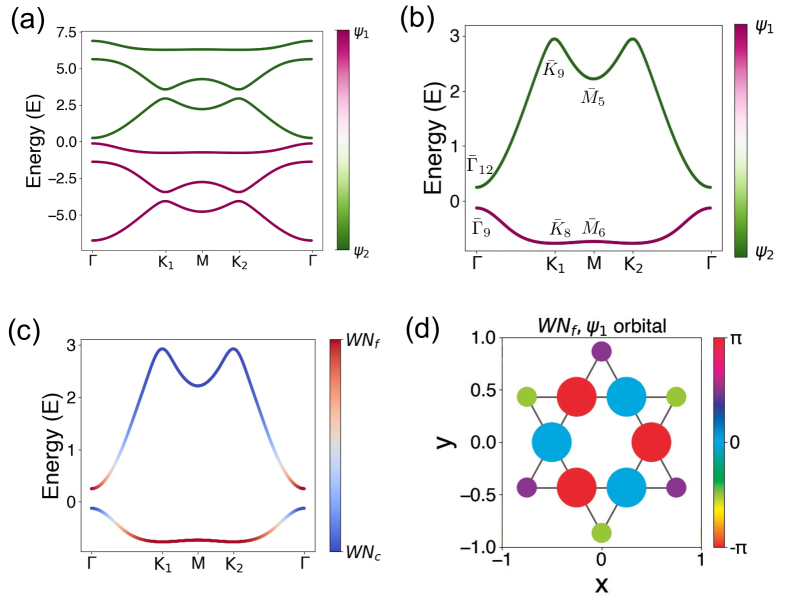
- Develop an orbital-based description of flat-band kagome electrons through emergent molecular orbitals.
- Construct an Anderson/Kondo-lattice framework for the molecular orbitals to access nonperturbative quantum criticality.
- Identify and characterize a continuous selective Mott transition of molecular orbitals and its quantum critical point.
Proposed method
- Construct a two-orbital Hubbard model on the kagome lattice with SOC along z and spin- z rotational symmetry.
- Identify emergent molecular orbitals via a Wannierization procedure, yielding tight f and c orbital descriptions on a triangular lattice.
- Project to an effective Anderson lattice model with dominant on-site f-electron interactions and weak c-electron interactions.
- Apply extended dynamical mean-field theory (EDMFT) to solve the Bose-Fermi Anderson model and capture Kondo destruction and RKKY competition.
- Compute local and lattice spin susceptibilities to extract scaling forms and dynamical exponents at the quantum critical point.
Experimental results
Research questions
- RQ1Can flat-band physics in a kagome lattice be encoded into an Anderson/Kondo lattice description via emergent molecular orbitals?
- RQ2Does the orbital-selective Mott transition of these molecular orbitals yield a quantum critical point with strange-metal signatures?
- RQ3What are the dynamical signatures (χ_loc, χ(q,ω)) and scaling properties at the orbital-selective Mott QCP?
- RQ4How does the competition between Kondo screening and RKKY interactions drive dehybridization and a Fermi-surface jump across the QCP?
Key findings
- An orbital-selective Mott transition of the molecular orbitals is identified within an EDMFT treatment of the effective Anderson lattice model.
- The quantum critical point exhibits χ_loc(ω) with a logarithmic divergence and χ(q,ω) with ω/(kB T) scaling, indicating an interacting, beyond-Gaussian criticality.
- A continuous selective transition leads to a Kondo-destruction-type quantum critical point and a jump in Fermi surface across the QCP.
- The flat-band kagome structure provides a route to strange-metal behavior analogous to heavy-fermion quantum criticality, with potential implications for unconventional superconductivity.
Better researchstarts right now
From reading papers to final review, dramatically reduce your research time.
No credit card · Free plan available
This review was created by AI and reviewed by human editors.