
[Paper Review] Metropolitan Scale and Longitudinal Dataset of Anonymized Human Mobility Trajectories
This paper introduces an open-source, anonymized, metropolitan-scale, and longitudinal human mobility dataset of 100,000 individuals' trajectories collected over 90 days from mobile phone location pings in an undisclosed Japanese metropolitan area. The dataset, spatially and temporally discretized into 500m×500m grid cells and 30-minute time bins, includes 75 days of normal behavior and 15 days of emergency conditions, enabling fair benchmarking of mobility prediction models through the HuMob Challenge 2023.
Modeling and predicting human mobility trajectories in urban areas is an essential task for various applications. The recent availability of large-scale human movement data collected from mobile devices have enabled the development of complex human mobility prediction models. However, human mobility prediction methods are often trained and tested on different datasets, due to the lack of open-source large-scale human mobility datasets amid privacy concerns, posing a challenge towards conducting fair performance comparisons between methods. To this end, we created an open-source, anonymized, metropolitan scale, and longitudinal (90 days) dataset of 100,000 individuals' human mobility trajectories, using mobile phone location data. The location pings are spatially and temporally discretized, and the metropolitan area is undisclosed to protect users' privacy. The 90-day period is composed of 75 days of business-as-usual and 15 days during an emergency. To promote the use of the dataset, we will host a human mobility prediction data challenge (`HuMob Challenge 2023') using the human mobility dataset, which will be held in conjunction with ACM SIGSPATIAL 2023.
Motivation & Objective
- To address the lack of open, large-scale, and privacy-preserving human mobility datasets for fair performance comparison of mobility prediction models.
- To provide a longitudinal, metropolitan-scale dataset with real-world trajectories collected from mobile devices over 90 days, including both normal and emergency conditions.
- To enable reproducible research and benchmarking by hosting a data challenge (HuMob Challenge 2023) using the dataset in conjunction with ACM SIGSPATIAL 2023.
- To support urban planning, epidemic modeling, and disaster risk management through high-fidelity, anonymized mobility data.
Proposed method
- Anonymized mobile phone location pings were collected from ~5% of Yahoo Japan app users, with user IDs and personal attributes (e.g., gender, age) removed.
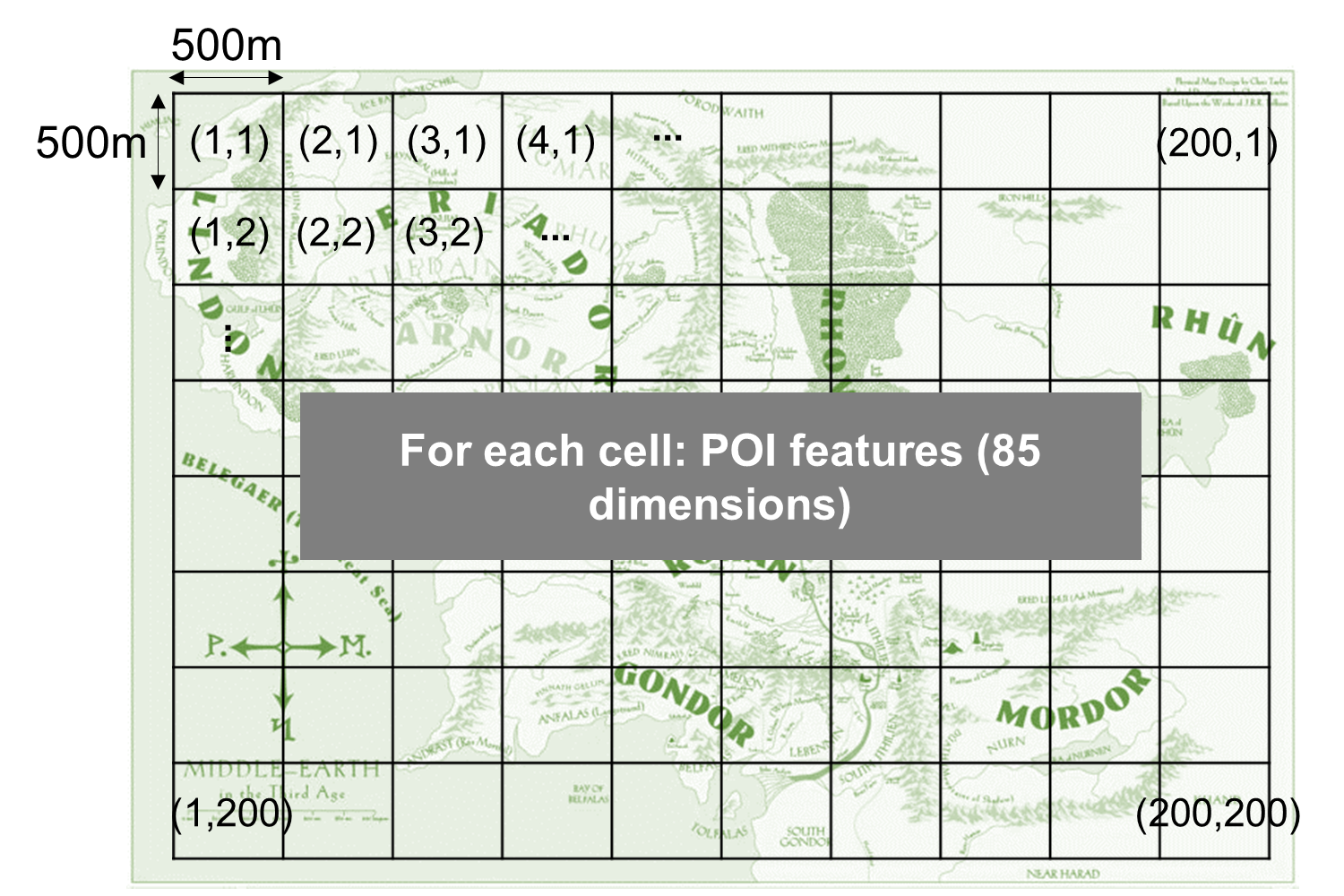
- Location data was spatially discretized into 500m×500m grid cells and temporally binned into 30-minute intervals to preserve privacy.
- The 90-day dataset includes 75 days of business-as-usual behavior and 15 days of emergency conditions with altered mobility patterns.
- A separate POI dataset with 85-dimensional vectors per grid cell was provided to indicate the count of different point-of-interest categories without revealing names.
- The dataset was released via Zenodo (DOI: 10.5281/zenodo.8111993) and used to host the HuMob Challenge 2023 for mobility trajectory prediction.
- Evaluation used Dynamic Time Warping (DTW) and GEO-BLEU metrics to assess trajectory similarity and local feature accuracy.
Experimental results
Research questions
- RQ1How can large-scale, anonymized, and longitudinal human mobility data be collected and shared responsibly while preserving individual privacy?
- RQ2To what extent can machine learning models predict masked mobility trajectories in a metropolitan setting using real-world data?
- RQ3How do emergency conditions affect human mobility patterns, and can models generalize across normal and anomalous behavior periods?
- RQ4What is the impact of auxiliary POI data on the accuracy of mobility trajectory prediction models?
- RQ5Can open, standardized datasets enable fair and reproducible benchmarking of human mobility prediction methods across different research groups?
Key findings
- The dataset comprises 100,000 anonymized individuals’ mobility trajectories over 90 days, with 75 days of normal behavior and 15 days of emergency conditions.
- The dataset is spatially discretized into 500m×500m grid cells and temporally binned into 30-minute intervals, ensuring user privacy.
- The HuMob Challenge 2023 was successfully hosted with 10 top teams invited to present at ACM SIGSPATIAL 2023 in Hamburg.
- The challenge used two prediction tasks: one with 20,000 masked individuals (Task 1) and another with 2,500 masked individuals (Task 2), both requiring trajectory reconstruction.
- Evaluation metrics included Dynamic Time Warping (DTW) and GEO-BLEU, with public code available for GEO-BLEU at https://github.com/yahoojapan/geobleu.
- The dataset is publicly available at https://zenodo.org/record/8111993, enabling reproducible research in urban mobility modeling.

Better researchstarts right now
From reading papers to final review, dramatically reduce your research time.
No credit card · Free plan available
This review was created by AI and reviewed by human editors.