
[Paper Review] Mixed Quantum-Semiclassical Simulation
This paper proposes a hybrid quantum-semiclassical simulation framework using Koopman-von Neumann (KvN) formalism to encode semiclassical systems within a quantum simulation architecture. By leveraging the Hilbert space structure of KvN mechanics, the method enables efficient quantum simulation of mixed quantum-semiclassical (MQS) systems, demonstrating that field simulations can achieve resource advantages proportional to the ratio of quantum to semiclassical actions ($S_q/S_c$), with a notable potential for semiclassical gravity due to the large action ratio ($\sim 10^{-18}$).
We study the quantum simulation of mixed quantum-semiclassical (MQS) systems, of fundamental interest in many areas of physics, such as molecular scattering and gravitational backreaction. A basic question for these systems is whether quantum algorithms of MQS systems would be valuable at all, when one could instead study the full quantum-quantum system. We study MQS simulations in the context where a semiclassical system is encoded in a Koopman-von Neumann (KvN) Hamiltonian and a standard quantum Hamiltonian describes the quantum system. In this case, because KvN and quantum Hamiltonians are constructed with the same operators on a Hilbert space, standard theorems guaranteeing simulation efficiency apply. We show that, in this context, $ extit{many-body}$ MQS particle simulations give only nominal improvements in qubit resources over quantum-quantum simulations due to logarithmic scaling in the ratio, $S_q/S_c$, of actions between quantum and semiclassical systems. However, $ extit{field}$ simulations can give improvements proportional to the ratio of quantum to semiclassical actions, $S_q/S_c$. Of particular note, due to the ratio $S_q/S_c \sim 10^{-18}$ of particle and gravitational fields, this approach could be important for semiclassical gravity. We demonstrate our approach in a model of gravitational interaction, where a harmonic oscillator mediates the interaction between two spins. In particular, we demonstrate a lack of distillable entanglement generation between spins due to classical mediators, a distinct difference in dynamics relative to the fully quantum case.
Motivation & Objective
- To determine whether quantum algorithms for mixed quantum-semiclassical (MQS) systems offer a computational advantage over classical simulations.
- To investigate whether MQS simulations can outperform fully quantum-quantum simulations in terms of qubit resource usage.
- To develop a unified quantum simulation framework that combines standard quantum Hamiltonians with KvN-based semiclassical dynamics.
- To explore the role of action ratios ($S_q/S_c$) in determining resource efficiency for MQS simulations.
- To validate the approach through a proof-of-principle model of gravitational interaction mediated by a harmonic oscillator.
Proposed method
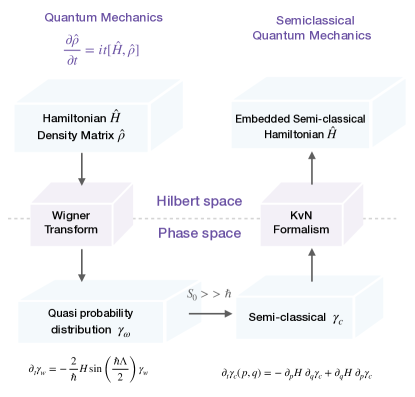
- Represent the semiclassical subsystem using the Koopman-von Neumann (KvN) formalism, which maps classical dynamics onto a Hilbert space with a Hermitian Hamiltonian.
- Encode both the quantum and semiclassical (KvN) systems within a common Hilbert space using standard quantum simulation techniques.
- Exploit the fact that KvN operators commute, enabling efficient time-evolution simulation via standard quantum algorithms.
- Apply Hamiltonian simulation algorithms (e.g., Trotter-Suzuki) to the combined KvN-quantum Hamiltonian, ensuring logarithmic scaling in system size.
- Use the ratio of actions ($S_q/S_c$) as a key parameter to assess resource efficiency relative to full quantum simulations.
- Implement a model of two spin-1/2 particles coupled via a harmonic oscillator, with the oscillator treated either quantum-mechanically or classically (KvN) to compare entanglement dynamics.
![Figure 1: Examples of MQS systems of interest. (i) In molecular scattering, the Born-Oppenheimer approximation is used to describe the light electronic degrees of freedom quantum mechanically, but the heavy nuclear system semiclassically [ 1 , 2 , 3 , 4 ] . (ii) Backreaction in gravity is studied wi](https://ar5iv.labs.arxiv.org/html/2308.16147/assets/x1.png)
Experimental results
Research questions
- RQ1Can quantum algorithms for MQS systems provide a computational advantage over classical simulations, and if so, under what conditions?
- RQ2Does the use of KvN formalism enable efficient quantum simulation of semiclassical systems within a unified quantum framework?
- RQ3Under what circumstances do MQS simulations require fewer qubits than equivalent fully quantum-quantum simulations?
- RQ4How does the ratio of quantum to semiclassical action ($S_q/S_c$) influence the resource efficiency of MQS simulations?
- RQ5What differences in entanglement dynamics arise between quantum and classical mediators in a gravitational-like interaction model?
Key findings
- MQS simulations using the KvN formalism achieve logarithmic resource scaling with system size, enabling efficient simulation of classical dynamics within a quantum framework.
- For many-body particle systems, the resource advantage of MQS simulations over full quantum simulations is nominal, scaling logarithmically with the action ratio $S_q/S_c$.
- In field-theoretic settings, MQS simulations can achieve resource reductions proportional to the action ratio $S_q/S_c$, offering significant potential for systems with large $S_q/S_c$.
- The action ratio for particle and gravitational fields is estimated at $S_q/S_c \sim 10^{-18}$, suggesting that MQS simulations could be highly advantageous for semiclassical gravity.
- In the proof-of-principle gravitational model, classical mediators (KvN oscillator) fail to generate distillable entanglement between spins, in contrast to the quantum oscillator case.
- The simulation framework enables direct comparison of entanglement dynamics under quantum versus classical backreaction, highlighting fundamental differences in quantum information behavior.
Better researchstarts right now
From reading papers to final review, dramatically reduce your research time.
No credit card · Free plan available
This review was created by AI and reviewed by human editors.