
[Paper Review] Model of Cosmic Ray Propagation in the Milky Way at the Knee
The paper presents an anisotropic, time-dependent model of PeV cosmic ray propagation in the Milky Way, where CRs are injected by discrete transient sources and propagate in a realistic Galactic magnetic field, leading to highly inhomogeneous local fluxes near the knee.
We present a new model of anisotropic cosmic ray propagation in the Milky Way, where cosmic rays are injected at discrete transient sources in the disc and propagated in the Galactic magnetic field. In the framework of our model, we show that the cosmic ray spectrum is time-dependent and space-dependent around the energy of the knee. It has a major contribution of one or a few nearby recent sources at any given location in the Galaxy, in particular at the position of the Solar system. We find that the distribution of $\sim$ PeV cosmic rays in our Galaxy is significantly clumpy and inhomogeneous, and therefore substantially different from the smoother distribution of GeV cosmic rays. Our findings have important implications for the calculation and future interpretation of the diffuse Galactic gamma-ray and neutrino fluxes at very high energies.
Motivation & Objective
- Motivate a propagation framework that explains the knee by anisotropic diffusion in the Galactic magnetic field.
- Investigate how discrete transient sources shape the time- and space-dependent CR distribution at PeV energies.
- Assess the impact of the regular magnetic field on CR confinement and local flux fluctuations.
- Explore implications for diffuse gamma-ray and neutrino fluxes from the Galaxy.
Proposed method
- Inject CRs at discrete reference sources in the Galactic disc and propagate individually in the Jansson-Farrar Galactic magnetic field model.
- Use an outer turbulence scale Lmax = 25 pc and reduce the turbulent field strength to satisfy B/C constraints.
- Simulate 10^3 trajectories per source at energies {1, 3, 10, 30, 100} PeV and record positions over 30 yr to 30 Myr.
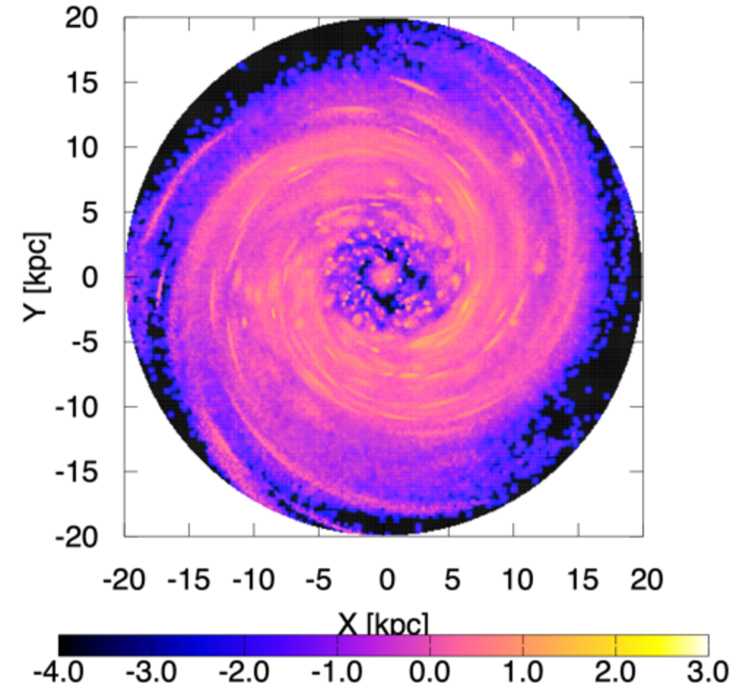
- Place a grid in the Galactic disc to compute CR density in 100 pc^3 bins up to R=20 kpc and |z|=400 pc.
- Relate injected spectra to observed data with parameters alpha and Emax, and adjust source density (1.6% vs 10% of SNe) to fit knee region data.
Experimental results
Research questions
- RQ1How does anisotropic diffusion in the regular Galactic magnetic field affect the distribution of PeV CRs compared to isotropic diffusion models?
- RQ2What is the role of a few nearby recent sources in shaping the local CR flux at the knee and above?
- RQ3How does the predicted clumpiness of PeV CRs influence the expected diffuse gamma-ray and neutrino signals?
- RQ4Can a reduced turbulent field in the JF12 model reproduce B/C constraints while allowing realistic CR confinement times?
- RQ5What source densities and spectral indices best reproduce knee region measurements from KASCADE, IceTop, AMS-02, DAMPE, CALET, etc.?
Key findings
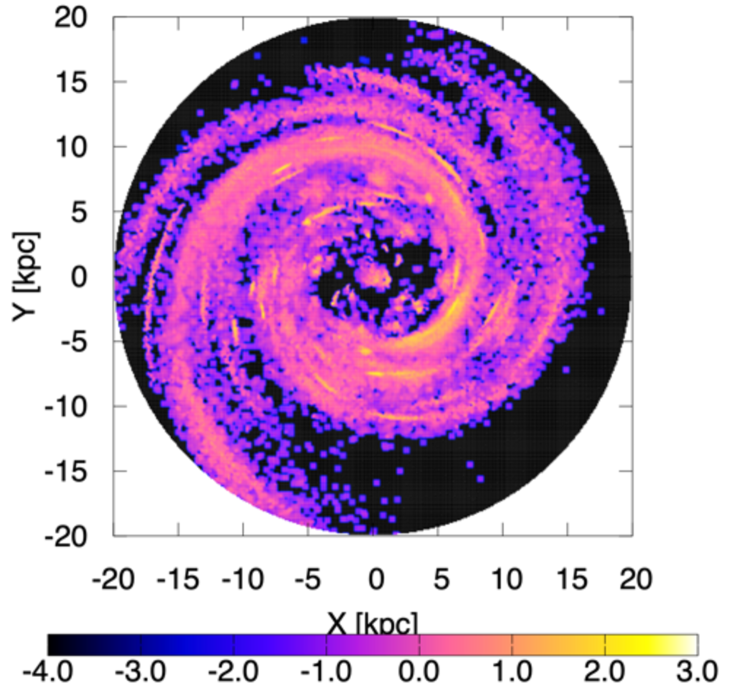
- The CR flux near the knee is time- and space-dependent and often dominated by one or a few nearby recent sources at a given location, including Earth.
- At 1 PeV the flux distribution is highly patchy, with contrast factors up to several orders of magnitude across the Galaxy.
- At 10 PeV and above, the distribution becomes even more inhomogeneous, with only a few sources contributing at most locations, including Earth.
- The Earth-received knee flux can be dominated by ~100 contributing sources over Myr timescales, with major fluctuations on ~100 kyr, depending on source density (1.6% vs 10% of SNe).
- Two source populations are needed to fit the knee region and the ~10 TeV bump, with alpha around 2.1–2.2 and varying contributions across energy ranges.
Better researchstarts right now
From reading papers to final review, dramatically reduce your research time.
No credit card · Free plan available
This review was created by AI and reviewed by human editors.