
[Paper Review] Modelling Cellular Perturbations with the Sparse Additive Mechanism Shift Variational Autoencoder
SAMS-VAE adds sparse additive perturbation mechanisms to a VAE for modeling cellular perturbations, enabling disentangled, interpretable latent subspaces and strong generalization in perturb-seq data. It also introduces correlated inference and an evaluation framework based on average treatment effects.
Generative models of observations under interventions have been a vibrant topic of interest across machine learning and the sciences in recent years. For example, in drug discovery, there is a need to model the effects of diverse interventions on cells in order to characterize unknown biological mechanisms of action. We propose the Sparse Additive Mechanism Shift Variational Autoencoder, SAMS-VAE, to combine compositionality, disentanglement, and interpretability for perturbation models. SAMS-VAE models the latent state of a perturbed sample as the sum of a local latent variable capturing sample-specific variation and sparse global variables of latent intervention effects. Crucially, SAMS-VAE sparsifies these global latent variables for individual perturbations to identify disentangled, perturbation-specific latent subspaces that are flexibly composable. We evaluate SAMS-VAE both quantitatively and qualitatively on a range of tasks using two popular single cell sequencing datasets. In order to measure perturbation-specific model-properties, we also introduce a framework for evaluation of perturbation models based on average treatment effects with links to posterior predictive checks. SAMS-VAE outperforms comparable models in terms of generalization across in-distribution and out-of-distribution tasks, including a combinatorial reasoning task under resource paucity, and yields interpretable latent structures which correlate strongly to known biological mechanisms. Our results suggest SAMS-VAE is an interesting addition to the modeling toolkit for machine learning-driven scientific discovery.
Motivation & Objective
- Learn a generative model of cellular observations under perturbations that disentangles perturbation effects from basal variation.
- Introduce sparse perturbation latent offsets that are additively composed and shared across samples receiving the same perturbation.
- Develop and compare correlated variational inference strategies to improve latent disentanglement and predictive performance.
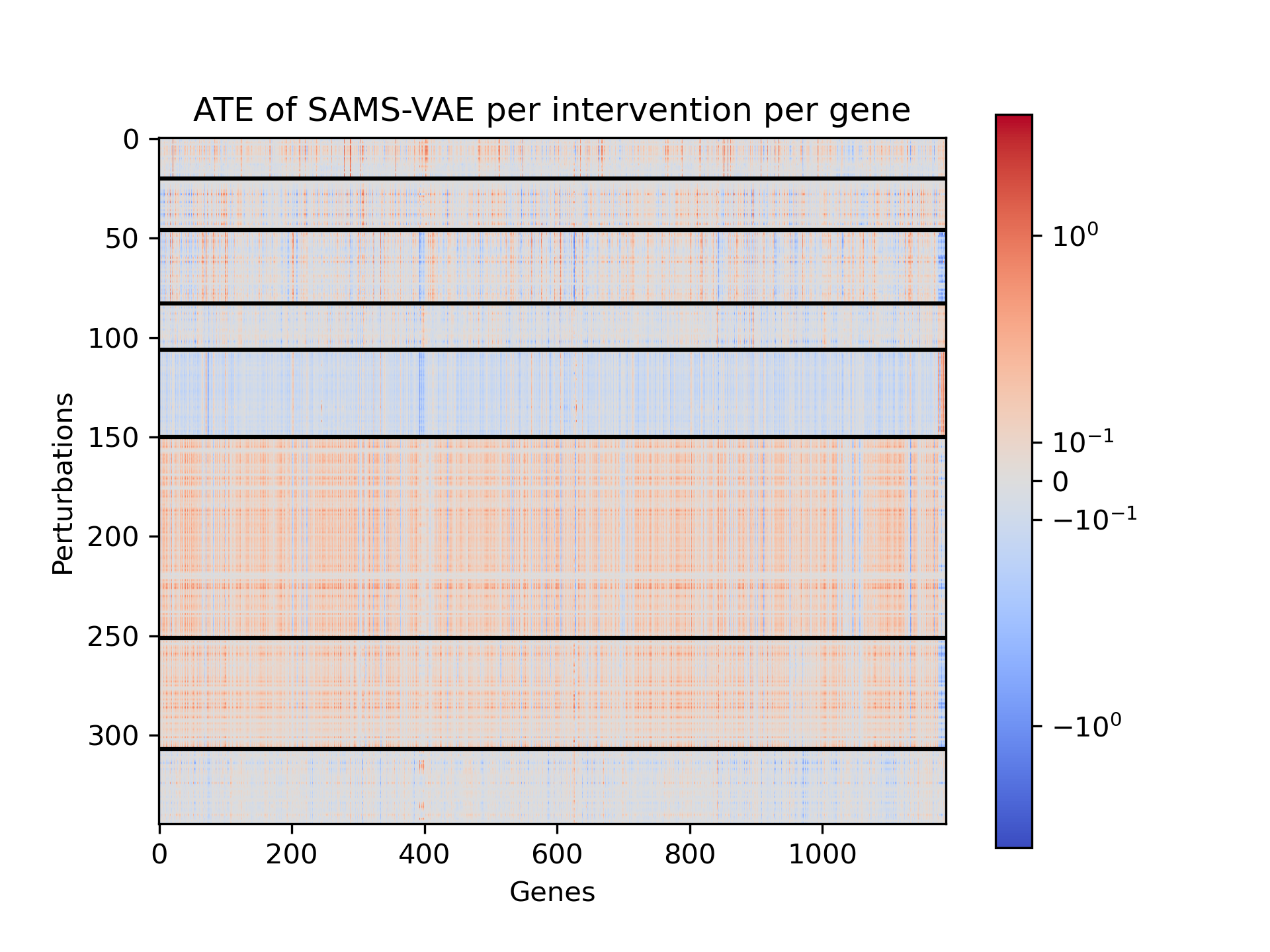
- Provide an evaluation framework for perturbation models using marginal likelihood (IWELBO) and posterior predictive checks via average treatment effects.
- Demonstrate improved generalization and interpretability on perturb-seq datasets compared to baselines.
Proposed method
- Define z_i = z_i^b + z_i^p as the latent state with z_i^p = sum_t d_{i,t} (e_t ⊙ m_t).
- Model e_t ~ N(0, βI) and m_t ~ Bern(α) to induce sparse, perturbation-specific offsets.
- Use a neural network to parameterize p(x_i|z_i; θ) and a scRNA-seq likelihood via a Gamma-Poisson (Negative Binomial) model with library size l_i.
- Infer with stochastic variational inference using a mean-field or correlated variational family that ties z^b, E, M across samples receiving perturbation t.
- Introduce CPA-VAE as an ablated variant with no sparsity mask (m_t fixed to 1).
- Provide two improved inference schemes: correlated z_basal and correlated embeddings E, for a richer variational family.
![Figure 2 : Visualization of inferred latent perturbation masks and embedding means for the best performing checkpoint of each model in replogle-filtered . We visualize the latent variables for the 345 perturbations with pathway annotations from Replogle et al. [ 17 ] and group by pathway. The SAMS-V](https://ar5iv.labs.arxiv.org/html/2311.02794/assets/x1.png)
Experimental results
Research questions
- RQ1Can SAMS-VAE accurately model perturbation effects as sparse additive latent offsets?
- RQ2Do correlated inference strategies improve latent disentanglement, interpretability, and predictive performance over baselines?
- RQ3How does SAMS-VAE generalize to in-distribution and out-of-distribution perturbations and to combinatorial perturbations?
- RQ4Is the proposed evaluation framework via average treatment effects and differential expression informative for assessing perturbation models?
- RQ5How does SAMS-VAE compare to CPA-VAE, SVAE+, and conditional VAE on perturb-seq datasets?
Key findings
- SAMS-VAE with fully correlated inference achieves the best test IWELBO and ATE correlation on replogle-filtered data.
- Correlated z_basal inference provides substantial gains across SAMS-VAE and CPA-VAE; correlated E yields modest gains.
- SAMS-VAE with both correlated z_basal and E achieves the highest Mask PW. Acc and ATE-Pearson among the tested configurations.
- SAMS-VAE and CPA-VAE demonstrate strong generalization in combinatorial perturbation settings (norman-ood) and data-efficiency scenarios.
- Latent perturbation masks from SAMS-VAE are more predictive of annotated biological pathways than those from SVAE+.
- Model-based ATE correlates well with data-driven differential expression, supporting the PPC framework.
Better researchstarts right now
From reading papers to final review, dramatically reduce your research time.
No credit card · Free plan available
This review was created by AI and reviewed by human editors.