
[Paper Review] Multimodal Prototyping for cancer survival prediction
MMP introduces unsupervised morphological and pathway prototypes to compress histology and transcriptomics tokens, enabling memory-efficient multimodal fusion with Transformer or OT cross-alignment for cancer survival prediction across six TCGA cohorts.
Multimodal survival methods combining gigapixel histology whole-slide images (WSIs) and transcriptomic profiles are particularly promising for patient prognostication and stratification. Current approaches involve tokenizing the WSIs into smaller patches (>10,000 patches) and transcriptomics into gene groups, which are then integrated using a Transformer for predicting outcomes. However, this process generates many tokens, which leads to high memory requirements for computing attention and complicates post-hoc interpretability analyses. Instead, we hypothesize that we can: (1) effectively summarize the morphological content of a WSI by condensing its constituting tokens using morphological prototypes, achieving more than 300x compression; and (2) accurately characterize cellular functions by encoding the transcriptomic profile with biological pathway prototypes, all in an unsupervised fashion. The resulting multimodal tokens are then processed by a fusion network, either with a Transformer or an optimal transport cross-alignment, which now operates with a small and fixed number of tokens without approximations. Extensive evaluation on six cancer types shows that our framework outperforms state-of-the-art methods with much less computation while unlocking new interpretability analyses.
Motivation & Objective
- Motivate prognostication by integrating histology (WSIs) and transcriptomics for survival prediction.
- Reduce token dimensionality via prototype-based summaries to enable efficient multimodal fusion.
- Develop a unified fusion framework (Transformer or OT) operating on compact prototype tokens.
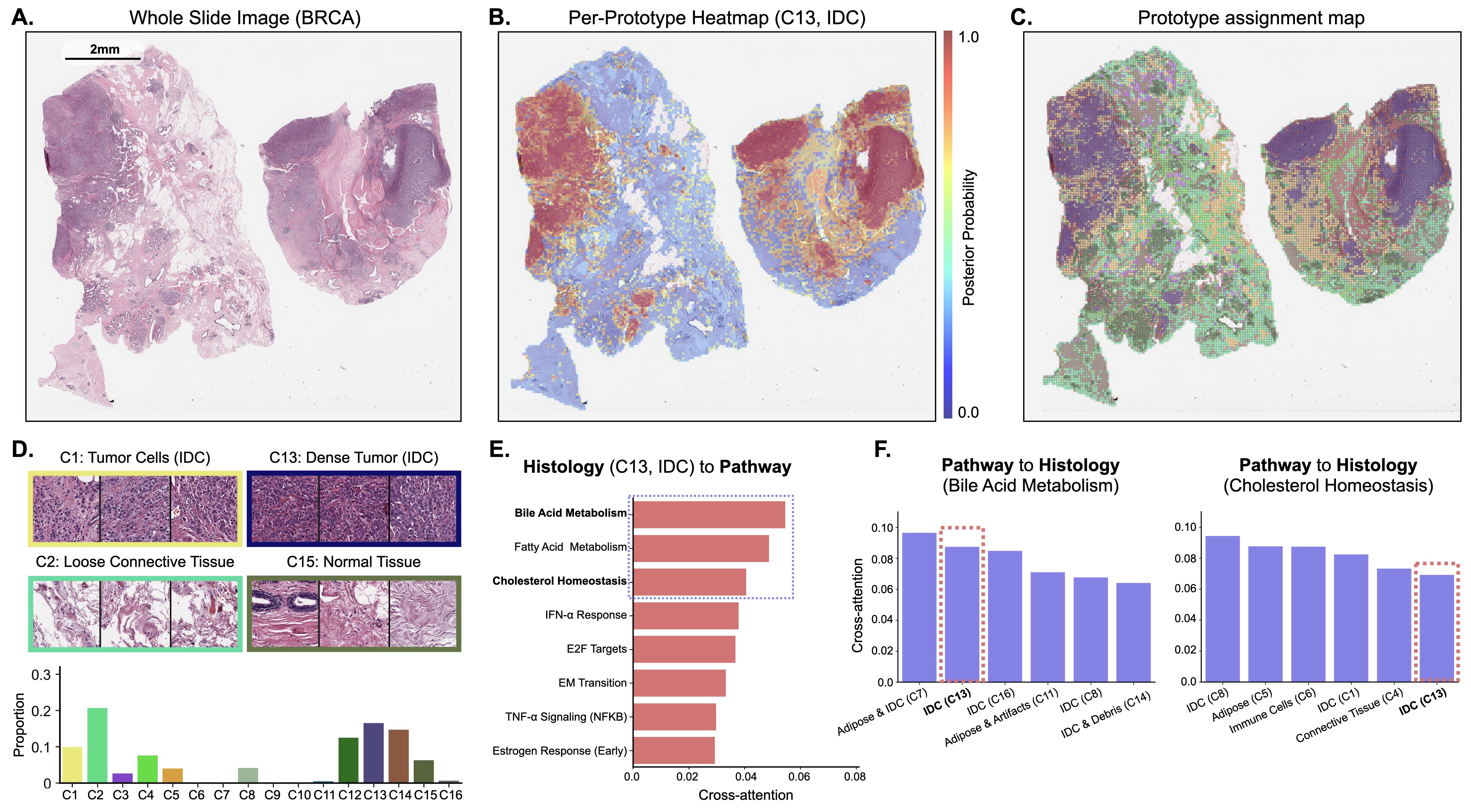
- Enable interpretability by visualizing interactions between morphological and pathway prototypes.
- Demonstrate predictive performance gains across multiple cancer types on TCGA data.
Proposed method
- Construct morphological prototypes by clustering patch embeddings with Gaussian mixtures to produce a small, fixed slide summary (C_h <= 32).
- Represent transcriptomics via fixed biological pathway prototypes (Hallmark pathways, C_g = 50).
- Match token dimensions across modalities using learned projections before fusion.
- Fuse modalities with either Transformer attention or entropic-regularized Optimal Transport cross-alignment, enabling intra- and cross-modal interactions.
- Predict survival using Cox proportional hazards loss on the fused patient embedding.
- Optionally incorporate prototype-specific encodings and prototype-specific post-attention networks to enhance prototype interpretability.
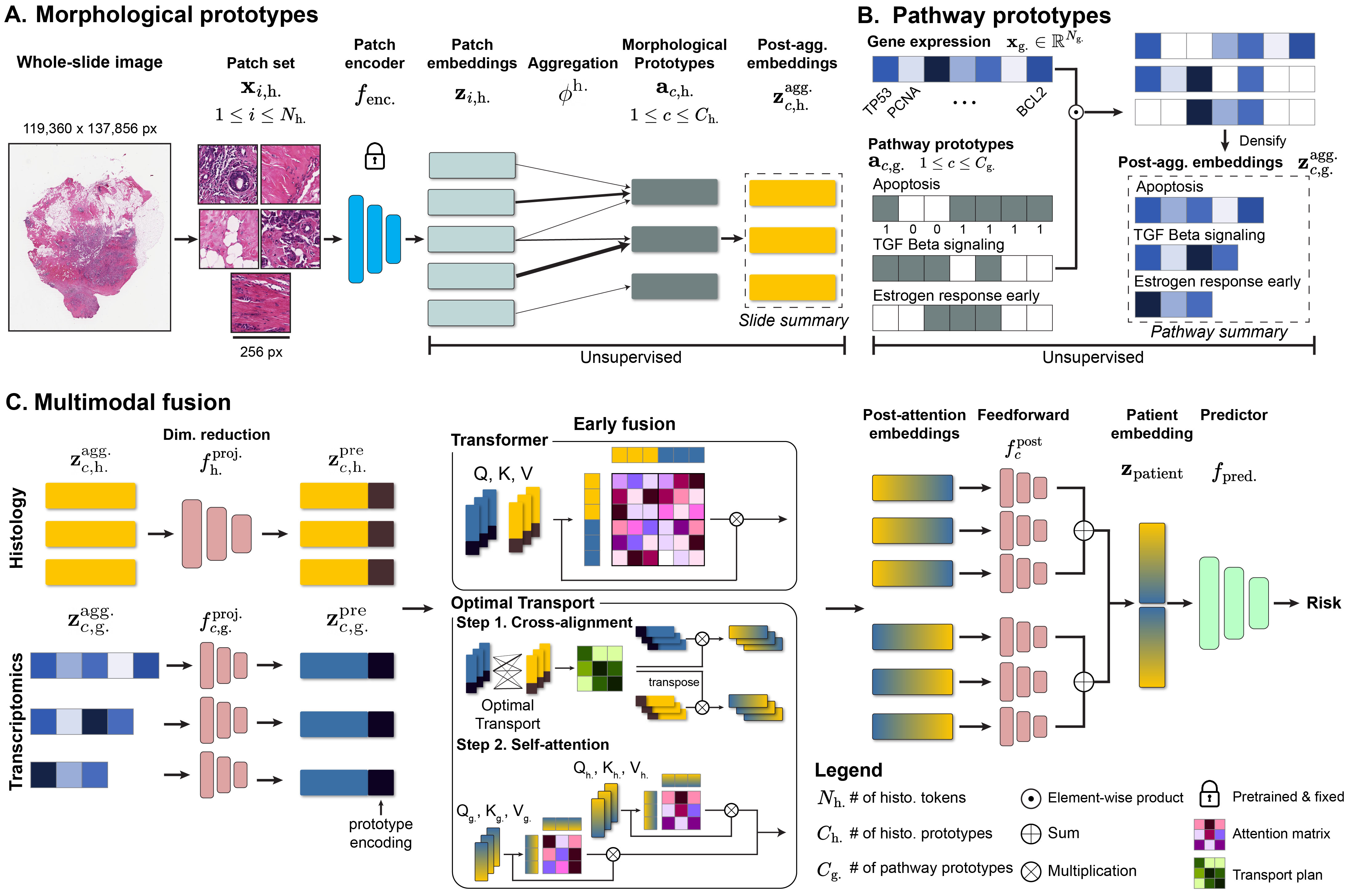
Experimental results
Research questions
- RQ1Can morphology-based prototypes effectively summarize WSIs for survival prediction without loss of prognostic information?
- RQ2Can pathway-based prototypes condense transcriptomic data into a fixed set of tokens suitable for multimodal fusion?
- RQ3How do Transformer-based and OT-based cross-modal fusion compare when using prototype tokens?
- RQ4Does prototype-based multimodal fusion outperform existing uni- and multimodal baselines across multiple cancer types?
- RQ5To what extent do prototype interactions enable interpretable cross-modal prognostic insights?
Key findings
- MMP outperforms nearly all baselines (both unimodal and multimodal) across six TCGA cancer types.
- Prototype-based histology summarization achieves large input compression (>300x) while preserving predictive power.
- Pathway prototypes provide compact, meaningful representations of transcriptomics and enable effective multimodal fusion.
- Transformer and OT cross-alignment yield comparable performance, validating the connection between the two approaches.
- MMP variants with prototypes achieve higher average concordance index than clinical baselines and many baselines (e.g., MMP_OT and MMP_Trans. show strong results).
- Prototype-based unimodal baselines (AttnMISL, unimodal MMP) remain among the best performers, underscoring prototype quality.
Better researchstarts right now
From reading papers to final review, dramatically reduce your research time.
No credit card · Free plan available
This review was created by AI and reviewed by human editors.