
[Paper Review] Multiorbital exciton formation in an organic semiconductor
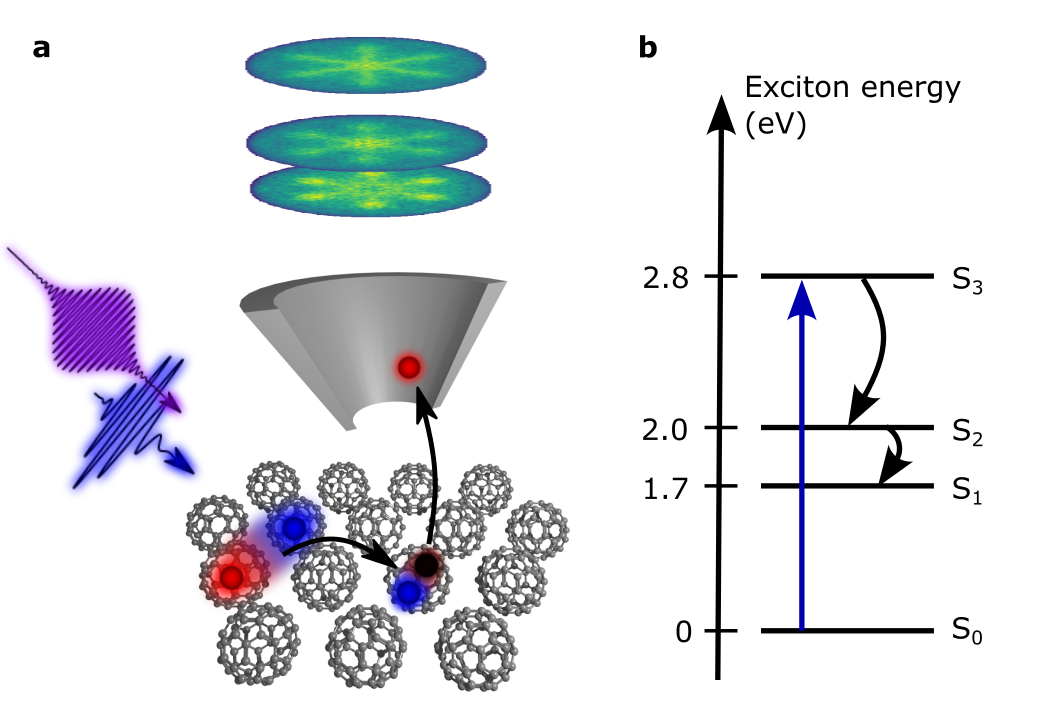
This study introduces time-resolved photoemission orbital tomography (tr-POT) combined with many-body GW+Bethe-Salpeter equation calculations to directly probe the multiorbital nature of excitons in organic semiconductors. For C60, the method reveals that the S3 exciton exhibits strong charge-transfer character with a 7.6 Å electron-hole separation and a star-shaped momentum fingerprint, while S1 and S2 are Frenkel-like, demonstrating that tr-POT can disentangle orbital contributions, localization, and charge-transfer dynamics in excitons.
Harnessing the optoelectronic response of organic semiconductors requires a thorough understanding of the fundamental light-matter interaction that is dominated by the excitation of correlated electron-hole pairs, i.e. excitons. The nature of these excitons would be fully captured by knowing the quantum-mechanical wavefunction, which, however, is difficult to access both theoretically and experimentally. Here, we use femtosecond photoemission orbital tomography in combination with many-body perturbation theory to gain access to exciton wavefunctions in organic semiconductors. We find that the coherent sum of multiple electron-hole pair contributions that typically make up a single exciton can be experimentally evidenced by photoelectron spectroscopy. For the prototypical organic semiconductor buckminsterfullerene (C$_{60}$), we show how to disentangle such multiorbital contributions and thereby access key properties of the exciton wavefunctions including localization, charge-transfer character, and ultrafast exciton formation and relaxation dynamics.
Motivation & Objective
- To directly access the quantum-mechanical wavefunction of excitons in organic semiconductors, which governs their optoelectronic behavior.
- To overcome the challenge of experimentally probing correlated electron-hole pairs in strongly interacting systems like organic semiconductors.
- To validate and extend time-resolved photoemission orbital tomography (tr-POT) for use in excitonic quasiparticles with multiorbital character.
- To determine the localization, charge-transfer character, and ultrafast dynamics of excitons in C60 using combined experimental and many-body theoretical approaches.
Proposed method
- Employed time-resolved photoemission orbital tomography (tr-POT) using femtosecond extreme ultraviolet (EUV) pulses to probe exciton states in C60 films.
- Combined tr-POT experiments with many-body GW+Bethe-Salpeter equation (BSE) calculations to simulate excitonic wavefunctions and photoemission spectra.
- Used momentum-resolved photoemission data to reconstruct the orbital character and spatial distribution of excitonic states.
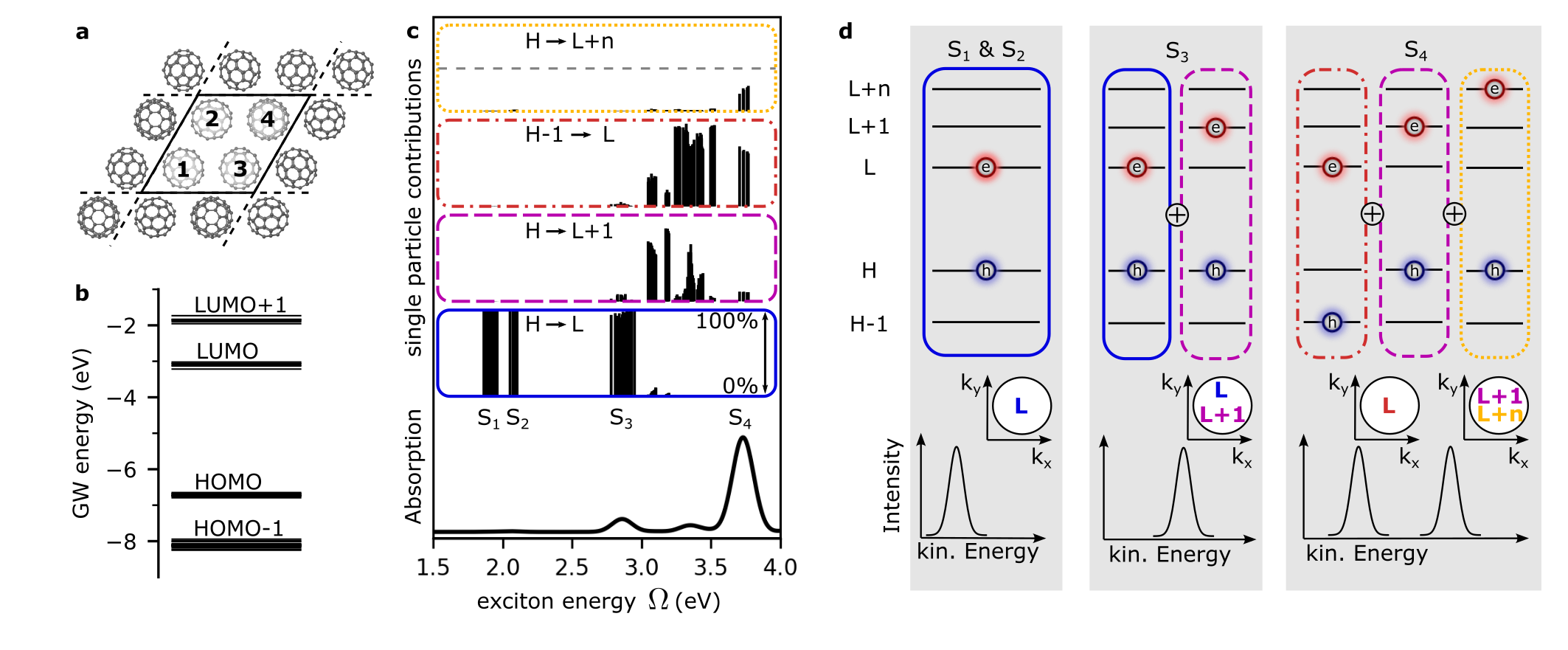
- Performed DFT and GW+BSE calculations on a C60 dimer model to analyze exciton symmetry, energy levels, and electron-hole separation.
- Compared experimental momentum maps with theoretical predictions to validate the multiorbital nature of excitons.
- Analyzed the correlation between electron and hole positions to quantify charge-transfer character and localization.
Experimental results
Research questions
- RQ1How does the multiorbital character of excitons in C60 influence the photoemission spectrum in tr-POT?
- RQ2To what extent can tr-POT resolve the spatial wavefunction of excitons, including their localization and charge-transfer character?
- RQ3What is the electron-hole separation in the S3 exciton state of C60, and how does it affect the momentum fingerprint in photoemission?
- RQ4Why do theoretical GW+BSE calculations on a dimer model fail to fully reproduce the star-shaped momentum map of the S3 exciton?
- RQ5Can tr-POT be reliably applied to extract excitonic properties from strongly correlated electron-hole pairs in organic semiconductors?
Key findings
- The S3 exciton in C60 exhibits a star-shaped momentum fingerprint in tr-POT, indicating multiorbital contributions from both LUMO and LUMO+1 orbitals.
- Theoretical calculations show a mean electron-hole separation of 7.6 Å in the S3 exciton, confirming its strong charge-transfer character.
- The S1 and S2 excitons are found to be of Frenkel-like nature, with energy splitting arising from different excitation symmetries (t1g, t2g, and hg).
- Experimental tr-POT data show multiple peaks in the photoemission spectrum, which are attributed to distinct orbital contributions and confirmed by GW+BSE calculations.
- The discrepancy between experiment and theory in the S3 momentum map is attributed to the limitations of the dimer model in capturing dispersion effects in extended C60 systems.
- The study establishes tr-POT as a viable method for accessing exciton wavefunctions, including localization and charge-transfer character, in organic semiconductors.
Better researchstarts right now
From reading papers to final review, dramatically reduce your research time.
No credit card · Free plan available
This review was created by AI and reviewed by human editors.