
[Paper Review] Multiple Peaks and a Long Precursor in the Type IIn Supernova 2021qqp: An Energetic Explosion in a Complex Circumstellar Environment
This study presents multiwavelength photometry and spectroscopy of Type IIn supernova 2021qqp, revealing a 300-day precursor and two distinct optical peaks. Using bolometric light curve modeling and velocity evolution, the authors infer a complex circumstellar environment with two major mass-loss episodes (10 and 5 M⊙ yr⁻¹), a total CSM mass of 2–4 M⊙, and an SN ejecta mass of 5–30 M⊙ with explosion energy of (3–10)×10⁵¹ erg, pointing to a massive progenitor such as a luminous blue variable or extreme stellar merger.
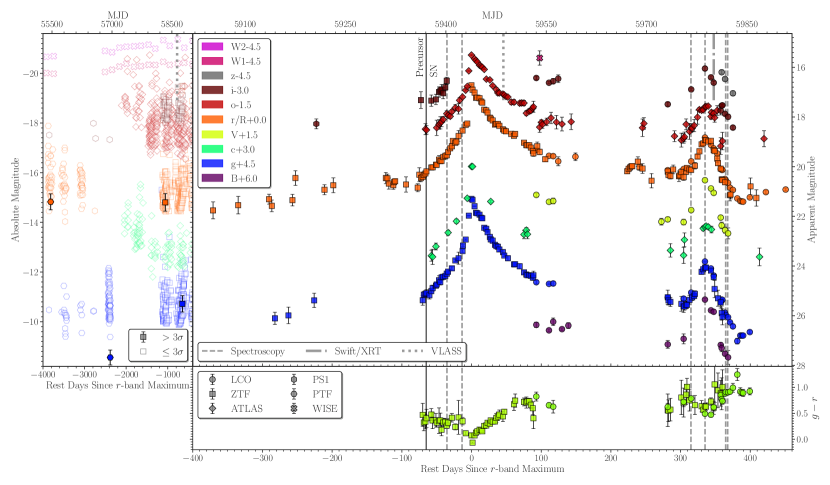
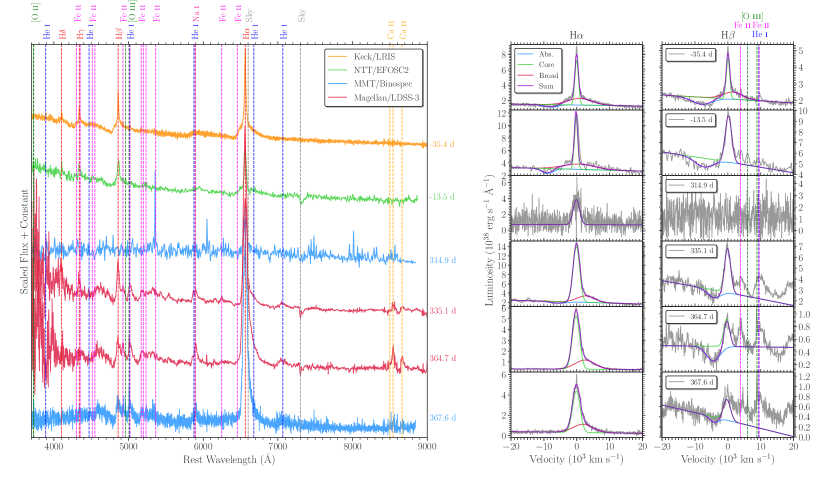
We present optical photometry and spectroscopy of the Type IIn supernova (SN) 2021qqp. Its unusual light curve is marked by a long precursor for $\approx300$ days, a rapid increase in brightness for $\approx60$ days, and then a sharp increase of $\approx1.6$ mag in only a few days to a first peak of $M_r \approx -19.5$ mag. The light curve then declines rapidly until it re-brightens to a second distinct peak of $M_r \approx -17.3$ mag centered at $\approx335$ days after the first peak. The spectra are dominated by Balmer lines with a complex morphology, including a narrow component with a width of $\approx 1300$ km s$^{-1}$ (first peak) and $\approx 2500$ km s$^{-1}$ (second peak) that we associate with the circumstellar medium (CSM) and a P Cygni component with an absorption velocity of $\approx 8500$ km s$^{-1}$ (first peak) and $\approx 5600$ km s$^{-1}$ (second peak) that we associate with the SN-CSM interaction shell. Using the luminosity and velocity evolution, we construct a flexible analytical model, finding two significant mass-loss episodes with peak mass loss rates of $\approx 10$ and $\approx 5\,M_{\odot}$ yr$^{-1}$ about $0.8$ and $2$ yr before explosion, respectively, with a total CSM mass of $\approx 2-4\,M_{\odot}$. We show that the most recent mass-loss episode could explain the precursor for the year preceding the explosion. The SN ejecta mass is constrained to be $\approx 5-30\,M_{\odot}$ for an explosion energy of $\approx (3-10) imes10^{51}$ erg. We discuss eruptive massive stars (luminous blue variable, pulsational pair instability) and an extreme stellar merger with a compact object as possible progenitor channels.
Motivation & Objective
- To understand the origin of the unusual light curve of Type IIn supernova 2021qqp, which features a 300-day precursor and two sharp optical peaks.
- To constrain the properties of the circumstellar medium (CSM) and the supernova explosion through detailed photometric and spectroscopic modeling.
- To identify the progenitor channel responsible for the energetic explosion in a complex CSM environment.
- To determine the mass-loss history and explosion parameters using analytical modeling of the bolometric light curve and velocity evolution.
Proposed method
- Multi-epoch optical photometry and spectroscopy were collected from multiple observatories, including LCO, Keck, Magellan, and ZTF, to trace the light curve and spectral evolution.
- The bolometric light curve was constructed from multi-band photometry to estimate the total radiated energy and energy budget of the SN.
- Velocity evolution of Balmer lines and P Cygni profiles was measured to trace the interaction between SN ejecta and CSM, with narrow components indicating CSM and P Cygni absorption revealing shock speed.
- An analytical model was developed to fit the light curve and velocity data, enabling derivation of CSM density profile, mass-loss history, and SN explosion parameters.
- The model assumed a power-law CSM density profile and used energy and momentum conservation to infer mass-loss rates and total CSM mass.
- Bayesian inference with emcee and dynesty was used to constrain uncertainties in the derived parameters, including ejecta mass and explosion energy.
Experimental results
Research questions
- RQ1What caused the 300-day precursor light curve in SN 2021qqp, and how does it relate to the progenitor's mass-loss history?
- RQ2What are the physical properties of the circumstellar medium (CSM) responsible for the multiple optical peaks?
- RQ3What is the explosion energy and ejecta mass of SN 2021qqp, and how do they compare to typical Type IIn SNe?
- RQ4Which progenitor channel—luminous blue variable, pulsational pair instability, or extreme stellar merger—best explains the observed CSM and explosion energetics?
Key findings
- The supernova exhibited a 300-day precursor phase followed by a rapid rise to a first peak at Mr ≈ -19.5 mag, followed by a decline and a second sharp peak at Mr ≈ -17.3 mag.
- The CSM was found to have a total mass of 2–4 M⊙, with two dominant mass-loss episodes at rates of ≈10 M⊙ yr⁻¹ and ≈5 M⊙ yr⁻¹, occurring 0.8 and 2 years before explosion.
- The narrow spectral component width increased from ≈1300 km s⁻¹ at the first peak to ≈2500 km s⁻¹ at the second peak, indicating evolving CSM interaction.
- The P Cygni absorption velocity decreased from ≈8500 km s⁻¹ at the first peak to ≈5600 km s⁻¹ at the second peak, consistent with shock deceleration in the CSM.
- The SN ejecta mass was constrained to 5–30 M⊙, with explosion energy of (3–10)×10⁵¹ erg, indicating a highly energetic explosion.
- The most recent mass-loss episode (≈5 M⊙ yr⁻¹) is sufficient to explain the precursor, suggesting a link between eruptive mass loss and the early brightening.
Better researchstarts right now
From reading papers to final review, dramatically reduce your research time.
No credit card · Free plan available
This review was created by AI and reviewed by human editors.