
[Paper Review] Navier-Stokes Equations for Low-Temperature One-Dimensional Fluids
This paper derives a universal Navier-Stokes hydrodynamic description for low-temperature one-dimensional quantum fluids by taking the low-temperature limit of generalized hydrodynamics (GHD). It shows that dynamic viscosity is proportional to temperature and universally expressible in terms of the Luttinger liquid parameter $K$ and compressibility, with finite viscosity even at zero temperature, thereby regularizing shocks and validating viscous hydrodynamics in gapless 1D systems.
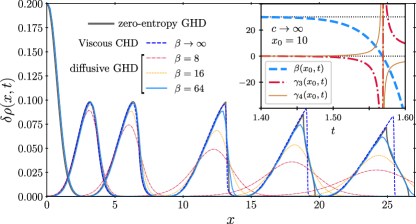
We consider one-dimensional interacting quantum fluids, such as the Lieb-Liniger gas. By computing the low-temperature limit of its (generalised) hydrodynamics we show how in this limit the gas is well described by a conventional viscous (Navier-Stokes) hydrodynamics for density, fluid velocity and the local temperature, and the other generalised temperatures in the case of integrable gases. The dynamic viscosity is proportional to temperature and can be expressed in a universal form only in terms of the emergent Luttinger Liquid parameter $K$ and its density. We show that the heating factor is finite even in the zero temperature limit, which implies that viscous contribution remains relevant also at zero temperatures. Moreover, we find that in the semi-classical limit of small couplings, kinematic viscosity diverges, reconciling with previous observations of Kardar-Parisi-Zhang fluctuations in mean-field quantum fluids.
Motivation & Objective
- To derive a low-temperature hydrodynamic description for one-dimensional interacting quantum fluids, such as the Lieb-Liniger gas.
- To determine whether viscous (Navier-Stokes) hydrodynamics emerges from generalized hydrodynamics (GHD) in the low-temperature limit.
- To establish a universal expression for dynamic viscosity in terms of the Luttinger liquid parameter $K$ and compressibility.
- To investigate the behavior of viscosity and thermalization in the zero-temperature limit, particularly regarding shock regularization.
- To reconcile the divergence of kinematic viscosity in the semi-classical limit with Kardar-Parisi-Zhang (KPZ) fluctuations in mean-field quantum fluids.
Proposed method
- Taking the low-temperature limit of generalized hydrodynamics (GHD) for the Lieb-Liniger model with repulsive interactions.
- Computing the effective viscosity by integrating over the rapidity distribution and extracting diffusive corrections from the infinite-coupling limit of the diffusion kernel.
- Using the Luttinger liquid parameter $K$ and compressibility to express the dynamic viscosity universally, independent of microscopic details.
- Analyzing the behavior of the viscosity in the $c o ho$ limit and the $T o 0$ limit, showing that viscosity remains finite even at zero temperature.
- Applying spatial derivatives to the Fermi weight in both finite and zero-temperature limits to demonstrate commutativity of the low-temperature limit and spatial derivatives.
- Deriving the viscous correction terms in the hydrodynamic equations by evaluating integrals over the rapidity variable involving $ heta$, $ heta^2/2$, and the diffusion kernel.
Experimental results
Research questions
- RQ1Does viscous hydrodynamics emerge from generalized hydrodynamics (GHD) in the low-temperature limit for one-dimensional quantum fluids?
- RQ2What is the universal form of the dynamic viscosity in low-temperature 1D quantum fluids, and how does it depend on the Luttinger liquid parameter $K$?
- RQ3Is the viscous contribution finite at zero temperature, and does it regularize hydrodynamic shocks in the absence of integrability?
- RQ4How does the kinematic viscosity behave in the semi-classical limit, and does it reconcile with KPZ-type fluctuations?
- RQ5Can the low-temperature limit be consistently applied to spatial derivatives of the hydrodynamic fields in GHD?
Key findings
- The dynamic viscosity is proportional to temperature and universally expressible as $\mu(\rho,T) = \frac{4T}{\pi c^2}\rho$, depending only on $K$ and compressibility.
- Viscosity remains finite even in the zero-temperature limit, implying that viscous effects are non-perturbative and essential for shock regularization.
- The low-temperature limit commutes with spatial derivatives, ensuring consistency in the hydrodynamic description.
- In the semi-classical limit ($c \gg 1$), the kinematic viscosity diverges, consistent with previous observations of KPZ-type fluctuations in mean-field quantum fluids.
- The viscous hydrodynamic equations derived from GHD fully regularize shocks that would otherwise form in Euler hydrodynamics, making viscous CHD a valid description for low-temperature gapless systems.
- The derivation confirms that the Navier-Stokes equations emerge as the correct hydrodynamic description for low-temperature 1D fluids, with viscosity arising from quantum many-body effects in the low-temperature regime.
Better researchstarts right now
From reading papers to final review, dramatically reduce your research time.
No credit card · Free plan available
This review was created by AI and reviewed by human editors.