
[Paper Review] Near-Field Wideband Beamforming for Extremely Large Antenna Arrays
The paper proposes a phase-delay focusing method with a piecewise-far-field channel model to mitigate near-field wideband beam split in extremely large antenna arrays, and introduces the effective Rayleigh distance as a practical near-field metric.
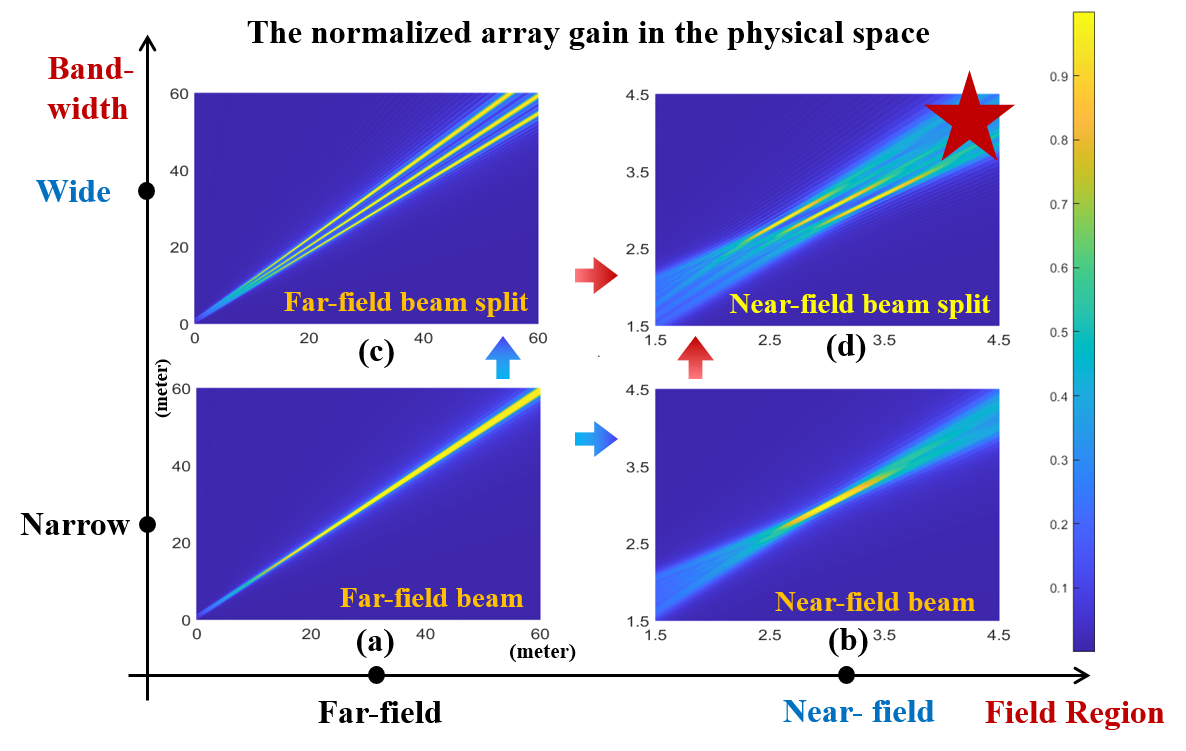
The natural integration of extremely large antenna arrays (ELAAs) and terahertz (THz) communications can potentially achieve Tbps data rates in 6G networks. However, due to the extremely large array aperture and wide bandwidth, a new phenomenon called "near-field beam split" emerges. This phenomenon causes beams at different frequencies to focus on distinct physical locations, leading to a significant gain loss of beamforming. To address this challenging problem, we first harness a piecewise-far-field channel model to approximate the complicated near-field wideband channel. In this model, the entire large array is partitioned into several small sub-arrays. While the wireless channel's phase discrepancy across the entire array is modeled as near-field spherical, the phase discrepancy within each sub-array is approximated as far-field planar. Built on this approximation, a phase-delay focusing (PDF) method employing delay phase precoding (DPP) architecture is proposed. Our PDF method could compensate for the intra-array far-field phase discrepancy and the inter-array near-field phase discrepancy via the joint control of phase shifters and time delayers, respectively. Theoretical and numerical results are provided to demonstrate the efficiency of the proposed PDF method in mitigating the near-field beam split effect.Finally, we define and derive a novel metric termed the "effective Rayleigh distance" by the evaluation of beamforming gain loss. Compared to classical Rayleigh distance, the effective Rayleigh distance is more accurate in determining the near-field range for practical communications.
Motivation & Objective
- Motivate near-field beamforming challenges in ELAA-THz wideband systems due to beam split.
- Propose a tractable channel model that partitions a large array into sub-arrays to separate inter- and intra-array phase effects.
- Develop a PDF method using phase shifters and time delays to compensate far-field intra- and near-field inter-array discrepancies.
- Analyze beamforming gain and derive an effective Rayleigh distance as a practical near-field boundary.
Proposed method
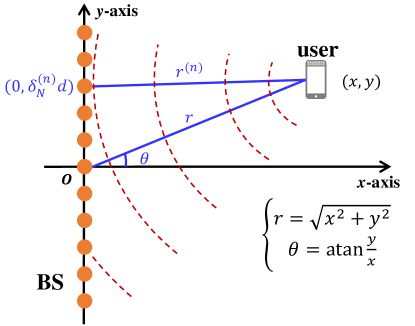
- Introduce a piecewise-far-field channel model by partitioning the ELAA into K sub-arrays of P antennas each.
- Decompose the channel phase into inter-array near-field and intra-array far-field components to identify the dominant beam split sources.
- Apply a delay-phase precoding (DPP) architecture with time delays to compensate the inter-array phase and phase shifters to align the intra-array phase.
- Formulate and solve an optimization to maximize bandwidth-wide beamforming gain across sub-carriers, yielding closed-form r_k' = L - r_k under a specified condition.
- Derive beamforming gain expressions using Xi_P Dirichlet sinc functions and provide theoretical gain loss bounds across bandwidths.
Experimental results
Research questions
- RQ1How does near-field beam split manifest in extremely large antenna arrays across wide bandwidths?
- RQ2Can a piecewise-far-field model accurately approximate near-field wideband channels for ELAA?
- RQ3How can phase-delay focusing with PS and TD components mitigate near-field beam split across sub-carriers?
- RQ4What is the impact of the proposed PDF method on average beamforming gain over bandwidths?
- RQ5What is an appropriate metric to define the near-field region for practical ELAA-based communications?
Key findings
- The near-field beam split causes beams at different frequencies to focus on different locations, reducing gain away from the center frequency.
- A piecewise-far-field channel model approximates the near-field channel by partitioning the array into sub-arrays, enabling separate handling of inter- and intra-array phase discrepancies.
- The PDF method with PS-based sub-arrays and a TD element can compensate inter-array phase across frequencies and maintain high beamforming gain.
- Optimal TD-based distance parameter r_k' can be set to r_k' = L - r_k under suitable conditions, maximizing the per-subcarrier beamforming gain.
- Analytical results show the average beamforming gain loss factor can be described by a product of wideband loss gamma(B,f_c,P) and geometry loss xi(r,theta,D), linking gain to bandwidth, geometry, and array size.
Better researchstarts right now
From reading papers to final review, dramatically reduce your research time.
No credit card · Free plan available
This review was created by AI and reviewed by human editors.