
[Paper Review] Nematicity and Orbital Depairing in Superconducting Bernal Bilayer Graphene with Strong Spin Orbit Coupling
The paper reports two superconducting states (SC1 and SC2) in Bernal bilayer graphene on WSe2 with proximity-induced Ising SOC, where SC2 arises from a nematic normal state; both states are robust to in-plane fields and violate the paramagnetic limit, linking enhanced superconductivity to Ising SOC.
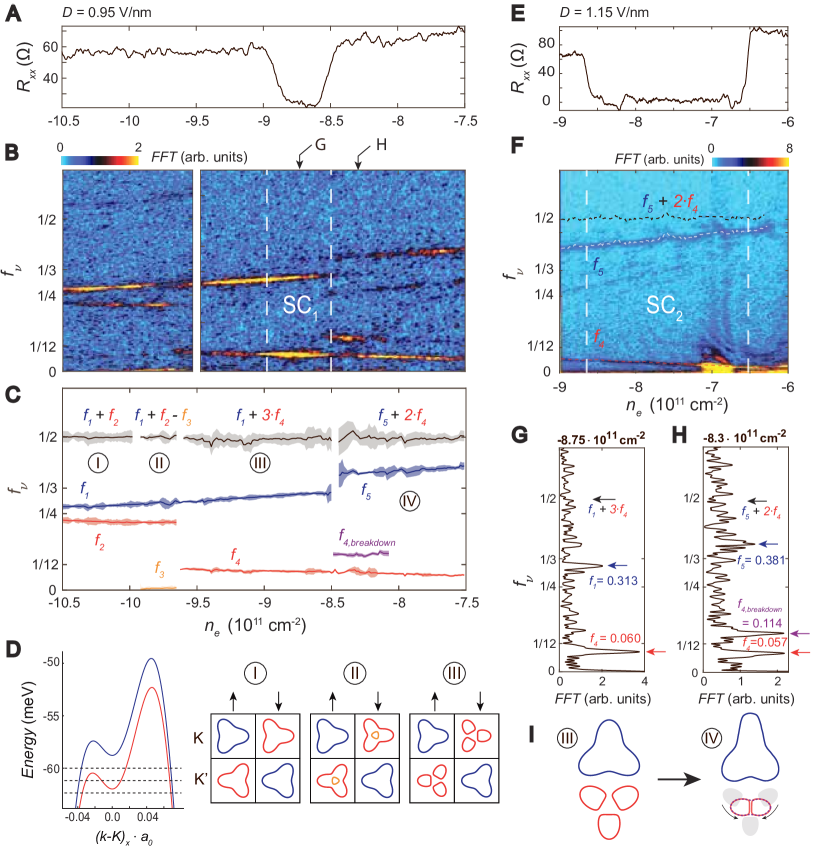
Superconductivity (SC) is a ubiquitous feature of graphite allotropes, having been observed in Bernal bilayers[1], rhombohedral trilayers[2], and a wide variety of angle-misaligned multilayers[3-6]. Despite significant differences in the electronic structure across these systems, supporting the graphite layer on a WSe$_2$ substrate has been consistently observed to expand the range of SC in carrier density and temperature[7-10]. Here, we report the observation of two distinct superconducting states (denoted SC$_1$ and SC$_2$) in Bernal bilayer graphene with strong proximity-induced Ising spin-orbit coupling. Quantum oscillations show that while the normal state of SC$_1$ is consistent with the single-particle band structure, SC$_2$ emerges from a nematic normal state with broken rotational symmetry. Both superconductors are robust to in-plane magnetic fields, violating the paramagnetic limit; however, neither reach fields expected for spin-valley locked Ising superconductors. We use our knowledge of the Fermi surface geometry of SC$_1$ to argue that superconductivity is limited by orbital depairing arising from the imperfect layer polarization of the electron wavefunctions. Finally, a comparative analysis of transport and thermodynamic compressibility measurements in SC$_2$ shows that the proximity to the observed isospin phase boundaries, observed in other rhombohedral graphene allotropes, is likely coincidental, constraining theories of unconventional superconducting pairing mechanisms in theses systems.
Motivation & Objective
- Investigate how proximity-induced Ising spin-orbit coupling (SOC) affects superconductivity in Bernal bilayer graphene (BBG) on WSe2.
- Identify and characterize distinct superconducting states (SC1 and SC2) and their normal-state fermiology.
- Determine the role of nematic order in the emergence of SC2 and its impact on superconductivity.
- Quantify the enhancement of superconductivity and its field dependence under Ising SOC.
- Assess how SOC influences resilience to in-plane magnetic fields and the paramagnetic limit.
Proposed method
- Use a tight-binding band structure model including Ising SOC to interpret the low-energy electronic structure.
- Measure electrical transport and quantum oscillations (Shubnikov–de Haas) to map Fermi-surface topology and validate Luttinger sum rules.
- Determine proximity-induced Ising SOC strength (λI) via Landau level coincidences.
- Analyze superconducting transitions using nonlinear transport and Berezinskii–Kosterlitz–Thouless (BKT) fits to extract Tc and TBKT.
- Test in-plane field dependence of Tc against the Ising-SOC-predicted scaling Tc/Tc0 = 1 − B_parallel^2/(B_SO B_P).
- Compare superconductivity in BBG/WSe2 to crystalline graphene without SOC by simultaneously measuring resistance and inverse compressibility κ.
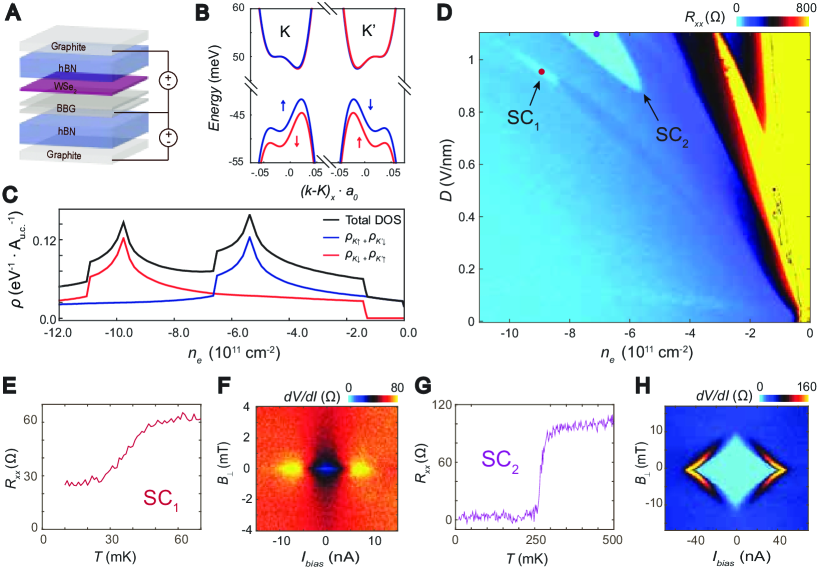
Experimental results
Research questions
- RQ1Does BBG on WSe2 host multiple superconducting states under Ising SOC?
- RQ2What is the nature of the normal state from which SC1 and SC2 condensate, and does nematic order participate?
- RQ3How does Ising SOC influence the robustness of superconductivity to in-plane magnetic fields and the paramagnetic limit?
- RQ4Can fermiology changes and nematicity be linked to enhanced superconductivity in these systems?
- RQ5Is the scaling of Tc with in-plane field consistent with Ising superconductivity across different densities and displacement fields?
Key findings
- Two distinct superconducting states, SC1 and SC2, appear in hole-doped BBG/WSe2 at large displacement fields; Tc for SC1 is ~40 mK, while SC2 reaches a higher Tc with a Berezinskii–Kosterlitz–Thouless temperature TBKT ≈ 255 mK.
- SC2 arises from a nematic normal state (N2,4) with broken rotational symmetry, as evidenced by the evolution of quantum oscillation frequencies and Luttinger-sum-rule analysis.
- Both SC1 and SC2 are robust to in-plane magnetic fields and violate the paramagnetic limit, consistent with Ising spin-orbit–coupled superconductivity; Tc scales with in-plane field following a law involving B_SO and B_P.
- The measured Ising SOC strength is λI ≈ 1.6 meV, and the Fermi-surface topology in the presence of SOC explains the observed Landau level coincidences and multiple oscillation frequencies (fν) that satisfy generalized Luttinger sum rules.
- SC2’s field dependence collapses onto a universal scaling η = Tc/(1 − B_parallel^2/(B_SO B_P)), indicating pairing occurs between spin-defined Fermi surfaces and supporting spin-valley locking as a mechanism for Ising superconductivity.
- A comparison to graphene systems without proximity SOC shows superconductivity in BBG/WSe2 is enhanced and not solely tied to isospin transitions, implicating SOC-induced stabilization of nematic orders as a route to higher Tc.
Better researchstarts right now
From reading papers to final review, dramatically reduce your research time.
No credit card · Free plan available
This review was created by AI and reviewed by human editors.