
[论文解读] Neural Common Neighbor with Completion for Link Prediction
NCN 通过 MPNN 引入可学习的成对特征来捕捉用于链路预测的共同邻居,而 NCNC 增加完成与目标链接移除来缓解图的不完整性,获得了最先进的结果。
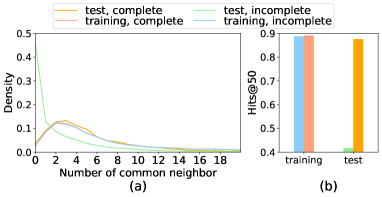
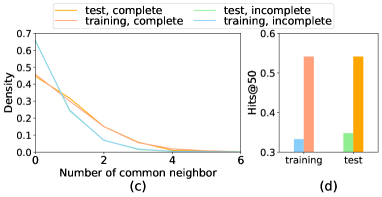
In this work, we propose a novel link prediction model and further boost it by studying graph incompleteness. First, we introduce MPNN-then-SF, an innovative architecture leveraging structural feature (SF) to guide MPNN's representation pooling, with its implementation, namely Neural Common Neighbor (NCN). NCN exhibits superior expressiveness and scalability compared with existing models, which can be classified into two categories: SF-then-MPNN, augmenting MPNN's input with SF, and SF-and-MPNN, decoupling SF and MPNN. Second, we investigate the impact of graph incompleteness -- the phenomenon that some links are unobserved in the input graph -- on SF, like the common neighbor. Through dataset visualization, we observe that incompleteness reduces common neighbors and induces distribution shifts, significantly affecting model performance. To address this issue, we propose to use a link prediction model to complete the common neighbor structure. Combining this method with NCN, we propose Neural Common Neighbor with Completion (NCNC). NCN and NCNC outperform recent strong baselines by large margins, and NCNC further surpasses state-of-the-art models in standard link prediction benchmarks. Our code is available at https://github.com/GraphPKU/NeuralCommonNeighbor.
研究动机与目标
- 通过捕捉 vanilla MPNN 基方法中缺失的成对关系来提升链路预测的动机。
- 引入 Neural Common Neighbor (NCN),其成对特征来自 MPNN 的可学习表示。
- 通过两种干预措施应对图不完整性:Common Neighbor Completion (CNC) 与 Target Link Removal (TLR)。
- 通过将 NCN 与 CNC(以及可能的迭代完成)结合,提出 Neural Common Neighbor with Completion (NCNC)。
- 展示与 GAE 相当的可扩展性,并在多个基准数据集中达到最先进表现。
提出的方法
- 定义一个涵盖启发式方法与之前基于 GNN 的方法的成对特征通用框架。
- 在 NCN 公式中用可学习的 MPNN 基提取器替换固定的基于度的成对函数:NCN(i,j,A,X)=sum_{u in N(i)∩N(j)} MPNN(u,A,X)。
- 论证由于 MPNN 已隐式学习信息,显式的高阶邻居对 NCN 的贡献有限。
- 研究图的不完整性及其对 CN 基信号的影响,提出两种干预:Common Neighbor Completion (CNC) 与 Target Link Removal (TLR)。
- NCNC 将 CNC 与 NCN 结合,通过 NCN 预测的概率对潜在共同邻居进行加权,并可选地进行迭代图完成(NCNC-K)。
- 通过保留一阶邻域并使用交集作为集合运算符,实现可扩展的推理;NCN/NCNC 的运行时与 GAE 相当,同时在基线中表现更好。
实验结果
研究问题
- RQ1如何学习目标节点之间的成对关系,而不是使用手工特征,以提升链路预测?
- RQ2用可学习表示(via MPNN)替换固定的成对特征,是否提高性能与可扩展性?
- RQ3图的不完整性如何影响链路预测,干预措施是否能缓解?
- RQ4共同邻居完成与目标链接移除是否能提升在真实数据集上的 NCN 基模型?
- RQ5在标准链路预测数据集上,NCN/NCNC 的经验性能如何,与基线相比的可扩展性如何?
主要发现
- NCN 在多个基准数据集上超越现有模型,并对具有竞争力的基线显示出显著提升。
- NCNC 进一步提升性能,在所有报道的数据集上达到最先进的结果,对 ogbl-ppa 有显著提升。
- 消融研究表明,学习型成对特征(NCN)在多个数据集上优于手工特征(GAE+CN、Neo-GNN、BUDDY)。
- 不完整性导致分布偏移和共同邻居信息的丢失;CNC 与 TLR 能有效缓解这些影响并带来额外提升。
- NCN/NCNC 保持与 GAE 相近的时间复杂度的可扩展性,在大批量场景下明显快于 SEAL;在大多数数据集上 NCNC-1 即足够。
阅读本论文
在 Nubint 阅读器中打开原文,边读边就任意段落提问。
在 Nubint 中阅读本论文本解读由 AI 根据论文原文生成,引用前请核对原文。