
[Paper Review] Neural Optimal Stopping Boundary
This paper introduces a deep learning-based method to directly compute the optimal stopping boundary for American and Bermudan options by parameterizing the boundary as a neural network graph and using a fuzzy boundary relaxation to enable differentiable optimization. The approach achieves high accuracy in high-dimensional settings, including Black-Scholes, Heston, and path-dependent look-back options, with theoretical justification for boundary existence under natural assumptions.
A method based on deep artificial neural networks and empirical risk minimization is developed to calculate the boundary separating the stopping and continuation regions in optimal stopping. The algorithm parameterizes the stopping boundary as the graph of a function and introduces relaxed stopping rules based on fuzzy boundaries to facilitate efficient optimization. Several financial instruments, some in high dimensions, are analyzed through this method, demonstrating its effectiveness. The existence of the stopping boundary is also proved under natural structural assumptions.
Motivation & Objective
- To directly compute the stopping boundary separating continuation and stopping regions in optimal stopping problems, rather than indirectly inferring it from value functions.
- To provide an interpretable, geometric characterization of optimal stopping rules via neural network parameterization of the boundary as a function graph.
- To overcome the non-differentiability of binary stopping decisions by introducing a fuzzy boundary formulation with probabilistic stopping near the boundary.
- To demonstrate the method's effectiveness on high-dimensional American and Bermudan options, including path-dependent derivatives.
- To establish the theoretical existence of the stopping boundary under natural structural assumptions, validating the method's foundation.
Proposed method
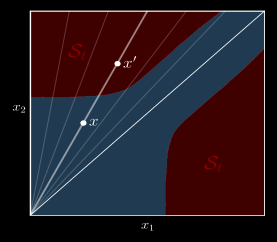
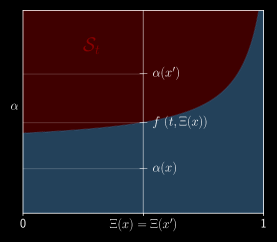
- The stopping boundary is parameterized as the graph of a deep neural network function, enabling direct optimization of the boundary's shape.
- A fuzzy boundary relaxation is introduced: states near the boundary stop with a probability proportional to their distance, enabling gradient-based optimization.
- The reward function is defined as the expected payoff under the relaxed stopping rule, with stopping probabilities computed via a signed distance function from the neural network boundary.
- Empirical risk minimization is used to train the network, with the reward function computed via Monte Carlo simulation of state trajectories.
- Importance sampling is applied to improve sample efficiency in financial simulations, particularly in high-dimensional settings.
- The Adam optimizer is used with a fixed fuzzy region width ε to stabilize training and ensure convergence.
Experimental results
Research questions
- RQ1Can deep neural networks effectively approximate the optimal stopping boundary in high-dimensional optimal stopping problems?
- RQ2Does the fuzzy boundary relaxation enable stable and efficient training of the stopping boundary via gradient-based optimization?
- RQ3How does the method perform on complex financial derivatives such as Bermudan max-call options and look-back options in high dimensions?
- RQ4Under what conditions does the stopping boundary exist as a continuous function, and can this be theoretically justified?
- RQ5Can the method provide interpretable, geometrically meaningful stopping rules compared to value-function-based approaches?
Key findings
- The method successfully computes the optimal stopping boundary for American put options in both Black-Scholes and Heston models, achieving high accuracy with confidence intervals.
- For the high-dimensional Bermudan max-call option, the method demonstrates strong performance, confirming the scalability of deep empirical risk minimization in high dimensions.
- The approach effectively handles path-dependent options, as shown in the numerical results for look-back options.
- Theoretical analysis proves the existence of the stopping boundary under natural assumptions, with the boundary defined as the graph of a function satisfying specific structural conditions.
- The fuzzy boundary formulation ensures convergence of the empirical reward to the true expected payoff as ε → 0, justifying the relaxation approach.
- The algorithm maintains topological consistency: the stopping and continuation regions are well-separated, and the boundary is robustly approximated even under approximation errors.
Better researchstarts right now
From reading papers to final review, dramatically reduce your research time.
No credit card · Free plan available
This review was created by AI and reviewed by human editors.