
[Paper Review] Neutrino physics with the PTOLEMY project: active neutrino properties and the light sterile case
The paper outlines the PTOLEMY project’s theoretical framework and sensitivity studies for detecting the Cosmic Neutrino Background via neutrino capture on tritium, including implications for the absolute neutrino mass scale and a light eV-scale sterile neutrino.
The PTOLEMY project aims to develop a scalable design for a Cosmic Neutrino Background (CNB) detector, the first of its kind and the only one conceived that can look directly at the image of the Universe encoded in neutrino background produced in the first second after the Big Bang. The scope of the work for the next three years is to complete the conceptual design of this detector and to validate with direct measurements that the non-neutrino backgrounds are below the expected cosmological signal. In this paper we discuss in details the theoretical aspects of the experiment and its physics goals. In particular, we mainly address three issues. First we discuss the sensitivity of PTOLEMY to the standard neutrino mass scale. We then study the perspectives of the experiment to detect the CNB via neutrino capture on tritium as a function of the neutrino mass scale and the energy resolution of the apparatus. Finally, we consider an extra sterile neutrino with mass in the eV range, coupled to the active states via oscillations, which has been advocated in view of neutrino oscillation anomalies. This extra state would contribute to the tritium decay spectrum, and its properties, mass and mixing angle, could be studied by analyzing the features in the beta decay electron spectrum.
Motivation & Objective
- Motivate direct detection of the Cosmic Neutrino Background (CNB) and its cosmological/particle-physics implications.
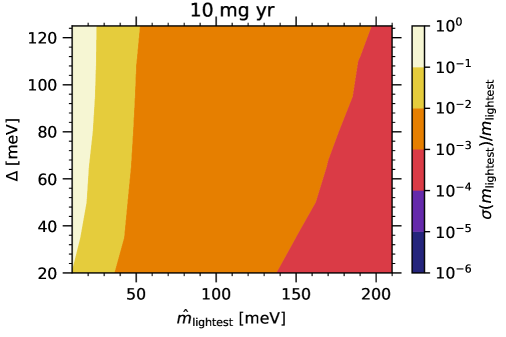
- Assess PTOLEMY’s sensitivity to the absolute neutrino mass scale via beta decay endpoint and CNB capture signals.
- Explore the impact of a light sterile neutrino (eV scale) on beta spectra and CNB detection.
- Evaluate how neutrino mass ordering and energy resolution affect detection prospects and event rates.
Proposed method
- Derive the CNB capture rate on tritium and connect it to the neutrino mass eigenstates via |U_{ei}|^2 and clustering factors f_{c,i}.
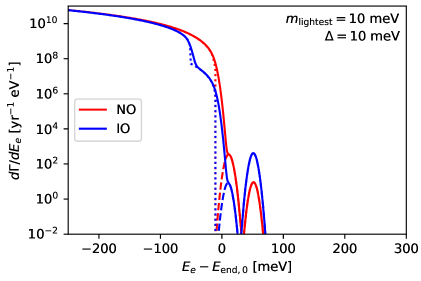
- Incorporate the energy resolution of the detector by convolving both the CNB signal and the beta background with a Gaussian of given FWHM Δ.
- Use a Bayesian framework to forecast PTOLEMY’s sensitivity to the neutrino mass scale and to sterile-neutrino parameters.
- Compute the beta-decay background spectrum and the neutrino capture signal with explicit cross sections and electroweak form factors in the supplied formulas.
- Assess the influence of neutrino mass ordering on the capture rates and signal features through the mixing elements U_{ei} and clustering terms.
Experimental results
Research questions
- RQ1What is PTOLEMY’s sensitivity to the standard neutrino mass scale from beta-decay endpoint and CNB capture signals?
- RQ2How does the energy resolution Δ affect the ability to resolve CNB capture peaks above the beta-decay background?
- RQ3What is the expected impact of a light sterile neutrino (m ~ eV) on the beta spectrum and CNB capture signals, through U_{e4} and Δm^2_{41}?
- RQ4How do neutrino mass ordering and potential clustering in the Milky Way modify the CNB capture rate?
Key findings
- The integrated CNB capture signal for Dirac neutrinos on 100 g of tritium is about 4 events per year, neglecting clustering enhancements.
- Majorana neutrinos can yield a larger rate, potentially up to a factor of two higher under certain mass/ordering conditions.
- Local relic neutrino overdensity due to clustering can increase the capture rate by 10-20% for masses ~60 meV or up to ~200% for masses ~150 meV, depending on the halo model.
- The presence of a light sterile neutrino (m4 ~ 1 eV) would modify the beta spectrum and could be constrained by analyzing the spectrum features and mixings, notably through U_{e4} and Δm^2_{41}.
- Kinematic features in the inverted ordering yield a visible kink in the beta spectrum due to heavier mass eigenstates, offering a model-independent handle on oscillation scenarios.
- Detection prospects depend critically on achieving sufficient energy resolution to separate the CNB signal from the beta background (Δ must be smaller than relevant mass splittings).
Better researchstarts right now
From reading papers to final review, dramatically reduce your research time.
No credit card · Free plan available
This review was created by AI and reviewed by human editors.