
[Paper Review] New Resonances of Supernova Neutrinos in Twisting Magnetic Fields
This paper proposes that twisting magnetic fields in supernovae induce a new type of resonant spin conversion in Dirac neutrinos via a geometrical (Berry) phase, significantly altering neutrino flavor composition during neutronization bursts. Even with magnetic moments as small as $10^{-15}\mu_B$, this effect could produce measurable flux modulations in future experiments like DUNE and Hyper-Kamiokande, offering a probe for non-zero neutrino magnetic moments beyond current laboratory sensitivity.
We investigate the effect of resonant spin conversion of the neutrinos induced by the geometrical phase in a twisting magnetic field. We find that the geometrical phase originating from the rotation of the transverse magnetic field along the neutrino trajectory can trigger a new resonant spin conversion of Dirac neutrinos inside the supernova, even if there were no such transitions in the fixed-direction field case. We have shown that even though resonant spin conversion is too weak to affect solar neutrinos, it could have a remarkable consequence on supernova neutronization bursts where very intense magnetic fields are quite likely. We demonstrate how the flavor composition at Earth can be used as a probe to establish the presence of non-negligible magnetic moments, potentially down to $10^{-15}~μ_B$ in upcoming neutrino experiments like the Deep Underground Neutrino Experiment (DUNE), and the Hyper-Kamiokande (HK). Possible implications are analyzed.
Motivation & Objective
- To investigate the impact of a rotating transverse magnetic field on neutrino spin-flavor conversion in supernovae.
- To determine whether the geometrical phase from field rotation can trigger resonant spin conversion in Dirac neutrinos, even when no such resonance exists in fixed-field configurations.
- To assess the detectability of non-zero neutrino magnetic moments down to $10^{-15}\mu_B$ through time-dependent flux variations in supernova neutronization bursts.
- To evaluate the sensitivity of upcoming experiments like DUNE and Hyper-Kamiokande to these new resonances as a probe for physics beyond the Standard Model.
Proposed method
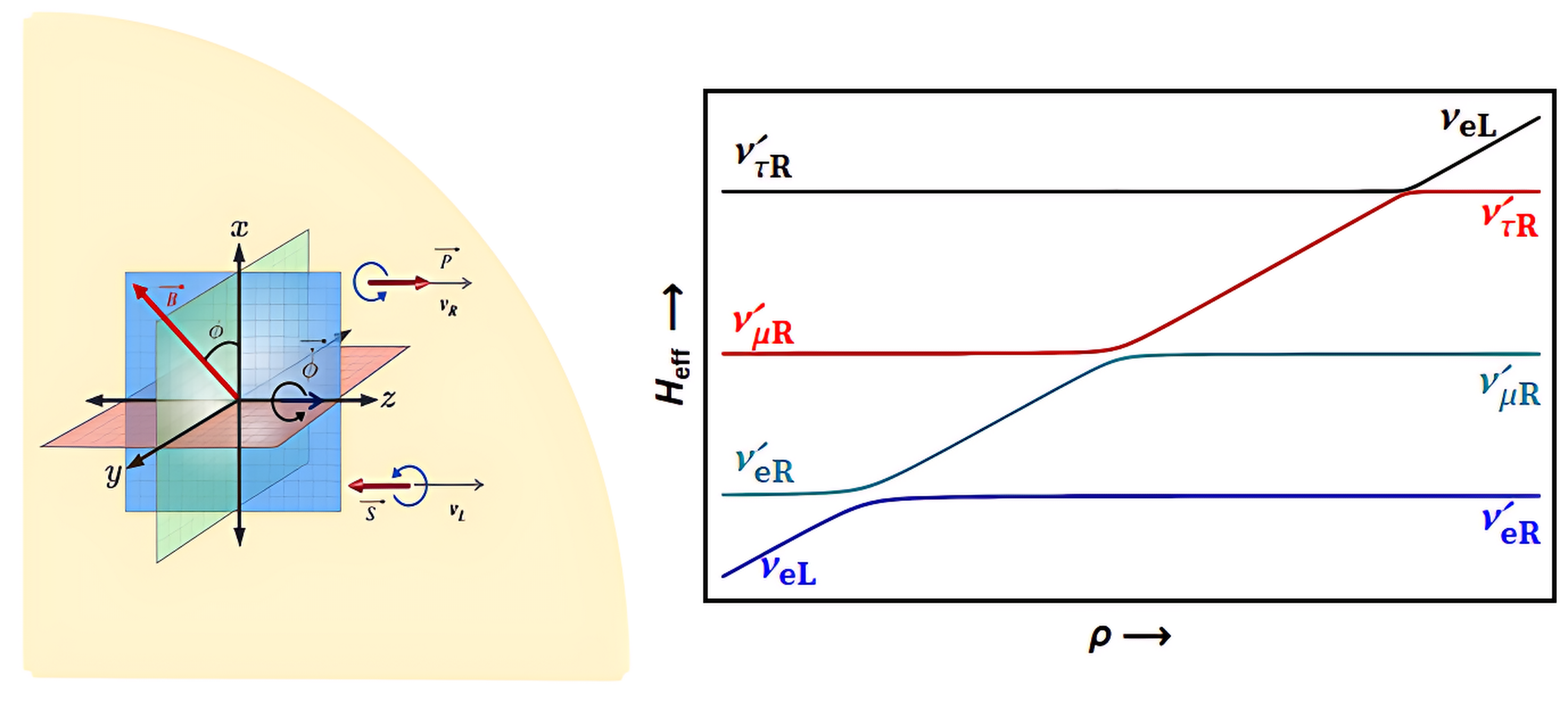
- Modeling neutrino evolution in a twisting magnetic field using a Hamiltonian that includes both dynamical and geometric phases from field rotation.
- Deriving the effective Hamiltonian for neutrino spin precession in a rotating transverse magnetic field, incorporating the Berry phase via the rotation angle $\phi(r)$.
- Simulating time-dependent neutrino fluxes for $\nu_e$, $\bar{\nu}_e$, and other flavors during the neutronization burst phase of a supernova.
- Using the $\chi^2$ estimator with nuisance parameter $\xi$ to assess sensitivity to magnetic moments, accounting for normalization uncertainty and time-bin variations.
- Applying detector-specific response functions for DUNE (liquid argon TPC) and Hyper-Kamiokande (water Cherenkov) to compute detectable event rates per energy bin.
- Evaluating the impact of varying field twist rates ($\dot{\phi} = \pm 0.9\,\text{m}^{-1}$) on flux suppression across different neutrino species and mass ordering cases.
Experimental results
Research questions
- RQ1Can a rotating transverse magnetic field induce a new resonant spin conversion in Dirac neutrinos through a geometrical phase, even in the absence of such resonance in a fixed-field configuration?
- RQ2What is the maximum suppression of supernova neutrino fluxes due to this new resonance, and how does it vary with magnetic field twist rate and neutrino mass ordering?
- RQ3To what extent can future experiments like DUNE and Hyper-Kamiokande detect non-zero neutrino magnetic moments as small as $10^{-15}\mu_B$ via time-dependent flux modulations?
- RQ4How does the presence of a twisting magnetic field affect the flavor composition of neutrinos from the neutronization burst, and can this be distinguished from standard oscillation effects?
Key findings
- The twisting magnetic field induces a new resonant spin conversion in Dirac neutrinos via the geometrical (Berry) phase, which is absent in fixed-direction field scenarios.
- For inverted neutrino mass ordering (IO), the new resonance can suppress the $\nu_e$ neutronization peak by up to 81% in the first 20 ms, depending on the field twist rate.
- Case 2 with $\dot{\phi} = +0.9\,\text{m}^{-1}$ causes suppression exceeding 70% in nearly all detection channels and time windows, making it optimal for observation.
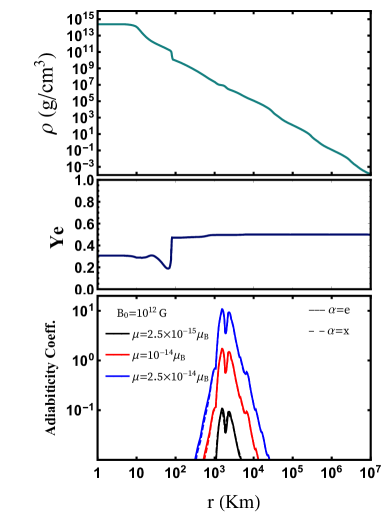
- DUNE and Hyper-Kamiokande can discover non-zero neutrino magnetic moments down to $4-8 \times 10^{-15}\mu_B$ at 90% confidence level, assuming $B_0 = 10^{12}\,\text{G}$.
- The time variation of the flux, rather than overall normalization, is the key observable, as interstellar magnetic fields do not affect temporal structure, isolating the resonance signal.
- The results are in the borderline of naturalness, as magnetic moments above $10^{-15}\mu_B$ may lead to unacceptably large neutrino masses in loop corrections, making this a critical testable window.
Better researchstarts right now
From reading papers to final review, dramatically reduce your research time.
No credit card · Free plan available
This review was created by AI and reviewed by human editors.