
[Paper Review] Noise-immune quantum correlations of intense light
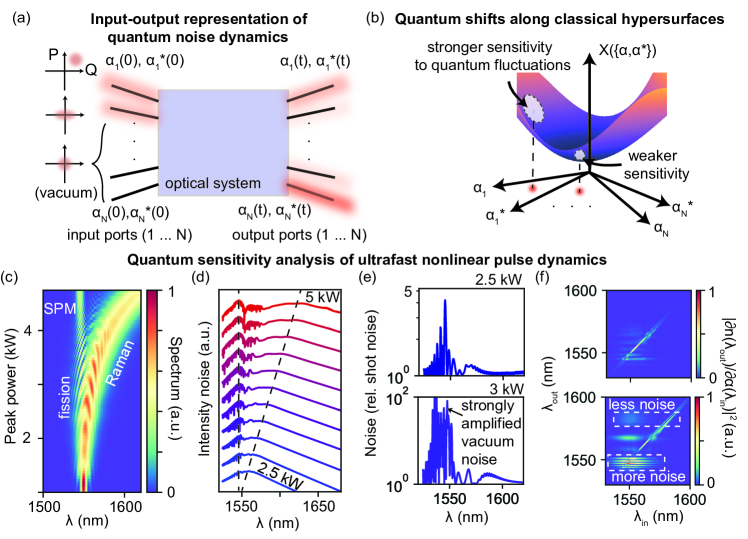
This paper introduces quantum sensitivity analysis, an ab initio framework that predicts quantum noise propagation in highly multimode light-matter systems by leveraging classical simulations and sensitivity gradients. It enables precise control of quantum fluctuations, demonstrating that ultra-low-noise wavelength pairs emerge despite individual high noise, and enables squeezing in intense, complex light sources by exploiting spectral dynamics of vacuum fluctuations.
Lasers with high intensity generally exhibit strong intensity fluctuations far above the shot-noise level. Taming this noise is pivotal to a wide range of applications, both classical and quantum. Here, we demonstrate the creation of intense light with quantum levels of noise even when starting from inputs with large amounts of excess noise. In particular, we demonstrate how intense squeezed light with intensities approaching 0.1 TW/cm^2, but noise at or below the shot noise level, can be produced from noisy inputs associated with high-power amplified laser sources (an overall noise-reduction of 30-fold). Based on a new theory of quantum noise in multimode systems, we show that the ability to generate quantum light from noisy inputs results from multimode quantum correlations, which maximally decouple the output light from the dominant noise channels in the input light. As an example, we demonstrate this effect for femtosecond pulses in nonlinear fibers, but the noise-immune correlations that enable our results are generic to many other nonlinear systems in optics and beyond.
Motivation & Objective
- To develop a general theoretical framework for predicting quantum noise dynamics in complex, highly multimode light-matter systems where traditional methods fail.
- To address the lack of general rules for noise propagation in nonlinear, multimode optical systems such as supercontinuum generation and soliton microcombs.
- To enable engineering of quantum light states—like squeezed states—using intense, noisy, and complex light sources by exploiting spectral dynamics of vacuum fluctuations.
- To provide a predictive and experimentally validated tool for quantum noise control across the electromagnetic spectrum, especially in integrated and nonlinear photonic systems.
- To extend quantum optics beyond few-mode systems to include material degrees of freedom, such as excitons and polaritons, in noise-sensitive applications.
Proposed method
- Develops quantum sensitivity analysis, a framework that computes the sensitivity of output quantum noise to input field and material parameters using adjoint-based optimization and gradient propagation.
- Uses classical simulations of nonlinear light-matter interactions (e.g., in nonlinear waveguides and microcombs) to compute the full quantum noise covariance matrix via the quantum-optical law of total variance.
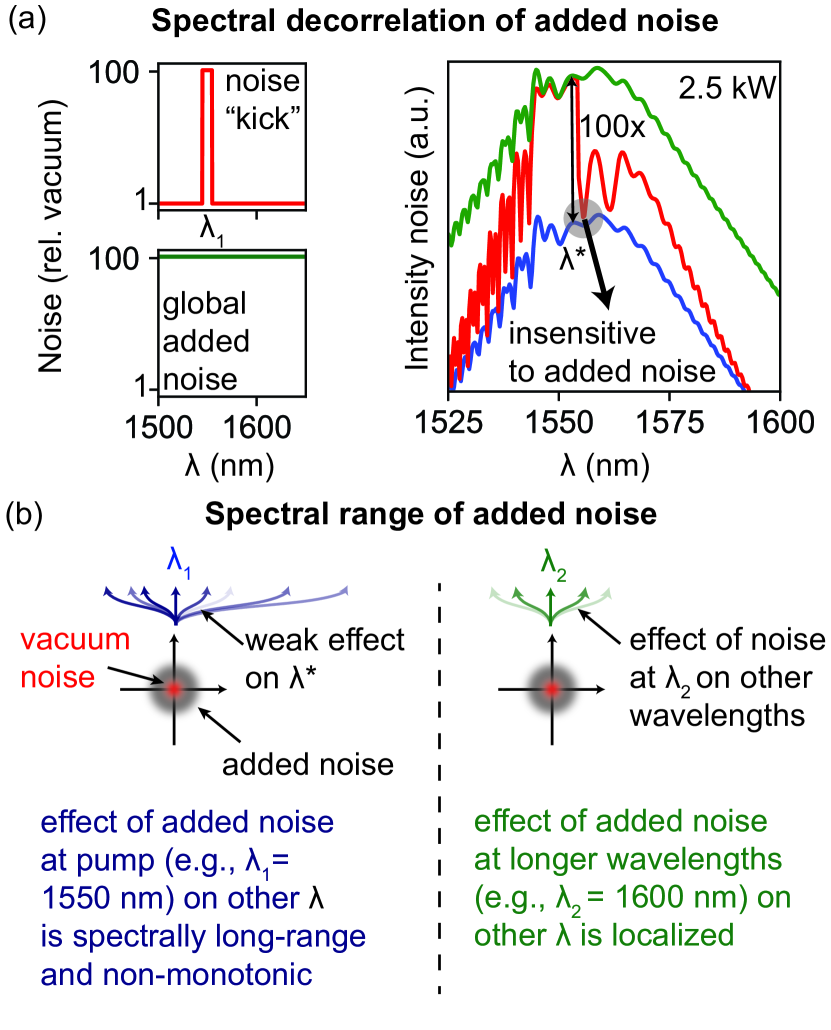
- Applies the framework to predict how vacuum fluctuations evolve spectrally under nonlinearity and Raman scattering, identifying conditions for spectral decorrelation and noise suppression.
- Employs programmable spectral filters in experiments to sample diverse filter functions and measure noise relative to shot noise, validating theoretical predictions.
- Calibrates experimental noise levels by fitting to linear loss behavior, confirming incident light is 10 dB above shot noise, and uses this to validate theoretical correlation matrices.
- Uses theoretical correlation matrices derived from simulations to predict squeezing performance, showing strong agreement with experimental data in spectral noise profiles.
Experimental results
Research questions
- RQ1How can quantum noise be predicted and controlled in highly multimode, nonlinear light-matter systems where traditional few-mode approximations fail?
- RQ2Can spectral decorrelation of vacuum fluctuations enable the generation of squeezed states from intense, noisy, and complex light sources?
- RQ3What are the general rules governing quantum noise propagation in systems with strong nonlinearity, dispersion, and multiple interacting degrees of freedom?
- RQ4To what extent can classical simulations and sensitivity gradients predict quantum noise dynamics in complex optical systems?
- RQ5How can quantum sensitivity analysis be used to optimize pump configurations and material parameters for minimal noise in quantum metrology and integrated photonics?
Key findings
- The framework accurately predicts quantum noise dynamics in ultrafast multimode systems, with strong agreement between theoretical predictions and experimental measurements of spectral noise profiles.
- In supercontinuum generation, the framework explains the emergence of ultra-low-noise wavelength pairs—despite individual wavelengths being highly noisy due to nonlinear amplification of vacuum fluctuations.
- Experiments show that noise can be reduced by 4 dB below the shot-noise level when using an average filter transmission of 10%, consistent with theoretical predictions.
- Theoretical modeling confirms that spectral decorrelation of vacuum fluctuations enables effective squeezing in intense, multimode pulses, even when individual modes are highly noisy.
- The quantum-optical law of total variance enables accurate noise prediction using classical simulations, providing a scalable path to quantum noise engineering in complex systems.
- The framework enables the design of optimal pump and filter configurations for maximizing squeezing, even under fabrication constraints, and extends to systems with material degrees of freedom like excitons and polaritons.
Better researchstarts right now
From reading papers to final review, dramatically reduce your research time.
No credit card · Free plan available
This review was created by AI and reviewed by human editors.