
[Paper Review] Non-classifiability of Ergodic Flows up to Time Change
This paper establishes that the Kakutani equivalence relation for ergodic measure-preserving transformations is not a Borel set, proving that classification up to Kakutani equivalence is inherently unclassifiable. Using continuous reductions from the space of ill-founded trees, the authors show this anti-classification result holds for ergodic $C^\infty$ diffeomorphisms on compact surfaces with a circle action and real-analytic diffeomorphisms on the 2-torus.
A time change of a flow $\{T_t\}$, ${t\in\mathbb{R}}$, is a reparametrization of the orbits of the flow such that each orbit is mapped to itself by an orientation-preserving homeomorphism of the parameter space. If a flow $\{S_t\}$ is isomorphic to a flow obtained by a reparametrization of a flow $\{T_t\}$, then we say that $\{S_t\}$ and $\{T_t\}$ are isomorphic up to a time change. For ergodic flows $\{S_t\}$ and $\{T_t\}$, Kakutani showed that this happens if and only if the two flows have Kakutani equivalent transformations as cross-sections. We prove that the Kakutani equivalence relation on ergodic invertible measure-preserving transformations of a standard non-atomic probability space is not a Borel set. This shows in a precise way that classification of ergodic transformations up to Kakutani equivalence is impossible. In particular, our results imply the non-classifiability of ergodic flows up to isomorphism after a time change. Moreover, we obtain anti-classification results under isomorphism for ergodic invertible transformations of a sigma-finite measure space. We also obtain anti-classification results under Kakutani equivalence for ergodic area-preserving smooth diffeomorphisms of the disk, annulus, and 2-torus, as well as real-analytic diffeomorphisms of the $2$-torus. Our work generalizes the anti-classification results under isomorphism for ergodic transformations obtained by Foreman, Rudolph, and Weiss.
Motivation & Objective
- To resolve the open question of whether Kakutani equivalence of ergodic flows is classifiable using Borel methods.
- To extend anti-classification techniques from isomorphism to Kakutani equivalence, a weaker but natural equivalence in ergodic theory.
- To establish unclassifiability results for smooth and real-analytic diffeomorphisms on compact surfaces and the 2-torus.
- To demonstrate that no Borel function can serve as a complete invariant for Kakutani equivalence in these settings.
Proposed method
- Construct a continuous reduction from the space of ill-founded trees to the space of ergodic $C^\infty$ diffeomorphisms on a compact surface with a circle action.
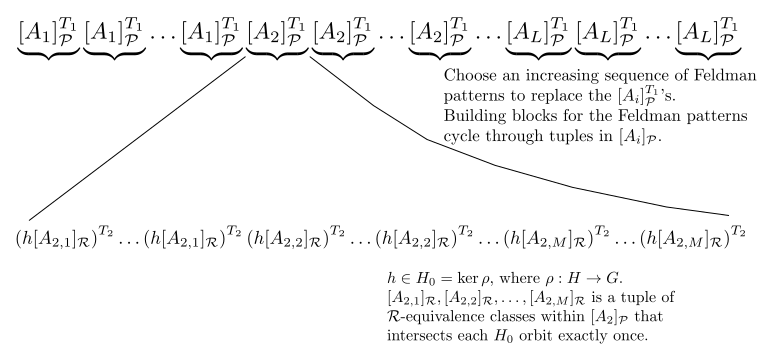
- Utilize a functor mapping odometer-based systems to circular systems, which are then realized as smooth diffeomorphisms via a parameterized construction.
- Employ growth and decay rate conditions on parameters $l_n$ to ensure convergence to a $C^\infty$ diffeomorphism isomorphic to the circular system.
- Leverage results from Foreman and Weiss (2019) on $C^\infty$ diffeomorphism spaces to control neighborhood behavior in the topology of the diffeomorphism space.
- Apply anti-synchronous isomorphism theory to link the existence of infinite branches in trees to Kakutani equivalence between a diffeomorphism and its inverse.
- Use the realization map $R$ to transfer Kakutani equivalence properties from symbolic systems to smooth diffeomorphisms, preserving the equivalence structure.
Experimental results
Research questions
- RQ1Is the Kakutani equivalence relation on ergodic measure-preserving transformations a Borel set?
- RQ2Can the anti-classification techniques used for isomorphism be extended to Kakutani equivalence?
- RQ3Does the unclassifiability result persist in the smooth and real-analytic categories?
- RQ4Is there a continuous reduction from the space of ill-founded trees to the space of ergodic $C^\infty$ diffeomorphisms such that Kakutani equivalence corresponds to the existence of infinite branches?
- RQ5Can the same method be adapted to real-analytic diffeomorphisms on the 2-torus?
Key findings
- The Kakutani equivalence relation on ergodic measure-preserving transformations is not a Borel set, proving that classification up to Kakutani equivalence is unclassifiable in a precise sense.
- The anti-classification result extends to ergodic $C^\infty$ diffeomorphisms on compact surfaces admitting a non-trivial circle action.
- The result also holds for real-analytic diffeomorphisms on the 2-torus, showing unclassifiability in the real-analytic category.
- A continuous reduction $F^s$ from the space of ill-founded trees to the space of ergodic $C^\infty$ diffeomorphisms was constructed, where trees with infinite branches map to diffeomorphisms that are Kakutani equivalent to their inverses.
- The construction ensures that the resulting diffeomorphisms are measure-theoretically isomorphic to circular systems, preserving Kakutani equivalence properties.
- The proof relies on a parameterized realization map $R$ that guarantees $C^\infty$ smoothness and isomorphism to the circular system, with convergence ensured by careful choice of growth rates in the sequence $(l_n)$.
Better researchstarts right now
From reading papers to final review, dramatically reduce your research time.
No credit card · Free plan available
This review was created by AI and reviewed by human editors.