
[Paper Review] Nonreciprocal pattern formation of conserved fields
This paper introduces a universal normal form—non-reciprocal Cahn-Hilliard (NRCH) equations—that unifies the dynamics of conserved fields in non-reciprocal systems, revealing how mass conservation and broken detailed balance drive traveling waves and complex spatiotemporal patterns. It demonstrates that traveling wave speed and structure emerge precisely from the local dispersion relation at interfaces, generalizing non-reciprocal pattern formation beyond prior models.
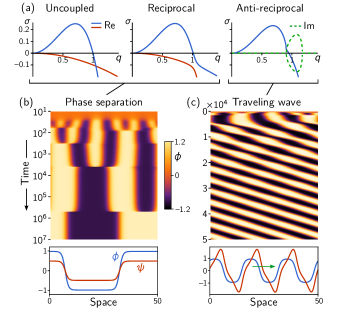
In recent years, nonreciprocally coupled systems have received growing attention. Previous work has shown that the interplay of nonreciprocal coupling and Goldstone modes can drive the emergence of temporal order such as traveling waves. We show that these phenomena are generically found in a broad class of pattern-forming systems, including mass-conserving reaction--diffusion systems and viscoelastic active gels. All these systems share a characteristic dispersion relation that acquires a non-zero imaginary part at the edge of the band of unstable modes and exhibit a regime of propagating structures (traveling wave bands or droplets). We show that models for these systems can be mapped to a common "normal form" that can be seen as a spatially extended generalization of the FitzHugh--Nagumo model, providing a unifying dynamical-systems perspective. We show that the minimal nonreciprocal Cahn--Hilliard (NRCH) equations exhibit a surprisingly rich set of behaviors, including interrupted coarsening of traveling waves without selection of a preferred wavelength and transversal undulations of wave fronts in two dimensions. We show that the emergence of traveling waves and their speed are precisely predicted from the local dispersion relation at interfaces far away from the homogeneous steady state. Our work thus generalizes previously studied nonreciprocal phase transitions and shows that interfaces are the relevant collective excitations governing the rich dynamical patterns of conserved fields.
Motivation & Objective
- To identify a minimal, universal model for non-reciprocal pattern formation in conserved fields across diverse physical systems.
- To explain the emergence of traveling waves in systems with mass conservation and broken detailed balance, despite diffusive relaxation.
- To unify disparate systems—active gels, reaction-diffusion, poroelastic media—under a common dynamical framework.
- To show that traveling wave speed and structure are determined by the local dispersion relation at interfaces, not global mode coalescence.
- To generalize previous non-reciprocal phase transition models by incorporating hydrodynamic modes from conserved fields.
Proposed method
- Derive the minimal non-reciprocal Cahn-Hilliard (NRCH) equations by coupling a conserved scalar field φ to a purely diffusive conserved field ψ with non-reciprocal cross-diffusion coefficients D12 ≠ D21.
- Analyze the linear stability of homogeneous states via the dispersion relation σ(q), showing a non-zero imaginary part at the band edge of unstable modes.
- Map the NRCH model to a spatially extended generalization of the FitzHugh-Nagumo model, enabling a unified dynamical systems perspective.
- Use gradient expansions and formal solutions of force-balance equations to derive effective equations for active gels and poroelastic media, reducing them to the NRCH form.
- Apply perturbative and numerical methods to study wave propagation, coarsening dynamics, and transverse undulations in 2D systems.
- Validate the theory by showing that wave speed and wavelength are predicted by the local dispersion relation far from the homogeneous state.
Experimental results
Research questions
- RQ1How does non-reciprocal coupling between conserved fields lead to traveling wave formation in systems with diffusive relaxation?
- RQ2What is the universal mechanism underlying non-reciprocal pattern formation in conserved systems beyond specific models?
- RQ3Why do traveling waves emerge in systems with conserved scalar fields despite the absence of explicit activator-inhibitor dynamics?
- RQ4How do hydrodynamic modes from mass conservation and translational invariance combine to generate propagating structures?
- RQ5To what extent can diverse active and nonequilibrium systems be described by a single normal form?
Key findings
- The NRCH equations provide a universal normal form for non-reciprocal pattern formation in conserved fields, capturing key features of active gels, reaction-diffusion systems, and poroelastic media.
- Traveling waves emerge generically when the dispersion relation acquires a non-zero imaginary part at the edge of the unstable mode band, even in the absence of explicit oscillatory terms.
- Wave speed and structure are precisely predicted by the local dispersion relation at interfaces far from the homogeneous state, not by global mode coalescence.
- The system exhibits interrupted coarsening of traveling waves without selection of a preferred wavelength, indicating a breakdown of conventional coarsening laws.
- In two dimensions, traveling wave fronts develop transverse undulations due to non-reciprocal coupling, a signature of non-Hermitian dynamics in conserved systems.
- The minimal NRCH model captures the essential physics of complex active matter systems, including the Min protein system and viscoelastic active gels, by reducing them to a common effective description.
Better researchstarts right now
From reading papers to final review, dramatically reduce your research time.
No credit card · Free plan available
This review was created by AI and reviewed by human editors.