
[Paper Review] Note on the bispectrum and one-loop corrections in single-field inflation with primordial black hole formation
The paper analyzes the bispectrum and one-loop power-spectrum corrections in single-field inflation with a temporary ultraslow-roll period that aims to form primordial black holes, confirming Maldacena’s theorem in this context and comparing two methods for the one-loop correction.
Primordial black holes can be formed from the collapse of large-amplitude perturbation on small scales in the early Universe. Such an enhanced spectrum can be realized by introducing a flat region in the potential of single-field inflation, which makes the inflaton go into a temporary ultraslow-roll period. In this paper, we calculate the bispectrum of curvature perturbation in such a scenario. We explicitly confirm that bispectrum satisfies Maldacena's theorem. At the end of the ultraslow-roll period, the bispectrum is generated by bulk interaction and field redefinition. At the end of inflation, bispectrum is generated only by bulk interaction. We also calculate the one-loop correction to the power spectrum from the bispectrum, called the source method. We find it consistent with the calculation of the one-loop correction from the second-order expansion of in-in perturbation theory.
Motivation & Objective
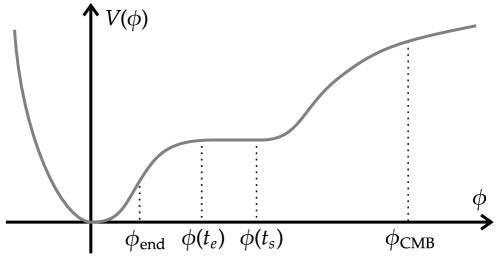
- Motivate the PBH formation scenario via a flat potential region inducing ultraslow-roll during inflation.
- Compute the curvature perturbation bispectrum arising from cubic self-interactions in this setting.
- Evaluate the one-loop correction to the large-scale power spectrum using two independent methods.
- Demonstrate consistency with Maldacena’s theorem in a non-attractor USR context.
- Address criticisms and clarify the correct application of Maldacena’s theorem.
Proposed method
- Derive the curvature perturbation dynamics through SR and USR phases, and express the Mukhanov-Sasaki variable with matching conditions at SR→USR and USR→SR transitions.
- Compute the bispectrum from the cubic self-interaction and from field redefinitions, focusing on the dominant H_int term in the USR transition regime.
- Apply in-in perturbation theory to evaluate the three-point function and isolate bulk and boundary contributions to the bispectrum.
- Show that the squeezed-limit bispectrum of the curvature perturbation obeys Maldacena’s theorem when expressed for ζ, not for the auxiliary variable ζ̃.
- Compute the one-loop correction to the large-scale power spectrum via two approaches (source method and second-order in-in expansion) and compare results.
- Respond to criticisms by highlighting the correct use of Maldacena’s theorem and the equivalence of the two loop-calculation methods.
Experimental results
Research questions
- RQ1Does a temporary ultraslow-roll phase in single-field inflation lead to a large small-scale power spectrum capable of PBH formation without violating perturbativity?
- RQ2What is the form and magnitude of the curvature perturbation bispectrum during and after the USR phase, and does it respect Maldacena’s theorem?
- RQ3How does the one-loop correction to the large-scale power spectrum arise from the small-scale enhancement, and do different calculation methods agree?
- RQ4Can the claimed no-go result for PBH formation in single-field inflation be reconciled with careful treatment of non-attractor phases and boundary contributions?
Key findings
- The bispectrum during and after USR is generated by bulk interaction and field redefinition, with Maldacena’s theorem confirmed for ζ (not ζ̃).
- The squeezed-limit bispectrum coefficient for ζ matches the spectral tilt, once field-redefinition effects are included, consistent with Maldacena’s theorem.
- Two independent calculations of the one-loop large-scale power spectrum (source method and second-order in-in) yield the same result, supporting the originally claimed perturbativity issue.
- The analysis argues that a large small-scale power (order 0.01) would induce a one-loop large-scale correction comparable to the tree-level term, challenging PBH formation in single-field inflation under these dynamics.
- The response to criticism clarifies that Maldacena’s theorem must be applied to ζ, and, after correcting a misapplication, the one-loop correction is reproduced by the source method as well.
![Figure 2: Power spectrum of the curvature perturbation. At CMB scale, $k\ll k_{s}$ , the power spectrum is almost scale invariant. $p_{*}=0.05~{}\mathrm{Mpc}^{-1}$ is the pivot scale with amplitude $\Delta_{s(\mathrm{SR})}^{2}(p_{*})=2.1\times 10^{-9}$ , based on observational result [ 11 ] . At sma](https://ar5iv.labs.arxiv.org/html/2303.00341/assets/x2.png)
Better researchstarts right now
From reading papers to final review, dramatically reduce your research time.
No credit card · Free plan available
This review was created by AI and reviewed by human editors.